

Key Takeaways
- The final out-of-pocket cost often differs significantly from the advertised vehicle price due to fees and add-ons.
- Understanding your financing terms - including APR and loan length - is just as important as negotiating the vehicle price.
- Dealer-added products and services are frequently negotiable or entirely optional.
- Always request an itemized breakdown of every charge before signing any documents.
- Comparing dealership financing with pre-approved offers from your bank or credit union can give you negotiating leverage.
Why the Questions You Ask Matter More Than You Think
The moment you sit down at the finance office, the pace of a car deal tends to accelerate. Documents appear, numbers shift, and the pressure to finalize can quietly override your instinct to slow down and read carefully. That's precisely when a prepared set of questions becomes your most practical tool.
Many car buyers focus almost exclusively on the monthly payment - but that single number can obscure a lot. A longer loan term, a higher interest rate, or a stack of optional add-ons can each inflate the total amount you pay without dramatically moving that monthly figure. As our guide to common car-buying assumptions explains, trusting surface-level numbers is one of the most widespread and costly mistakes buyers make.
The questions below are designed to surface what's actually in the deal - before you commit.
What is the total out-of-pocket cost, including all fees?
The advertised price is rarely what you'll actually pay. Ask the dealer to provide a complete, itemized cost sheet that includes documentation fees, dealer preparation fees, advertising fees, title and registration costs, and any state or local taxes. Some of these - particularly dealer fees - vary widely and are sometimes negotiable. You cannot evaluate whether a deal is fair without seeing every line item before you sign.
You cannot evaluate a deal fairly without seeing every line item before signing.
What is the APR on this loan, and how was it determined?
The APR - the annual percentage rate - determines how much the financing actually costs you over time. Dealerships often mark up the interest rate above what a lender originally quoted them, a practice sometimes called a dealer reserve. Before accepting dealer financing, compare it against a pre-approved offer from your bank or credit union. Even a one- or two-percentage-point difference can add hundreds of dollars in interest over the life of the loan.
A one-point difference in APR can quietly add hundreds of dollars to your total loan cost.
How long is the loan term, and what does that mean for total interest paid?
Longer loan terms - 72 or 84 months - reduce the monthly payment but increase the total interest you pay. They also increase the risk of becoming "upside down," meaning you owe more on the car than it's worth. Ask the finance office to show you the total interest paid for each loan term option. That figure, not the monthly payment, is the more meaningful comparison. Our saving and debt guidance covers how loan structures affect your overall financial picture.
Longer loan terms lower monthly payments but often cost significantly more in total interest.
Which add-ons are included, and which are optional?
Finance offices routinely bundle products like extended warranties, paint protection, GAP insurance, tire-and-wheel protection, and credit life insurance into the deal. Some buyers assume these are required - they are not. Ask for each product to be listed separately with its cost, and ask which ones are mandatory for the loan to proceed. Most are optional. Consider each independently rather than agreeing to a package. GAP insurance in particular, if you want it, is often available at lower cost through your auto insurer.
Most finance office add-ons are optional - ask which, if any, are actually required.
What exactly does the warranty cover, and for how long?
New vehicles come with manufacturer warranties that vary in scope and duration. Used vehicles may carry a remaining factory warranty, a certified pre-owned warranty, or no warranty at all. Ask for the warranty terms in writing: what's covered, what's excluded (wear items, certain components, or specific failure types), and what the deductible is. If you're considering a vehicle history report to assess a used car's condition, our article on reading a vehicle history report explains what to look for.
Always get warranty terms in writing - verbal summaries often omit significant exclusions.
Is there a prepayment penalty on this loan?
Some auto loans include a prepayment penalty, which charges you a fee if you pay off the loan early. If you plan to make extra payments to reduce interest costs, a prepayment penalty could offset those savings. Ask directly whether the loan agreement includes one, and if so, what the penalty structure looks like. This is a straightforward yes-or-no question that has real implications for how you manage the loan over time.
Prepayment penalties can erase the savings you'd gain by paying off a loan early.
Can I take the contract home to review before signing?
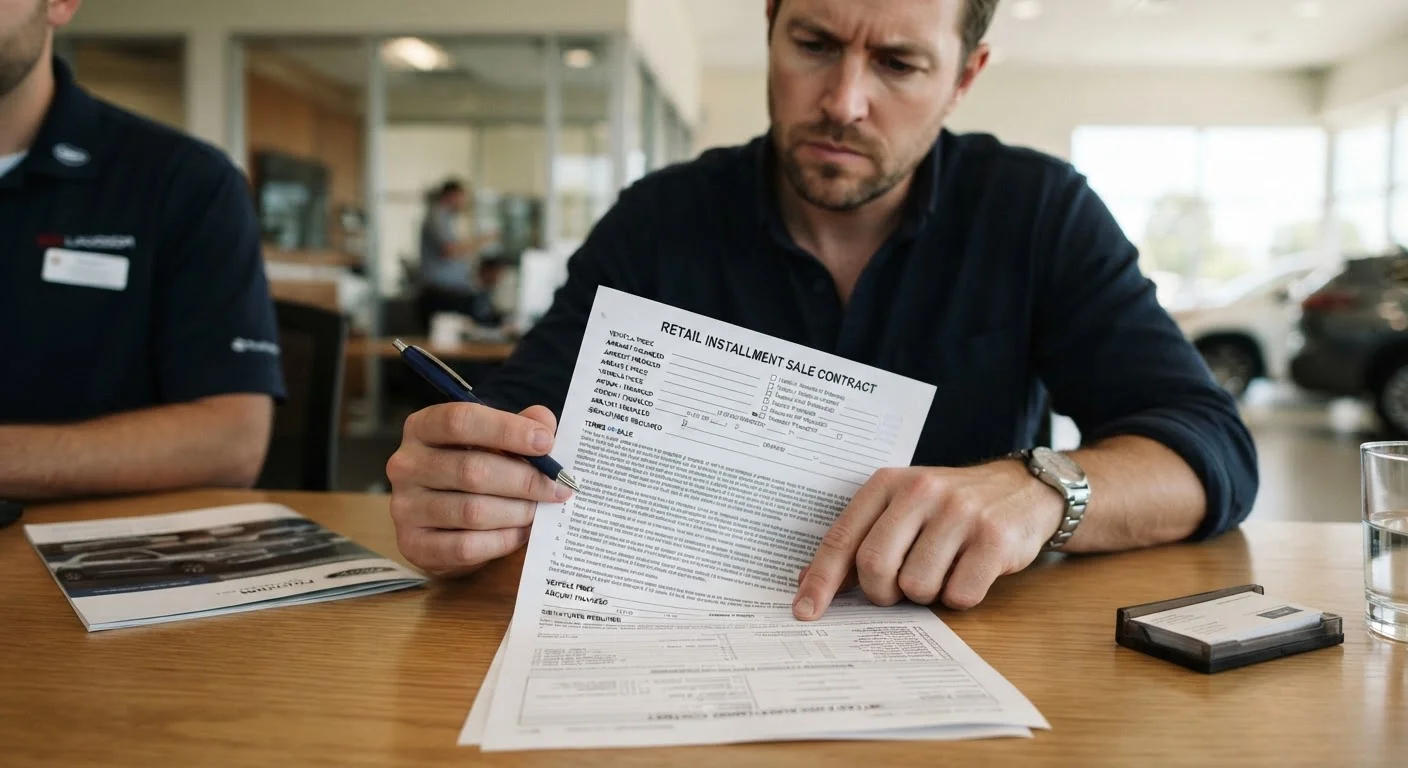
You are entitled to read what you're signing. The finance office is a high-pressure environment, and some buyers feel rushed into decisions they haven't fully processed. Asking to take documents home - or at minimum requesting 30 uninterrupted minutes to read them at the dealership - is entirely reasonable. Pay particular attention to the itemized fees, the loan APR and term, the list of add-on products and their costs, and the total amount financed versus the amount you agreed to pay for the vehicle itself.
Requesting time to read the full contract before signing is a reasonable and smart step.
Take These Into the Finance Office With You
Printing or saving these questions on your phone before your dealership visit keeps you grounded when the conversation moves fast. If a dealer is unwilling to answer any of these questions clearly and in writing, that reluctance itself is useful information.
Bring Your Pre-Approval in Writing
If you've secured a pre-approved auto loan from a bank or credit union, bring the written offer to the dealership. Showing the finance office a competing rate gives you a concrete benchmark and can prompt them to match or beat it. Pre-approval also signals that you've done your homework, which can change the dynamic of the conversation.
For first-time buyers who want broader context on what to expect throughout the process, our beginner's car-buying guide covers the full arc from budgeting through signing day. And if you want to sharpen your approach at the table itself, see our piece on negotiating at a dealership without the anxiety.
This article is for informational and educational purposes only. It does not constitute legal, financial, or professional advice. Consult a qualified financial professional before making significant purchasing or financing decisions.