

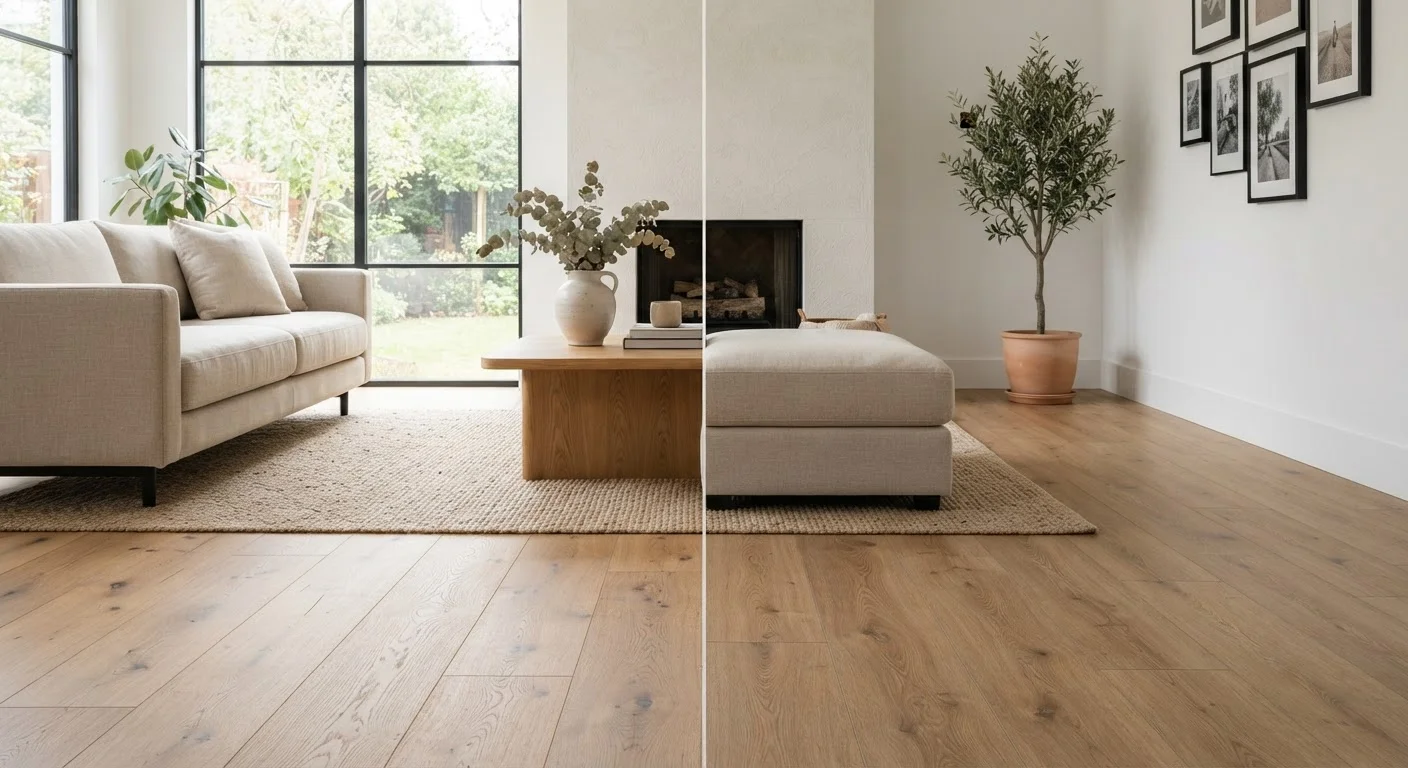
Option A
Hardwood Flooring
The timeless, refinishable classic with lasting appeal.
Best for: Homeowners in dry climates who prioritize long-term value, natural aesthetics, and the ability to sand and refinish the floor multiple times.
Option B
Luxury Vinyl Plank (LVP)
The resilient, moisture-friendly modern alternative.
Best for: Homeowners seeking a waterproof, low-maintenance floor that handles high-traffic areas, kitchens, basements, and households with kids or pets.
If you want a floor that can be refreshed and last decades
Hardwood Flooring
Solid hardwood can be sanded and refinished multiple times, allowing you to remove scratches, change stain color, or restore its look after years of wear.
If your space has moisture exposure or temperature swings
Luxury Vinyl Plank (LVP)
LVP is 100% waterproof and dimensionally stable, meaning it won't warp, cup, or swell in humid environments like basements, laundry rooms, or below-grade spaces.
If you have pets or young children and need durability
Luxury Vinyl Plank (LVP)
LVP's wear layer resists scratches from claws and dropped toys better than most hardwood species, and spills wipe up without concern for damage.
If maximizing long-term home resale value is a priority
Hardwood Flooring
Real wood flooring remains a recognized selling point for homebuyers and may contribute to higher perceived home value, particularly in traditional or upscale markets.
If you want easier DIY installation with minimal subfloor prep
Luxury Vinyl Plank (LVP)
Most LVP uses a click-lock floating system that can go over existing floors with minimal prep, while hardwood often requires professional installation and acclimation time.
How Each Floor Behaves Over Time
Shopping for flooring is largely a visual experience - both hardwood and luxury vinyl plank (LVP) can look nearly identical in a showroom. The real differences emerge after installation, when your floor faces daily foot traffic, humidity shifts, spills, and the occasional furniture scrape.
Hardwood is a natural material, which means it responds to its environment. Wood absorbs and releases moisture, causing planks to expand in humid summers and contract in dry winters. Without consistent indoor humidity control (generally between 35-55% relative humidity), hardwood can gap, cup, or warp over time. That's not a defect - it's simply the nature of wood - but it does mean hardwood floors require a home with a stable climate.
LVP, by contrast, is an engineered synthetic product with a rigid or flexible core topped by a photographic layer and a protective wear layer. It doesn't absorb moisture, so it holds its shape across humidity and temperature fluctuations. This makes LVP inherently more forgiving in spaces like basements, kitchens, and bathrooms where hardwood has traditionally been discouraged.
| Criterion | Hardwood Flooring | Luxury Vinyl Plank (LVP) |
|---|---|---|
| Waterproof | No - moisture-sensitive | Yes - fully waterproof |
| Can be refinished | Yes - multiple times | No - replace when worn |
| Typical lifespan | 50-100 years | 15-25 years |
| Below-grade installation | Not recommended (solid) | Yes - all grade levels |
| Humidity sensitivity | High - expands/contracts | Low - dimensionally stable |
| Scratch resistance | Varies by wood species | Depends on wear layer thickness |
| Resale value perception | Generally higher | Growing, but typically lower |
| DIY installation ease | Moderate to difficult | Easier with click-lock systems |
Durability, Scratches, and Surface Wear
Hardwood's durability depends heavily on the species. Harder species like white oak and hickory resist dents and scratches better than softer options like pine. All hardwood, however, can show surface scratches from pet nails, high heels, and furniture being dragged across it. The meaningful advantage hardwood offers is that these imperfections can be sanded away during refinishing - a process that can typically be done several times over the floor's life.
LVP durability is tied to its wear layer, measured in mils (thousandths of an inch). Residential LVP typically ranges from 6 to 20 mils. A thicker wear layer means more resistance to scratches and scuffs before the decorative print layer underneath becomes vulnerable. Once the wear layer is fully compromised, the plank cannot be refinished - it must be replaced. For most households, a quality LVP wear layer will last many years before reaching that point.
12-20 mils
Wear layer for heavy residential LVP use
Flooring industry guidance generally recommends a minimum 12-mil wear layer for active households with pets or children.
35-55%
Ideal indoor relative humidity for hardwood
The National Wood Flooring Association recommends maintaining this humidity range year-round to minimize wood movement and gapping.
3-5 times
Average refinishing cycles for solid hardwood
Most solid hardwood floors with standard 3/4-inch thickness can be sanded and refinished several times before the wood becomes too thin.
Understanding this distinction matters: hardwood rewards a long-game approach, while LVP is durable within defined limits.
Moisture, Subfloor, and Installation Realities
Installation day is when hardwood's demands become clear. Solid hardwood must acclimate to your home's humidity for several days before installation. It requires a dry, flat subfloor and cannot be installed below grade (basements). Engineered hardwood - real wood veneers bonded over a plywood core - is more dimensionally stable and can work in some below-grade applications, but still carries moisture sensitivity.
LVP is more forgiving at installation. Most click-lock LVP products can float over existing floors, reducing demolition costs. They can be installed at, above, or below grade, and most require only a reasonably flat subfloor without the strict moisture-testing protocols hardwood demands. That said, serious subfloor imperfections - dips or humps - should still be corrected before any flooring goes down, since floating floors can flex and cause locking joints to stress over time.
One important note: even waterproof LVP can be affected by standing water that seeps beneath the planks through gaps at the edges. Proper perimeter sealing and baseboard or transition installation still matter.
Long-Term Maintenance and Lifespan
Day-to-day care for both floors is similar: sweep regularly, mop with a damp (not soaking wet) mop, and avoid harsh chemical cleaners. The divergence comes over years and decades.
A solid hardwood floor installed correctly and maintained well can last 50 to 100 years. The ability to refinish it means you can restore its surface appearance every decade or so, adapting the stain color to changing tastes. This long lifespan is part of what makes hardwood a valued home feature.
LVP, depending on quality and traffic levels, typically has a practical lifespan in the range of 15 to 25 years for residential use. Many manufacturers offer warranties of 15 to 25 years, though warranty terms vary significantly - read the fine print carefully. When LVP reaches the end of its useful life, the entire floor generally needs replacement rather than renewal.
Engineered Hardwood: A Middle Ground
If you like the look and refinishability of hardwood but need slightly better moisture resistance, engineered hardwood is worth researching. It uses a real wood veneer over a plywood core, offering improved dimensional stability compared to solid wood. However, its thinner veneer limits how many times it can be refinished, so it's still a different trade-off than solid hardwood or LVP. Consult a flooring professional to understand what options work for your specific subfloor and environment.
Neither floor type is universally superior. Your climate, subfloor conditions, household activity level, and long-term plans for the home are all valid factors in the decision.