

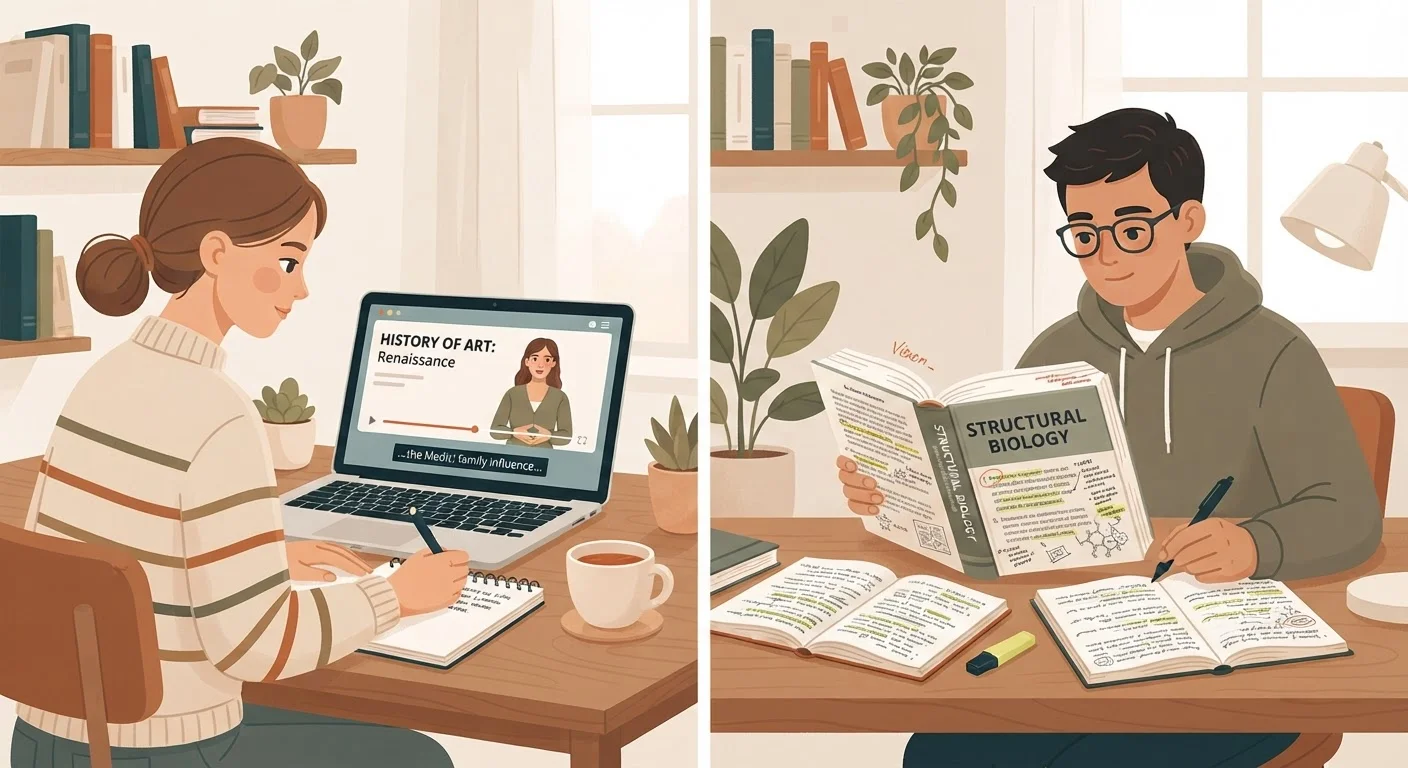
Key Takeaways
- Online courses offer structure, pacing, and multimedia support that many learners find motivating.
- Textbooks allow flexible, deep reading at your own pace without requiring internet access or subscriptions.
- Neither format is universally superior - the best choice depends on your learning goal, time constraints, and engagement style.
- Combining both formats is often more effective than committing exclusively to one.
- Research on active recall suggests how you engage with material matters more than the format itself.
Our Verdict
Online courses and textbooks are tools, not competitors. Courses tend to serve learners who benefit from guided structure, multimedia explanation, and built-in accountability. Textbooks suit those who need depth, flexibility, or offline access. For most adults, using both strategically - a course for foundations, a book for deeper context - outperforms either alone.
| Best for | Recommended |
|---|---|
| Those who need guided structure and accountability | Online Courses |
| Those pursuing deep conceptual understanding or research | Textbooks |
| Learners with irregular schedules or limited internet access | Textbooks |
| Beginners entering an unfamiliar subject area | Online Courses |
Why the Format Question Actually Matters
Choosing between an online course and a textbook might seem like a minor logistical decision, but it has real consequences for how much you retain, how long you stay engaged, and whether you reach your goal. Adults learning on limited time can't afford formats that don't match how they actually absorb information.
Research in cognitive science consistently shows that how you engage with material - actively testing yourself, spacing out review, applying concepts - matters more than the medium delivering it. That said, different formats make some of those productive habits easier or harder to build. For a deeper look at study habits that research actually supports, see our guide on active recall vs. passive review.
Before picking a format, get clear on three things: what you need to learn, why you need to learn it, and how much time and consistency you can realistically commit.
What Online Courses Do Well
Structured online courses - whether offered through universities, professional platforms, or independent educators - bundle content into a sequenced curriculum. That structure is their clearest advantage for learners who feel lost when starting something new.
- Guided pacing: Courses break large topics into manageable modules, reducing the overwhelm of not knowing where to start.
- Multimedia explanation: Video, audio narration, and interactive exercises can clarify concepts that plain text struggles to convey, such as mathematical proofs or physical processes.
- Built-in accountability: Deadlines, progress bars, and discussion forums create mild external pressure that many self-directed learners need to stay consistent.
- Instructor access: Many courses offer Q&A forums or feedback, which a book cannot replicate.
Courses work especially well when entering a field where you don't yet know what you don't know. A curated curriculum does the prioritisation work for you.
Use Both Formats Strategically
Start with a course to build orientation in an unfamiliar subject, then use a textbook to deepen the areas that matter most for your specific goal. This combination reduces the weaknesses of each format. Even reading one key chapter from a relevant book alongside a course module can significantly improve retention and understanding.
If you're weighing whether a particular course is worth enrolling in, our article on evaluating an education program without getting misled by marketing can help you look past promotional language.
What Textbooks Do Well
A well-written textbook remains one of the most information-dense learning tools available. Its advantages are often underestimated in a world that defaults to video for everything.
- Depth and nuance: Books can develop an argument over dozens of pages in ways that a 10-minute video segment cannot. For subjects requiring careful reasoning - law, philosophy, advanced science - this depth is essential.
- Reader-controlled pace: You can skip sections you already know, re-read difficult passages, and annotate freely without worrying about a platform's structure.
- Offline access: Physical books and downloaded e-books don't require a stable internet connection, a subscription renewal, or a device with a charged battery.
- Longevity: A textbook purchased once doesn't expire. Courses can be retired, paywalled, or significantly altered.
Textbooks also tend to reward learners who already have some familiarity with a subject and want to go significantly deeper. For those returning to formal study after a gap, going back to college as an adult learner often involves a mix of assigned textbooks alongside structured coursework.
| Online Courses | Textbooks | |
|---|---|---|
| Structure | Pre-built curriculum and sequence | Reader determines their own path |
| Depth of coverage | Broad overview, modular | Can be highly detailed and thorough |
| Interactivity | Video, quizzes, forums | Annotation and self-testing only |
| Cost range | Varies; free to hundreds of dollars | Free via library; purchase varies widely |
| Offline access | Limited; platform-dependent | Full access offline |
| Best for beginners | Strong - guided entry into new topics | Moderate - assumes some orientation |
| Accountability support | Deadlines, progress tracking | Self-imposed only |
Matching the Format to Your Specific Situation
There is no universally correct answer, but there are clearer fits for common situations.
Choose an online course if: You're entering a subject cold, you struggle with self-direction without external checkpoints, your goal is a specific skill or credential within a defined timeline, or you find multimedia explanations easier to follow than dense text.
Be cautious of a widespread but unsupported idea: that you have a fixed "learning style" - visual, auditory, kinesthetic - and should always match your format to it. The evidence doesn't support that framing. Our companion article on learning style myths explains what the research actually shows.
Choose a textbook if: You already have baseline knowledge and want depth, you value flexibility to move at your own speed, the subject demands careful reading and synthesis rather than demonstration, or cost is a significant factor and library access is available.
In practice, using both is often the most effective approach. A course can orient you to a subject's landscape; a book can deepen your understanding of its most important territory. This kind of self-directed learning works best when you're honest about where your gaps actually are.