

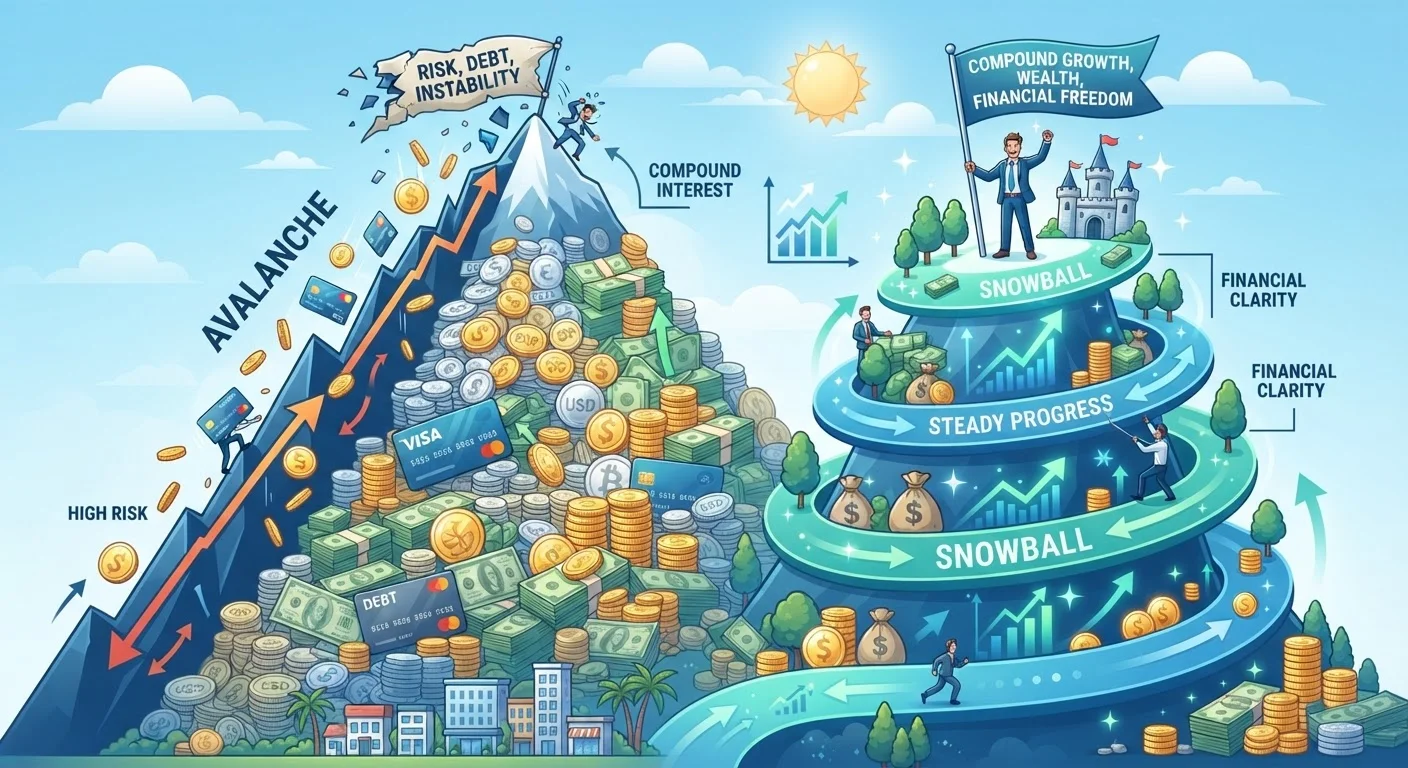
Key Takeaways
- The debt avalanche targets your highest-interest balance first, saving you the most money over time.
- The debt snowball targets your smallest balance first, delivering faster early wins that sustain motivation.
- Both methods require paying minimums on all debts while directing extra funds to one priority account.
- The avalanche is mathematically superior; the snowball often wins on behavioral consistency.
- Your best strategy is the one you will actually stick with month after month.
- Consider consulting a nonprofit credit counselor if you are unsure which approach fits your situation.
Option A
Debt Avalanche
The mathematically optimal, interest-minimizing approach.
Best for: People who are motivated by long-term savings and want to pay the least interest over time.
Option B
Debt Snowball
The psychologically rewarding, momentum-building method.
Best for: People who need early wins to stay motivated and build consistent repayment habits.
If minimizing total interest paid is your top priority
Debt Avalanche
Paying off high-APR balances first directly reduces how much interest accrues, leaving more money in your pocket over the full repayment timeline.
If you struggle to stay motivated during a long repayment journey
Debt Snowball
Clearing small balances quickly creates visible progress and a psychological boost that research suggests keeps people on track longer.
If your debts carry similar interest rates
Debt Snowball
When APR differences are minimal, the snowball's motivational advantages outweigh its marginal math disadvantage.
If you carry one or two very high-rate debts alongside moderate ones
Debt Avalanche
A single high-APR account can cost disproportionately more over time; tackling it first produces meaningful savings.
If you want a hybrid approach blending wins and savings
Debt Snowball
Start with one small payoff to build confidence, then switch to avalanche ordering - many financial educators endorse this flexible combination.
How Each Strategy Works
Both the debt avalanche and debt snowball share the same mechanical foundation: pay the required minimum on every debt each month, then direct any extra funds toward one designated priority debt. Where they differ is in how that priority is chosen.
With the debt avalanche, you rank your debts from highest APR to lowest. Extra dollars go to the highest-rate balance first. Once it is paid off, that freed-up payment rolls into the next-highest-rate debt, and so on. Because interest compounds on the most expensive balances, eliminating them first limits how much interest builds up across your entire debt load. For a deeper look at terms like APR and amortization, see our plain-language debt glossary.
With the debt snowball, you rank debts from smallest balance to largest, regardless of interest rate. Extra payments attack the smallest balance until it is gone, then you redirect that combined payment to the next smallest - the "snowball" growing as it rolls. The approach was popularized by personal finance educators and is widely cited for its psychological effectiveness.
| Criterion | Debt Avalanche | Debt Snowball |
|---|---|---|
| Priority order | Highest APR first | Smallest balance first |
| Total interest paid | Lower (mathematically optimal) | Potentially higher |
| Time to first payoff | Longer (if top debt is large) | Faster early wins |
| Motivational structure | Requires delayed gratification | Quick visible progress |
| Best suited for | Analytically motivated savers | Habit-builders needing momentum |
| Flexibility | Can be combined with snowball | Can shift to avalanche later |
The Math vs. The Motivation Trade-Off
On a pure numbers basis, the avalanche wins. By reducing high-interest principal faster, it limits compounding and typically results in less total interest paid and a shorter payoff timeline - sometimes by hundreds or even thousands of dollars depending on balances and rates. However, these savings only materialize if you stay consistent for months or years.
The snowball trades some mathematical efficiency for psychological momentum. Behavioral finance research consistently finds that visible progress - even small wins - strengthens financial commitment. Eliminating an account entirely, regardless of its rate, produces a concrete sense of achievement that can sustain motivation through a long payoff journey.
~$1,000+
Potential interest savings with avalanche vs. snowball
Exact savings depend on balances and rates; financial planning tools can model your specific scenario.
3 in 4
Americans carrying some form of debt
According to Federal Reserve consumer credit data, the vast majority of U.S. households hold at least one form of outstanding debt.
Neither method requires a perfect credit score, a windfall, or a dramatic lifestyle change. Both work within whatever extra payment capacity you already have - even an additional $25 to $50 per month accelerates payoff meaningfully. If you are weighing whether to save simultaneously, our article on saving while carrying debt addresses common misconceptions head-on.
Choosing the Right Fit for Your Situation
There is no universally correct answer, but a few questions can guide your decision:
- Are your interest rates spread widely apart? A 24% APR credit card sitting alongside a 6% personal loan creates a clear avalanche case.
- Have you struggled to maintain a debt plan in the past? If previous attempts stalled, the snowball's early payoffs may provide the structure you need.
- How many separate accounts do you carry? Many small balances can make the snowball feel especially rewarding, while fewer large accounts may suit the avalanche.
Some people start with one snowball payoff to build confidence, then shift to avalanche ordering - a hybrid approach many financial educators endorse. What matters most is consistency. A plan you follow imperfectly beats a theoretically optimal plan abandoned after three months.
For a broader picture of balancing repayment with other money goals, see our complete overview of saving and paying down debt simultaneously. If you are also considering consolidating multiple debts into one, our piece on how debt consolidation works explains the trade-offs clearly.
This article provides general financial education and is not personalized financial or legal advice. Consult a qualified financial professional or nonprofit credit counselor for guidance specific to your situation.