

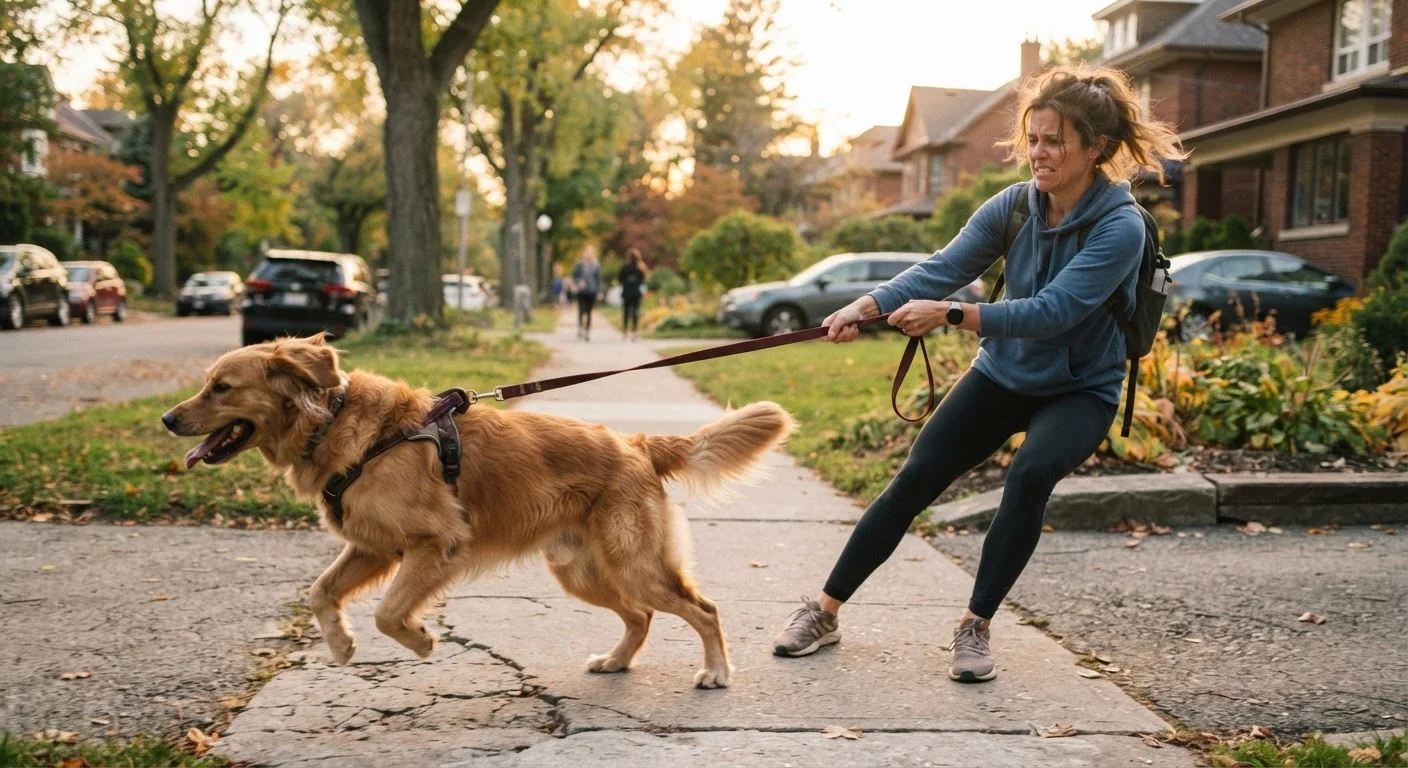
Key Takeaways
- Leash pulling is a learned behavior reinforced when forward movement rewards the dog.
- Many owners unintentionally train their dogs to pull by continuing to walk when tension exists.
- Consistency across every walk and every handler is essential for real improvement.
- Understanding why pulling starts helps owners choose more effective responses.
Why Dogs Pull in the First Place
Dogs don't pull on the leash to dominate you or test your authority - a common misconception addressed in our look at common dog training myths. They pull because it works. A dog that lunges toward an interesting smell, another dog, or a patch of grass gets exactly what it wants the moment its owner follows. That forward movement is an immediate, powerful reward, and dogs are remarkably efficient at learning which behaviors produce results.
Dogs also experience the world at a nose-level intensity that humans can't easily appreciate. A single city block contains layered scent information - other animals, food scraps, environmental changes - that activates a dog's brain the way an absorbing book might absorb a person. The urge to rush toward that stimulation is natural. Without deliberate guidance, most dogs will default to exploring as fast as their legs (and your arm) allow.
Breed tendencies matter too. Dogs bred for tasks involving forward drive - herding, hunting, sledding - often have a physical and neurological predisposition toward pulling. That doesn't make improvement impossible, but it does mean some dogs require more patient, structured training than others.
The Habits That Keep Pulling Going
Continuing to walk when the leash is taut.
Why it happens: Owners want to finish the walk or reach a destination, so they keep moving even when the dog is pulling. It feels like the path of least resistance.
Allowing occasional pulling 'just this once.'
Why it happens: Some situations feel urgent - the owner is in a hurry, the weather is bad, or the dog is very excited - and enforcing the rule feels inconvenient.
Using equipment as a substitute for training.
Why it happens: Front-clip harnesses and head halters can reduce pulling immediately, which feels like the problem is solved. Owners sometimes stop there.
Training only in the same low-distraction environment.
Why it happens: Dogs make quick progress in quiet spaces, and owners assume the skill has been learned. But behavior doesn't automatically transfer to new environments.
Punishing the dog after the fact.
Why it happens: Frustrated owners sometimes scold or correct a dog long after the pulling occurred, hoping to communicate disapproval.
Beyond the individual mistakes outlined above, two bigger-picture patterns derail progress more than anything else. The first is inconsistency across handlers. If one family member stops when the leash goes taut while another keeps walking, the dog learns that pulling sometimes pays off - and intermittent reinforcement is actually one of the strongest forces in behavioral learning. Everyone in the household needs to respond the same way, every time.
The second pattern is skipping the foundational work. Loose-leash walking isn't something most dogs figure out on their own; it needs to be practiced deliberately, often starting in low-distraction environments before adding the complexity of busy streets or dog parks. Expecting a dog to behave perfectly outdoors without that foundation is a setup for frustration on both ends of the leash.
A consistent daily routine can also support leash training by ensuring your dog gets adequate exercise and mental stimulation - a dog that arrives at walk time in a state of pent-up energy is far more likely to pull than one whose needs are met throughout the day.
What to Do Instead
Avoid Punishment-Based Corrections
Jerking the leash, using prong collars, or applying physical corrections to stop pulling can suppress the behavior temporarily but often increase anxiety and erode your dog's trust in you. Current evidence from animal behavior science points toward reward-based approaches as both more effective and less likely to produce unwanted side effects. If you're unsure which methods are appropriate, a certified professional trainer can help you develop a plan.
The most widely supported approach among certified trainers and animal behaviorists is to make pulling unrewarding. When the leash tightens, stop moving entirely - or change direction - so the dog learns that tension never produces forward progress. When the leash is loose, walking continues and the dog may periodically be allowed to sniff as a reward. This requires patience, particularly in the early stages, but the underlying principle is straightforward: behavior that produces no result tends to fade.
Short, frequent practice sessions tend to outperform long, chaotic walks during the learning phase. Ending a five-minute session on a successful note builds more reliable habits than grinding through a forty-minute walk in which both dog and owner grow increasingly frustrated.
If your dog's pulling is severe, if they're large enough to cause physical injury, or if anxiety appears to be driving the behavior - pulling toward home, for example, rather than away from it - consulting a certified professional trainer or a veterinary behaviorist is a reasonable next step. Some dogs benefit from management tools like front-clip harnesses as a temporary aid, but equipment alone doesn't teach a dog what to do; it only limits what they can do.
This article is for general informational and educational purposes only. For persistent behavior concerns or signs of underlying anxiety, consult a certified professional trainer or a licensed veterinary behaviorist.