

Key Takeaways
- Freshwater tanks cost significantly less to set up and maintain than saltwater systems.
- Saltwater tanks require precise salinity control and are far more sensitive to water parameter changes.
- Freshwater fish are generally hardier and more forgiving of beginner mistakes.
- Reef tanks add another layer of complexity beyond basic saltwater setups, involving coral and specialized lighting.
- Both tank types require understanding the nitrogen cycle before adding any fish.
- Most aquarium experts recommend starting with freshwater to build foundational skills first.
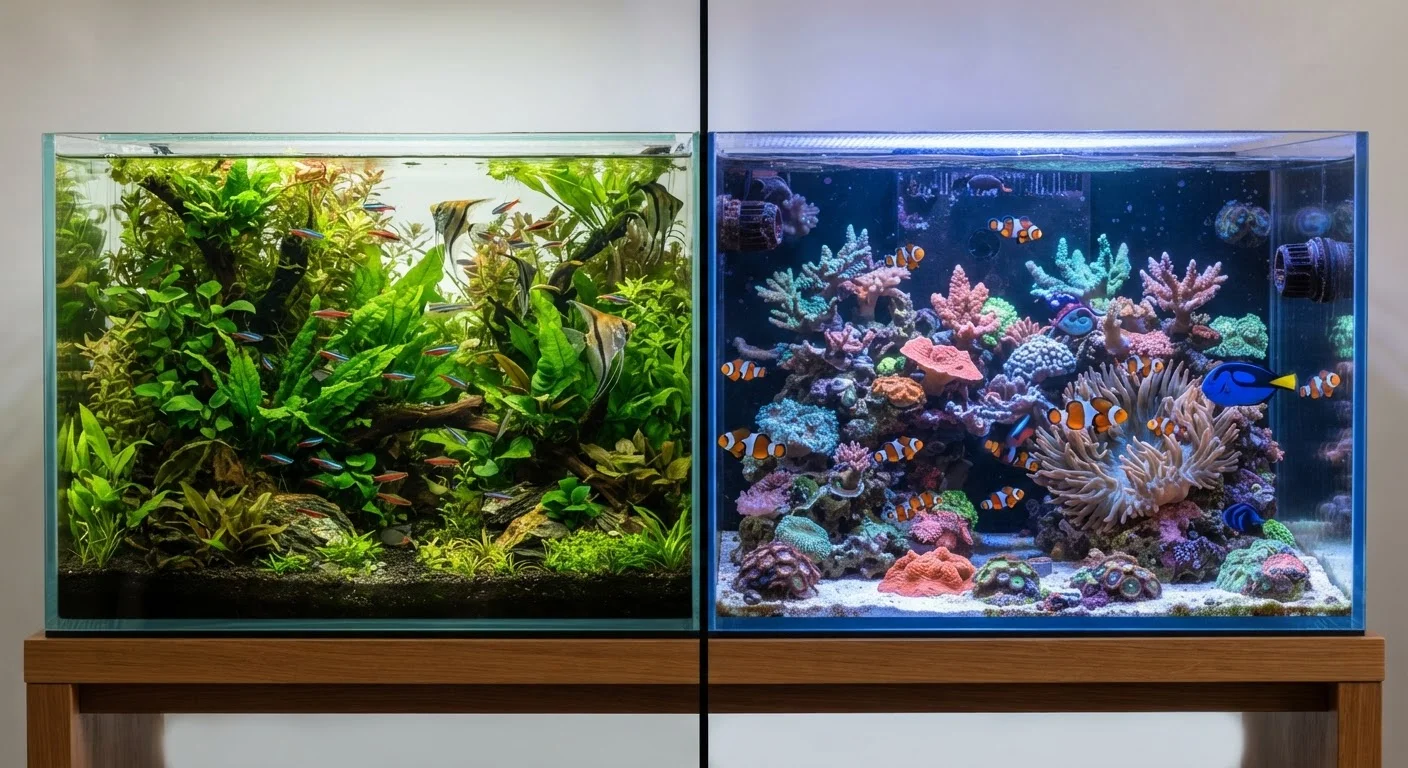
Option A
Freshwater Aquarium
The forgiving, beginner-friendly starting point.
Best for: New fish owners who want manageable daily care, lower upfront costs, and a wide variety of hardy fish species.
Option B
Saltwater Aquarium
The visually stunning but high-maintenance choice.
Best for: Dedicated hobbyists willing to invest more time, money, and technical knowledge in exchange for a living reef ecosystem.
If you're setting up your very first fish tank
Freshwater Aquarium
Freshwater tanks are more forgiving of the inevitable beginner mistakes in water chemistry and fish selection, making early success much more likely.
If you want colorful coral and exotic marine fish
Saltwater Aquarium
Reef systems offer unmatched visual diversity, but should only be attempted after gaining hands-on experience with water chemistry and tank maintenance.
If your budget for setup and ongoing care is limited
Freshwater Aquarium
Fish, equipment, and consumables cost considerably less in freshwater setups, and routine maintenance is simpler and less time-intensive.
If you have prior fishkeeping experience and want a new challenge
Saltwater Aquarium
Experienced hobbyists who already understand water parameters and tank cycling are better equipped to handle the demands of a marine system.
The Core Difference Between the Two Systems
At the most basic level, freshwater and saltwater aquariums differ in the type of water they use and the creatures they can house - but that difference cascades into nearly every aspect of setup, maintenance, and cost. Freshwater tanks replicate rivers, lakes, and streams; saltwater tanks mimic ocean environments. The ocean is a far more chemically stable environment than most freshwater habitats, which means marine fish and coral have evolved to expect very narrow, consistent conditions. That's exactly what makes saltwater tanks more demanding to manage at home.
Before committing to either system, every new owner should understand one concept that applies equally to both: the nitrogen cycle. Beneficial bacteria must establish themselves in your tank to convert harmful ammonia (from fish waste) into less toxic compounds. Skipping or rushing this process is one of the most common reasons new fish don't survive. See our explanation of the nitrogen cycle for new aquarium owners for a full walkthrough before you add any livestock.
Setup Complexity and Equipment
A basic freshwater setup requires a tank, a filter, a heater, a light, a thermometer, and a water conditioner to neutralize tap water chlorine. That's a manageable list, and most of those components are straightforward to use. Equipment failures are easier to diagnose and replace.
A saltwater tank requires all of the above, plus a protein skimmer (a device that removes organic waste before it breaks down), a hydrometer or refractometer to measure salinity, and high-quality salt mix to prepare the water. Reef tanks - which house coral in addition to fish - add even more: high-output LED or T5 lighting tuned to specific spectrums, calcium and alkalinity dosing equipment, and powerheads for water circulation. Live rock, which serves as both decoration and biological filtration, is another essential and ongoing expense.
| Criterion | Freshwater Aquarium | Saltwater Aquarium |
|---|---|---|
| Typical setup cost (20-30 gal) | $100-$300 | $400-$1,000+ |
| Equipment complexity | Low to moderate | Moderate to high |
| Water parameter sensitivity | Moderate tolerance | Very narrow tolerance |
| Fish hardiness | Generally hardy | More delicate |
| Maintenance time per week | 1-2 hours | 3-5+ hours |
| Coral/reef capability | Not applicable | Possible with added equipment |
| Recommended experience level | Beginner-friendly | Intermediate to advanced |
The complexity difference is real, but it's not insurmountable. Many hobbyists who start with freshwater successfully transition to saltwater after a year or two of building confidence with water chemistry and equipment maintenance.
Water Quality, Stability, and Maintenance
Freshwater fish - think tetras, guppies, goldfish, bettas - have a relatively wide tolerance for fluctuating water parameters. That doesn't mean water quality doesn't matter; it absolutely does. But a small spike in ammonia or a few degrees of temperature variation is less immediately catastrophic than it would be in a marine tank.
Saltwater fish and especially coral are highly sensitive. Salinity (measured as specific gravity) must stay within a tight range, typically around 1.025 for a reef tank. Temperature swings, pH drops, and elevated nitrate levels can stress or kill marine animals within hours. This means more frequent testing - often several parameters multiple times per week - and faster corrective action.
Testing Kits Are Non-Negotiable
Both freshwater and saltwater tanks require regular water testing - but the parameters differ. Freshwater owners typically test ammonia, nitrite, nitrate, and pH. Saltwater owners add salinity, calcium, alkalinity, and magnesium to that list, especially in reef tanks. Liquid test kits generally provide more accurate readings than strip tests and are worth the extra cost.
Water changes are essential in both systems. In freshwater tanks, a 20-25% weekly change is a common guideline. Saltwater changes require pre-mixing and aerating the salt solution before it goes into the tank, adding a step that new owners often underestimate. If you've been experiencing unexplained fish loss, water quality is almost always a factor - our article on why fish keep dying and what your tank is telling you covers the most frequent culprits.
Cost Comparison and Long-Term Commitment
Startup costs for a modest freshwater tank (20-30 gallons) typically run from around $100-$300 including equipment and initial fish. Ongoing costs - food, water conditioner, replacement filter media - are relatively low.
A comparable saltwater-only fish tank can easily run $400-$800 or more at setup, and a reef system with coral can exceed several thousand dollars once lighting, dosing equipment, and live rock are factored in. Marine fish themselves cost more, and losses are more expensive to replace. Electricity costs are also higher due to stronger lighting and additional pumps.
~700,000
Households keeping saltwater fish in the U.S.
According to the American Pet Products Association, saltwater fishkeeping remains a niche hobby compared to the much larger freshwater segment.
13.3 million
U.S. households with freshwater fish
The American Pet Products Association's national pet owner survey consistently shows freshwater fish as the most common aquarium choice among American households.
The commitment isn't just financial. Saltwater tanks require more consistent attention. Skipping a week of testing or delaying a water change has more serious consequences than it would in a freshwater system. If your schedule is unpredictable or you travel frequently, that's an important practical consideration.
This article is for general informational purposes only. Always consult with a qualified aquatics specialist or veterinarian experienced in fish health for guidance specific to your setup and livestock.