

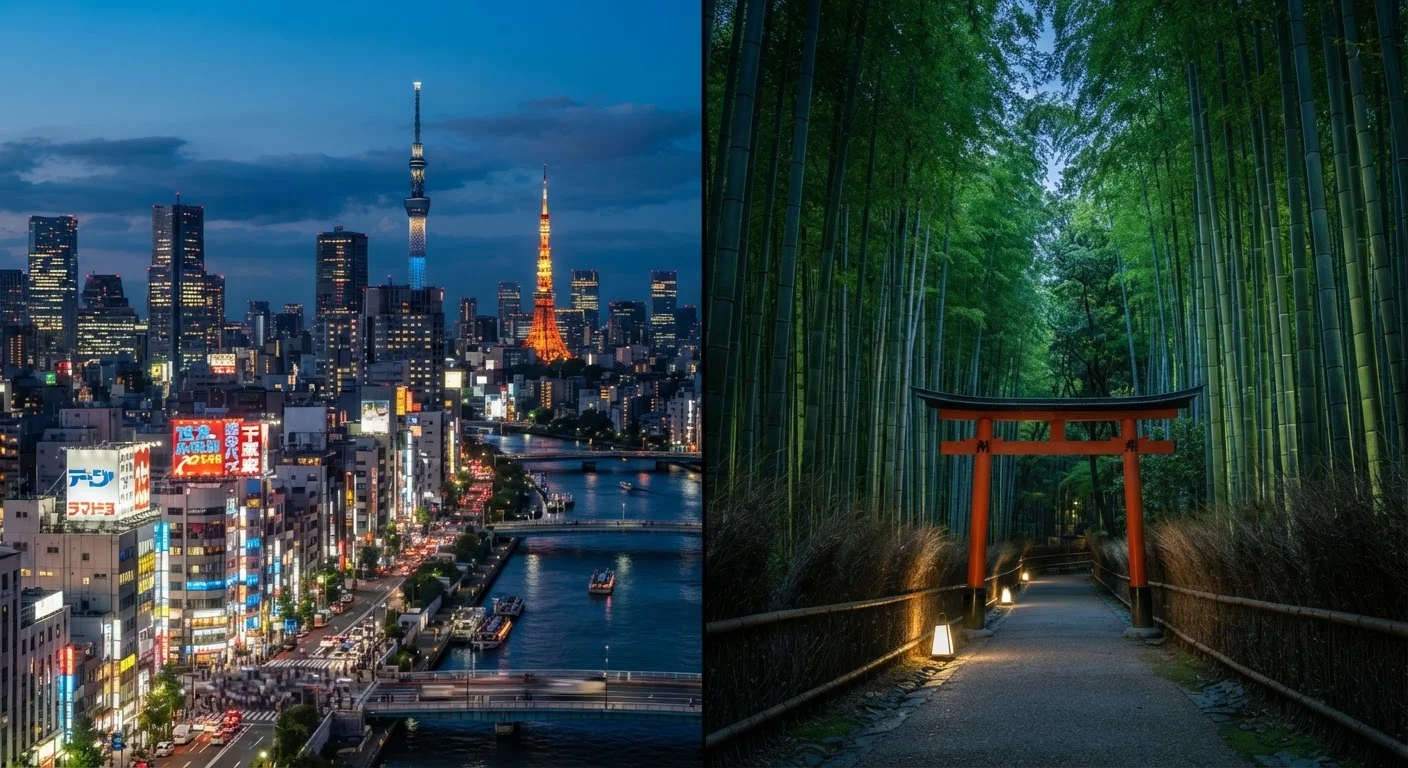
Key Takeaways
- Tokyo is Japan's modern capital; Kyoto served as imperial capital for over a thousand years.
- Both cities are connected by the Shinkansen bullet train in roughly 2.5 hours.
- Tokyo suits visitors who want urban excitement; Kyoto suits those seeking cultural depth and calm.
- Kyoto's accommodations tend to include more traditional ryokan options; Tokyo offers a broader range of hotel styles.
- Many travelers combine both cities in a single trip, often with Osaka added as a third stop.
Option A
Tokyo
Japan's electric, ever-evolving megacity.
Best for: Travelers who want cutting-edge food, nightlife, pop culture, and a relentless urban energy.
Option B
Kyoto
Japan's living museum of history and tradition.
Best for: Travelers drawn to ancient temples, tea ceremonies, traditional crafts, and peaceful natural scenery.
If you want a first-time, big-city Japan experience
Tokyo
Tokyo's world-class transit, diverse neighborhoods, and round-the-clock energy make it an exceptional entry point for first-time visitors to Japan.
If experiencing traditional Japanese culture is your top priority
Kyoto
Kyoto concentrates Japan's most iconic temples, shrines, geisha districts, and traditional arts in a walkable, historically rich setting.
If you're a food and nightlife traveler
Tokyo
Tokyo holds more Michelin-starred restaurants than any other city in the world and offers neighborhoods catering to virtually every taste and hour.
If you want a slower-paced, reflective travel experience
Kyoto
Kyoto's pace is calmer, its gardens invite lingering, and a stay in a traditional ryokan offers an unhurried immersion in Japanese hospitality.
If you have limited time and can only visit one city
Tokyo
Tokyo's sheer variety means a few days can cover everything from ancient shrines to futuristic neighborhoods, making it the more time-efficient single destination.
The Big Picture: Two Cities, One Country, Very Different Souls
Japan is often described as a country where the ancient and the ultramodern coexist - and nowhere is that contrast clearer than between Tokyo and Kyoto. These two cities sit roughly 320 miles apart on the island of Honshu, connected by the iconic Shinkansen (bullet train) in about 2.5 hours. Despite the short distance, stepping from one city to the other can feel like crossing centuries.
Tokyo is Japan's capital and largest city, home to around 14 million people in the city proper. It is a place of constant reinvention: neon-lit entertainment districts, towering skyscrapers, avant-garde fashion, and a food scene with unmatched global variety. Kyoto, by contrast, served as Japan's imperial capital for more than 1,000 years, and its identity is still deeply shaped by that heritage. With over 1,600 Buddhist temples, 400 Shinto shrines, and several UNESCO World Heritage Sites, Kyoto is Japan's cultural and spiritual heart.
Neither city is objectively better - they simply serve different travel goals. Understanding what each offers helps you build a trip that matches what you actually want from Japan.
| Criterion | Tokyo | Kyoto |
|---|---|---|
| Character | Ultramodern megacity | Ancient imperial capital |
| Population (city proper) | ~14 million | ~1.4 million |
| UNESCO Heritage Sites | None within city limits | 17 sites |
| Pace | Fast, high-energy | Slower, contemplative |
| Food scene | Global variety, Michelin-dense | Traditional kaiseki and tofu cuisine |
| Getting around | Extensive metro network | Bus, limited subway, bicycle |
| Accommodation style | Hotels dominate | Ryokan widely available |
| Best season to visit | Year-round | Spring and autumn most popular |
Neighborhoods and Atmosphere
Tokyo is a city of distinct neighborhoods, each with its own personality. Shibuya and Shinjuku pulse with commercial energy and nightlife. Asakusa contains the ancient Senso-ji temple amid traditional market streets. Harajuku draws visitors interested in youth fashion subcultures, while Yanaka offers a rare glimpse of old-town Tokyo that survived wartime destruction. The city rewards exploration precisely because no two areas feel the same.
Kyoto's layout is more cohesive. Gion, the famous geisha district, anchors the east side of the city near the Kamo River. The Higashiyama district links many of Kyoto's most celebrated shrines and temples along forested hillside paths. Arashiyama, on the city's western edge, is home to the widely photographed bamboo grove and the Tenryu-ji garden. Throughout Kyoto, traditional wooden townhouses called machiya line quiet lanes, lending the city a visual consistency that Tokyo - with its constantly evolving skyline - does not share.
Combining Both Cities in One Trip
Most travelers visiting Japan for 10 days or more find it practical - and rewarding - to include both Tokyo and Kyoto in a single itinerary. A common structure is three to four nights in Tokyo, followed by two to three nights in Kyoto, often with Osaka added given its proximity (about 15 minutes from Kyoto by Shinkansen). This combination lets travelers experience Japan's modern and traditional faces without feeling rushed in either city.
Practical Considerations: Getting Around and Planning Your Visit
Both cities have reliable public transportation, but they operate at different scales. Tokyo's metro system is one of the world's most extensive, covering virtually every corner of the city. Navigating it can feel overwhelming at first, but signage is available in English throughout, and transit apps make routing straightforward. An IC card (a rechargeable transit card) simplifies fare payment across trains and buses in both cities.
Kyoto's transit network is smaller and more manageable, with buses and a limited subway system supplemented by rental bicycles, which are a popular and practical option given the city's relatively flat central terrain. Many of Kyoto's top sites cluster in walkable districts, making it easier to explore on foot than Tokyo.
17
UNESCO World Heritage Sites in Kyoto
Kyoto's 17 UNESCO-designated properties include temples, shrines, and the historic Nijo Castle, making it one of the world's densest concentrations of heritage sites.
2.5 hrs
Tokyo to Kyoto by Shinkansen
The Tokaido Shinkansen line connects Tokyo Station and Kyoto Station, making a day trip or multi-city itinerary genuinely practical.
200+
Michelin stars held by Tokyo restaurants
Tokyo has consistently ranked among the cities with the highest concentration of Michelin-starred restaurants globally, according to the Michelin Guide.
Accommodation in Tokyo skews toward Western-style business hotels and international chains, though capsule hotels and boutique guesthouses are also widely available. Kyoto offers more opportunity to stay in a ryokan - a traditional Japanese inn featuring tatami-mat rooms, futon bedding, and multi-course kaiseki meals - an experience that is itself considered part of the Kyoto itinerary. Ryokan stays typically require advance booking, especially during peak seasons such as cherry blossom season (late March to early April) and autumn foliage season (mid-November).
Visitors planning to see both cities are advised to verify current Japan Rail Pass rules before travel, as pass eligibility and pricing structures have changed in recent years. Always check official sources for entry requirements, transportation options, and any travel advisories before booking.