

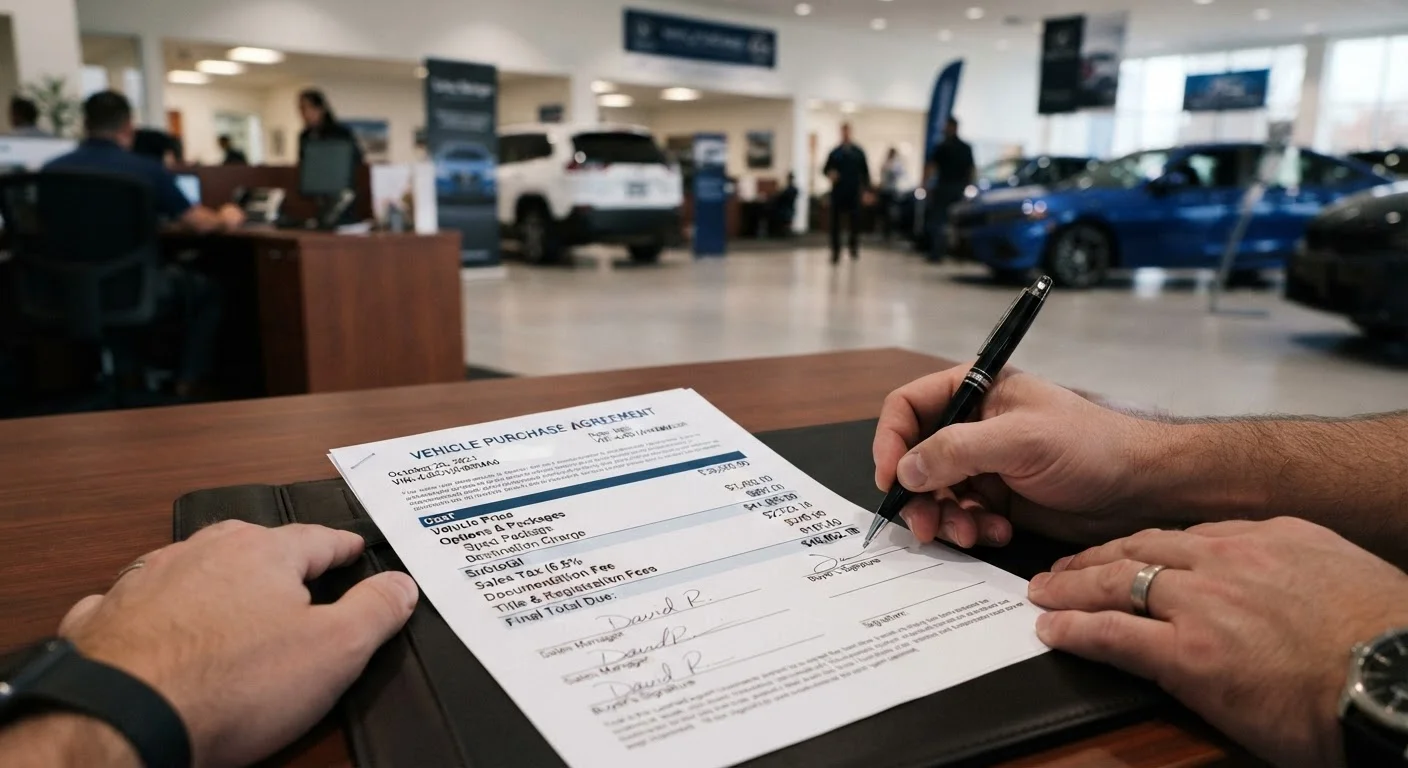
Key Takeaways
- The sticker price is only one part of what you'll actually pay at a dealership.
- Taxes, title, registration, and dealer fees can add hundreds or thousands to the sale price.
- Always ask for the out-the-door price in writing before agreeing to any deal.
- Negotiating on the OTD total - not the monthly payment - gives you a clearer financial picture.
- Some dealer fees are negotiable; documentation fees vary widely by state and dealership.
Out-the-Door Price
The out-the-door (OTD) price is the total amount you actually pay to drive a vehicle off the dealership lot. It includes the vehicle's negotiated sale price plus every additional charge - taxes, title and registration fees, and any dealer fees. Unlike the sticker price or advertised price, it leaves nothing hidden.
The OTD price is the figure that should appear on the purchase agreement before any financing is applied. It is distinct from the financed amount, which may also include loan origination costs or a down payment adjustment.
The Gap Between the Advertised Price and What You Actually Pay
Walk into a dealership after seeing a $28,000 price online, and you may leave owing $31,000 or more. That gap isn't an error - it's the result of taxes, fees, and charges that are added after the base price is set. The out-the-door (OTD) price is the figure that closes that gap. It's the all-in total you'll pay to legally drive the vehicle away from the lot.
Understanding this number matters because many car buyers focus on the wrong figures. Ads highlight the sale price. Finance offices spotlight the monthly payment. Neither tells you the complete story. The OTD price does. See why the monthly payment can be misleading when it becomes the center of negotiations.
$1,000-$3,000+
Typical fees added above vehicle sale price
Industry estimates suggest taxes, title, registration, and dealer fees commonly add this range to the negotiated price, varying significantly by state.
$500-$800
Average documentation fee range nationally
Documentation fees vary widely across states; some states cap them by law while others impose no limit, according to consumer automotive data.
What's Actually Included in the Out-the-Door Price
The OTD price is typically made up of several components. Knowing each one helps you spot inflated charges or unnecessary add-ons.
- Negotiated vehicle price: The sale price you and the dealer agree on - this is the figure you should negotiate first.
- Sales tax: Calculated as a percentage of the sale price. The rate depends on your state and sometimes your county or city. This is non-negotiable.
- Title and registration fees: Government fees to legally transfer ownership and register the vehicle in your name. Also fixed by the state.
- Documentation fee ("doc fee"): A dealer charge for processing paperwork. Amounts vary widely - some states cap them by law; others do not. This fee is sometimes negotiable.
- Destination charge: A manufacturer fee for shipping the vehicle to the dealership. Typically non-negotiable and already reflected in the MSRP on new cars.
- Dealer add-ons: Items like paint protection, window tinting, or security systems added by the dealer. These are often negotiable or can be declined entirely.
Ask for the OTD Breakdown Before Entering Finance
Before you sit down with a finance manager, request a complete written itemization of every charge included in the out-the-door price. Review each line carefully and ask about any item you don't recognize. This is standard practice and a reputable dealership will accommodate the request.
It's also worth understanding common car-buying assumptions that quietly add cost, since several relate directly to how fees and pricing are presented.
How to Use the OTD Price When Negotiating
The most effective way to use the OTD concept is to make it the anchor of every conversation at the dealership. Before discussing financing, trade-ins, or monthly payments, get the complete OTD breakdown in writing. Compare that figure across multiple dealerships if you're shopping around.
When reviewing the itemized sheet, look closely at any line items beyond taxes and registration. Documentation fees, dealer prep fees, and bundled protection packages are areas where costs can be reduced or removed. Government fees are fixed - everything else is potentially open to discussion.
Once you know the OTD price, you can make informed decisions about financing. The OTD total becomes the starting point for calculating how much you'll borrow - and that feeds directly into your loan's principal and total interest cost. For a full explanation of how loan math works from there, see the anatomy of a car loan.
The OTD Price Is Only the Beginning of Ownership Costs
Even after you've secured a fair out-the-door price, it's important to recognize that this number covers only the purchase transaction. Ongoing costs - insurance, fuel, routine maintenance, and eventual repairs - are separate and add up significantly over time. The real costs of car ownership beyond the monthly payment offers a detailed look at what to budget for over the life of the vehicle.
Approaching a car purchase with the OTD price as your benchmark puts you in control. It prevents the common experience of agreeing to a deal that seemed affordable, only to be surprised by thousands in added charges at the signing table. Knowledge of this single figure is one of the most practical tools any car buyer can bring to a dealership.
This article is for general informational and educational purposes only. Vehicle pricing, fees, and tax rates vary by state, locality, and dealership. Consult a qualified financial professional for advice tailored to your specific situation.