

Key Takeaways
- Your owner's manual is the definitive source for which fuel grade your car requires or recommends.
- Using regular gas in an engine that requires premium can cause knock and long-term damage.
- Putting premium in a car designed for regular provides no measurable benefit for most drivers.
- Mid-grade fuel serves a narrow range of vehicles and is rarely necessary.
- Modern engines with knock sensors can adapt, but adaptation has limits and may reduce performance.
- Fuel grade choice affects your wallet - but only when you're choosing the wrong grade for your engine.
Fuel Octane Rating
An octane rating measures a fuel's ability to resist 'knocking' - the premature ignition of the air-fuel mixture inside an engine's cylinders. Regular unleaded typically carries an 87 octane rating, mid-grade sits at 89, and premium is generally 91-93. Higher octane doesn't mean more energy; it means the fuel burns in a more controlled way under high pressure.
Engine knock (also called detonation or ping) occurs when the fuel-air mixture ignites before the spark plug fires. High-compression and turbocharged engines are more susceptible, which is why many require premium fuel to function as designed.
What the Numbers at the Pump Actually Mean
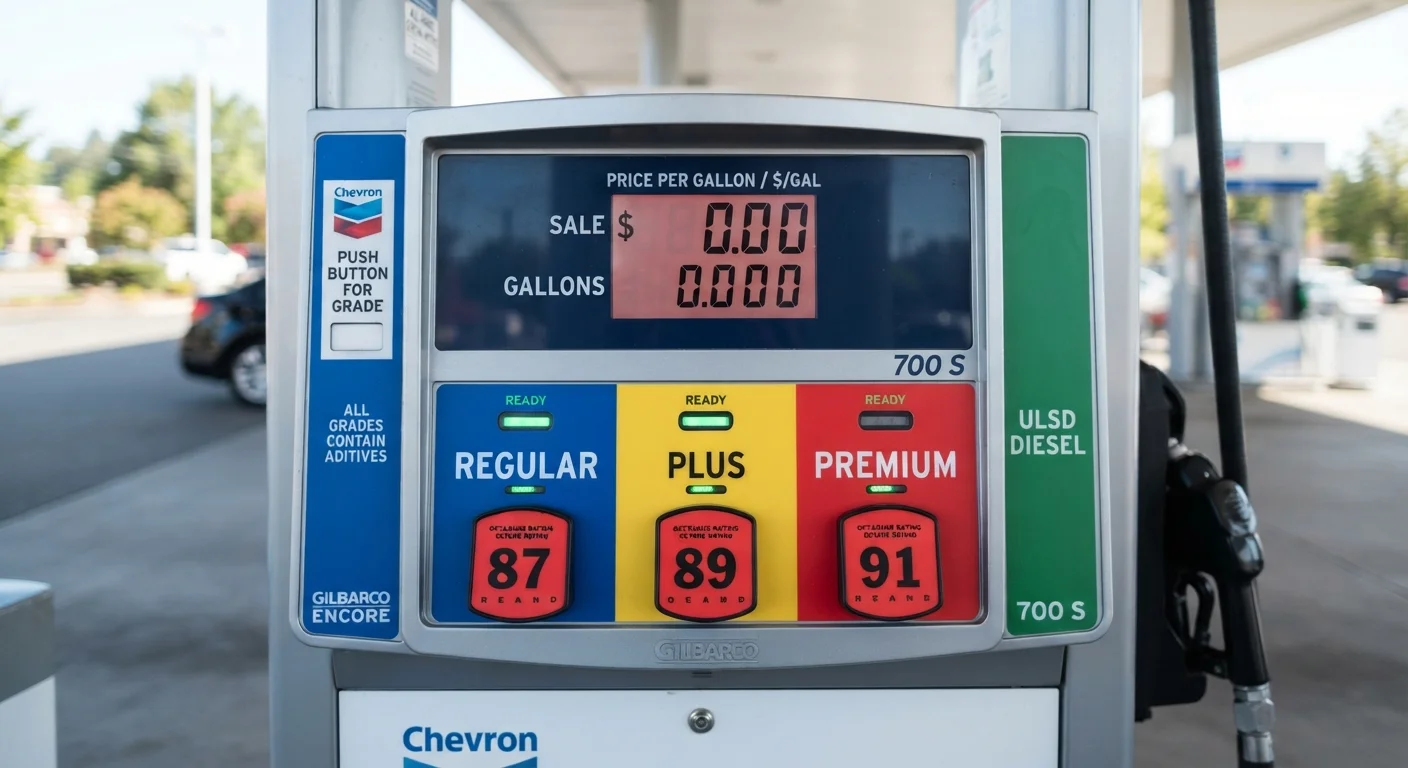
Walk up to any gas pump in the United States and you'll see three buttons: 87, 89, and 91 or higher. These numbers represent octane ratings - a measure of how well a fuel resists premature combustion inside the engine cylinder, commonly called knocking or pinging.
Contrary to popular belief, a higher octane number does not mean the fuel contains more energy or burns 'hotter.' It simply means the fuel is more resistant to igniting under pressure before the spark plug fires. For most engines, that distinction is irrelevant. For high-compression or turbocharged engines, it's critical.
The three grades available at the pump are:
- Regular (87 octane): The standard grade used by the majority of passenger vehicles on U.S. roads.
- Mid-grade (89 octane): A middle-tier option rarely specified by modern vehicle manufacturers.
- Premium (91-93 octane): Required or recommended for high-performance, turbocharged, or high-compression engines.
State regulations in the U.S. generally require that fuel labeled 'regular' meet a minimum of 85-87 octane, and 'premium' typically begins at 91. Exact labeling can vary slightly by state and retailer.
~70%
U.S. vehicles designed for regular 87-octane fuel
According to AAA research, the majority of passenger vehicles on American roads are engineered to run on regular unleaded gasoline.
$2.1B+
Estimated annual U.S. spending on unnecessary premium fuel
AAA estimated that American drivers collectively spend over two billion dollars per year on premium fuel in vehicles that don't require it.
91-93
Octane range classified as premium in the U.S.
The American Automobile Association defines premium gasoline as fuel with an octane rating of 91 or higher at U.S. retail pumps.
Required vs. Recommended: A Critical Distinction
The single most important thing you can do as a vehicle owner is open your owner's manual and find the fuel specification page. You'll see one of two terms: required or recommended. These words carry very different meanings.
When a manufacturer states that premium fuel is required, it means the engine was engineered around that octane level. Using a lower grade can cause knock - the sound of fuel igniting at the wrong moment - which stresses pistons, connecting rods, and cylinder walls. Modern vehicles include knock sensors that detect this and adjust ignition timing to reduce damage, but this adaptation comes at the cost of power and efficiency, and it has limits.
When premium is recommended (but not required), the engine is optimized for that grade but can tolerate regular fuel. Drivers in this category often run regular without noticeable problems, particularly during everyday, low-load driving. Performance-focused drivers or those in hotter climates may notice more benefit from sticking with premium.
Check the Fuel Door First
Before you reach the pump, look inside your fuel door. Many manufacturers print the required octane grade directly on a label there. If it says '87,' that's your answer - no need to second-guess. If it says 'Premium Required,' that's non-negotiable for the health of your engine.
For more on separating fact from fiction around fuel habits, see Car Maintenance Myths That Are Costing Drivers Money.
Why Paying More Doesn't Always Mean Getting More
A persistent myth is that premium fuel cleans your engine, improves acceleration, or delivers better mileage - regardless of what your vehicle actually needs. For an engine designed around 87 octane, none of that is true. Combustion engineers calibrate ignition timing, compression ratio, and fuel delivery to work precisely with the specified octane. Pouring in premium doesn't unlock hidden performance; the engine simply isn't configured to use it differently.
The cost difference adds up quickly. Over the course of a year, a driver using premium unnecessarily on a 15,000-mile annual driving cycle can spend a meaningful amount more at the pump with zero measurable return. That money is better directed toward the maintenance items that actually protect your engine - oil changes, air filters, and coolant flushes performed on schedule.
Understanding your fuel costs is part of the larger picture of smart ownership. Fuel Economy Myths That Are Costing American Drivers Money covers additional ways drivers spend more than necessary without realizing it. Similarly, aggressive driving habits can undermine fuel efficiency in ways that no octane upgrade will fix.
When Premium Is Non-Negotiable
Certain engines genuinely depend on premium fuel. Turbocharged engines, supercharged engines, and naturally aspirated engines with high compression ratios (generally above 10:1) all produce conditions inside the cylinder where lower-octane fuel can ignite unpredictably. Performance vehicles, many luxury sedans, and some trucks and SUVs fall into this category.
If you're buying a used vehicle and you're unsure of its fuel requirement, the fuel door label and owner's manual are your starting points. Your owner's manual also contains a broader maintenance schedule that affects far more than fuel - see Reading Your Vehicle's Maintenance Schedule Without Getting Overwhelmed for help making sense of it.
Bottom line: use the grade your manufacturer specifies. It's not a suggestion designed to sell more expensive fuel - it reflects how the engine was built to perform safely and efficiently over its lifespan.