

Key Takeaways
- R-value measures thermal resistance - higher numbers indicate better insulating performance.
- The right R-value depends on your climate zone and where in the home you're insulating.
- Attics typically require higher R-values than walls or floors due to greater heat loss at the top of a structure.
- The U.S. Department of Energy publishes recommended R-values by zip code and building zone.
- Combining insulation types or adding layers can help you reach recommended R-value targets.
Insulation R-Value
R-value is a number that measures how effectively insulation resists the flow of heat. The higher the R-value, the better the insulation slows heat moving in or out of your home. It applies to materials like fiberglass batts, spray foam, cellulose, and rigid foam boards. Think of it as a thermal resistance score - a higher score means your home stays warmer in winter and cooler in summer.
R-value is calculated per inch of material thickness and is additive - layers of insulation can be combined to reach a target total R-value. However, compressed insulation loses R-value proportionally.
What R-Value Actually Measures
R-value stands for thermal resistance - it quantifies how much a material slows the movement of heat. Heat naturally moves from warmer areas to cooler ones, whether that means your heated living room losing warmth through the ceiling in January or outdoor summer heat pushing into your air-conditioned rooms.
Every insulation product you'll find at a home improvement store carries an R-value label. A batt rated R-15 resists heat flow more than one rated R-11. Crucially, R-value is additive: if you install two layers that each provide R-19, you've achieved roughly R-38 total. This is why attic upgrades often involve adding new material over old rather than removing and replacing everything.
One common point of confusion: R-value measures resistance per unit of thickness, but the label on a product tells you the total R-value of that specific product at its rated thickness. Compressing a batt to fit a narrower space reduces its effective R-value - something worth keeping in mind when fitting insulation around obstructions.
R-Value Is Not the Whole Picture
R-value measures resistance to conductive heat flow, but it doesn't account for air leakage - which can significantly undermine insulation performance. A well-insulated attic with gaps around recessed lights or plumbing penetrations can still lose substantial heat. Air sealing those gaps before or alongside insulation upgrades is generally recommended by building professionals.
Why Your Location Changes the Recommended Number
The United States is divided into eight climate zones by the Department of Energy, ranging from the hot-humid Gulf Coast (Zone 1) to the bitterly cold northern states and Alaska (Zone 7-8). The colder your climate, the harder your heating system works - and the higher the R-value you'll need to adequately resist that heat loss.
For example, the DOE generally recommends attic insulation of around R-30 to R-49 in moderate climates and R-49 to R-60 in the coldest zones. Homes in Florida may be appropriately insulated at lower levels that would be wholly inadequate in Minnesota. You can look up your specific climate zone using your zip code on the DOE's website.
R-38 to R-60
Recommended attic R-value in coldest U.S. zones
According to U.S. Department of Energy climate zone guidelines for Zones 6-8, which cover the northern U.S. and Alaska.
~90%
U.S. homes estimated to be under-insulated
The North American Insulation Manufacturers Association has estimated that a large majority of existing U.S. homes fall short of current recommended insulation levels.
It's also worth noting that even within a state, zone recommendations can differ. Mountain regions sit in higher zones than coastal areas nearby. Always verify the zone that applies to your specific address rather than assuming based on your state alone.
How Recommended R-Values Vary by Location Within Your Home
Where in your home you're insulating matters just as much as where your home sits on the map. Heat rises, which means the attic is typically the biggest source of thermal loss - and it consequently gets the highest R-value recommendations.
- Attics: The DOE recommends R-38 to R-60 for most U.S. climates. This is often the single highest-impact upgrade a homeowner can make.
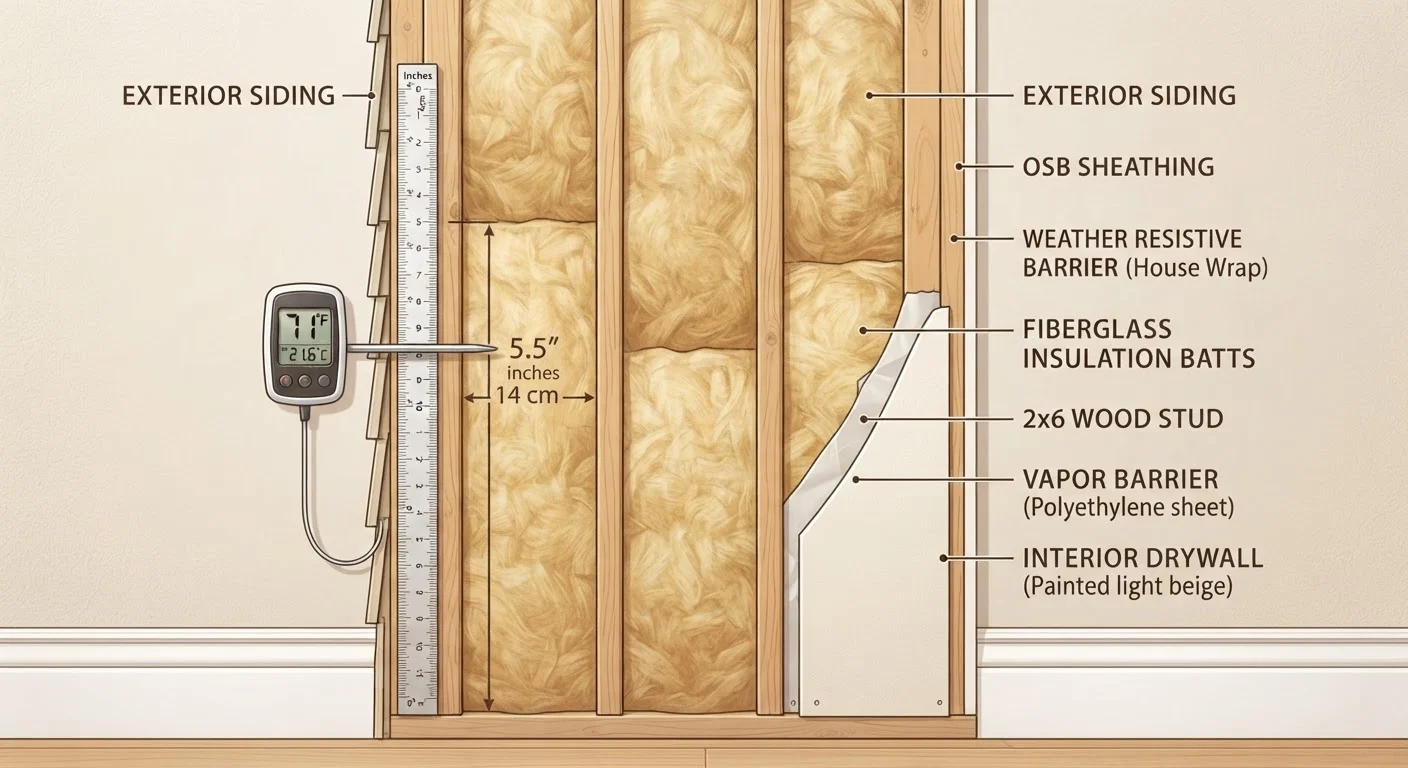
- Exterior walls: Recommendations typically fall between R-13 and R-21, limited partly by standard stud cavity depths. Continuous rigid foam on the exterior can supplement cavity insulation.
- Floors over unconditioned spaces: Ranges of R-19 to R-38 are common, depending on zone.
- Basement walls: Recommendations vary widely; in colder zones, finished basement walls benefit from R-10 to R-19.
If you're not sure where your home currently stands, an energy auditor can use tools like an infrared camera to identify where heat is escaping most significantly. Many utility companies offer subsidized audits - check with yours for available programs.
Start With a Free or Low-Cost Energy Audit
Before purchasing insulation materials or hiring a contractor, consider requesting a home energy audit. Many utility providers offer these at reduced cost or free to qualifying customers. An auditor can pinpoint your home's specific weak spots, so you can prioritize the upgrades that will have the most meaningful impact for your climate and home type.
Choosing Insulation Type to Hit Your R-Value Target
Different insulation materials offer different R-values per inch of thickness. When you have limited space - say, a 2x4 wall cavity - a higher-density material lets you achieve a better R-value without requiring more physical room.
Common options include fiberglass batts (roughly R-3.1 to R-4.3 per inch), mineral wool batts (R-3.7 to R-4.2 per inch), blown-in cellulose (R-3.2 to R-3.8 per inch), and closed-cell spray foam (R-6 to R-7 per inch). Open-cell spray foam offers lower R-values per inch but excellent air sealing.
There's no single material that's right for every situation - cost, moisture management, installation access, and fire ratings all factor in. For a deeper look at common misconceptions that trip up homeowners, see our guide to insulation myths, which covers why simply adding more material isn't always the complete answer.
When in doubt about what's appropriate for your specific home, consulting a licensed insulation contractor or building performance professional can help you avoid both under-insulating and spending unnecessarily on excess material.