

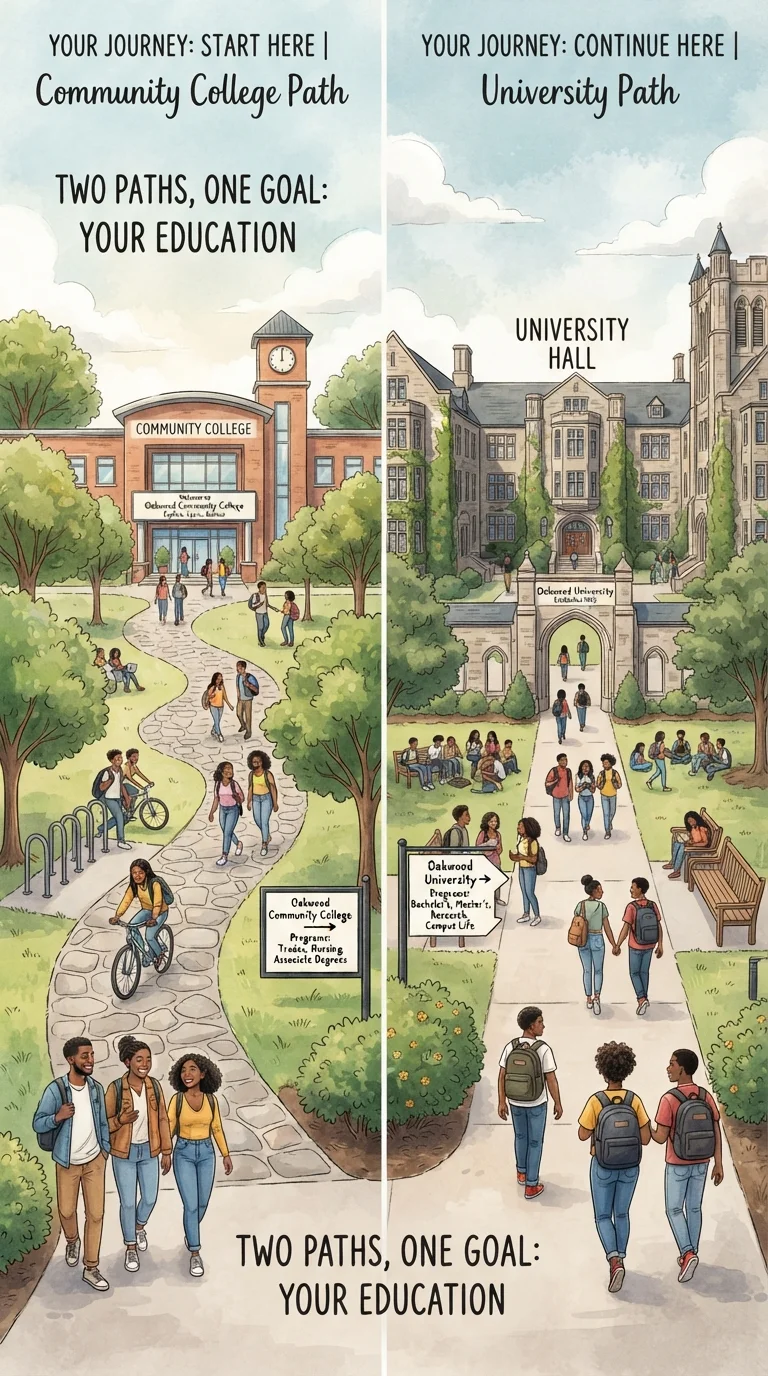
Key Takeaways
- Associate degrees typically take two years and cost significantly less than bachelor's degrees.
- Bachelor's degree holders generally earn more over a lifetime, though outcomes vary widely by field.
- Many associate degrees offer transfer pathways that allow students to continue toward a bachelor's degree.
- Neither credential is universally superior - the right choice depends on career goals, finances, and timeline.
- Some high-demand fields reward associate degree holders with strong salaries without requiring a four-year credential.
Option A
Associate Degree
The faster, lower-cost pathway to workforce entry.
Best for: Students seeking quicker workforce entry, lower upfront costs, or a foundation before transferring to a four-year program.
Option B
Bachelor's Degree
The broader, traditionally higher-earning credential.
Best for: Students targeting professions that require a four-year credential, or those seeking broader career flexibility and higher long-term earning potential.
If you want to enter the workforce quickly with manageable debt
Associate Degree
A two-year program cuts tuition costs roughly in half and gets you working sooner, which matters especially in fields like nursing technology, HVAC, or IT support.
If your target career explicitly requires a four-year credential
Bachelor's Degree
Fields such as accounting, engineering, social work, and most management roles set a bachelor's degree as a minimum requirement - an associate degree won't meet the bar.
If you're uncertain about your long-term career direction
Associate Degree
Starting with an associate degree at a community college with transfer articulation agreements lets you explore before committing to a specific major and institution.
If you're a career changer looking to pivot efficiently
Associate Degree
Targeted two-year programs in healthcare, IT, or skilled trades can retool your credentials faster and at lower cost than a second full bachelor's program.
If long-term earning potential and career mobility are top priorities
Bachelor's Degree
Bureau of Labor Statistics data consistently shows higher median weekly earnings and lower unemployment rates for bachelor's degree holders compared to associate degree holders.
Time and Cost: The Core Tradeoff
The most immediate difference between an associate and a bachelor's degree is commitment - in both time and money. Associate degrees are designed to be completed in roughly two years of full-time study, typically at a community college. Bachelor's degrees generally require four years at a college or university, though many students take longer.
On cost, the gap is substantial. According to the College Board, average annual tuition and fees at public two-year institutions are a fraction of those at public four-year universities, and the difference widens considerably at private four-year schools. When you factor in two additional years of living expenses, the total investment for a bachelor's degree can be two to three times higher. See our full breakdown of hidden bachelor's degree costs for a closer look at expenses beyond tuition.
| Criterion | Associate Degree | Bachelor's Degree |
|---|---|---|
| Typical Duration | ~2 years | ~4 years |
| Average Annual Tuition (public) | Lower (2-year college) | Higher (4-year university) |
| Median Weekly Earnings (BLS) | ~$1,000 | ~$1,400+ |
| Unemployment Rate (BLS) | Moderate | Lower |
| Transfer to 4-Year Degree | Often possible via articulation | N/A - terminal credential |
| Career Flexibility | Moderate - field-dependent | Broader across industries |
| Typical Institution | Community college | College or university |
For students with financial constraints or family obligations, the lower cost and shorter timeline of an associate degree aren't just convenient - they can be decisive.
Career Outcomes and Earning Potential
The Bureau of Labor Statistics (BLS) reports that bachelor's degree holders earn a higher median weekly wage than associate degree holders and experience lower rates of unemployment. However, these are averages across all fields, and the picture shifts significantly depending on the specific career path.
~$400
Weekly earnings gap (bachelor's vs. associate)
Bureau of Labor Statistics data shows bachelor's degree holders earn roughly $400 more per week at the median than associate degree holders.
2 years
Time saved with an associate degree
Full-time students can typically complete an associate degree in about two years, entering the workforce two years earlier than a bachelor's degree path.
~60%
Community college students who intend to transfer
According to the National Student Clearinghouse Research Center, a substantial share of community college students express intent to transfer to a four-year institution.
In some fields, an associate degree leads directly to well-compensated work. Registered nurses, dental hygienists, and certain IT roles can be entered with two-year credentials, and earnings in those occupations can rival or exceed those of many bachelor's-level jobs. In contrast, careers in engineering, business management, finance, and most licensed professions typically require a four-year degree as a floor, not a preference.
For field-specific data, salary outcomes by education path and industry offer a more granular view than national averages alone.
Transfer Pathways and Long-Term Flexibility
One feature of the associate degree that often goes underappreciated is its role as a stepping stone. Many community colleges have formal articulation agreements with four-year universities, guaranteeing that credits transfer toward a bachelor's degree. This allows students to complete general education requirements at lower cost before moving to a university setting.
This pathway isn't seamless everywhere - credit transfer policies vary by state and institution - but where articulation agreements exist, they represent a financially strategic route to a bachelor's degree. Students considering this approach should verify transfer guarantees directly with both institutions before enrolling.
For those weighing all available options beyond these two degree types, our comparison of trade schools, community colleges, and universities provides useful context. If a career change is the motivator, matching education options to your specific situation as a career changer addresses those distinct constraints directly.
This article is for general informational and educational purposes only and does not constitute financial, career, or academic advising. Individual outcomes vary; consult a qualified counselor or advisor for guidance tailored to your circumstances.