
Trade School, Community College, or Four-Year University: What Sets Them Apart

Key Takeaways
- Trade schools typically take six months to two years to complete and focus on specific skilled trades or technical careers.
- Community colleges offer two-year associate degrees and certificates at lower costs, often with transfer pathways to four-year universities.
- Four-year universities provide the broadest academic scope but require the longest time commitment and tend to carry higher total costs.
- The right choice depends on your career goals, financial situation, and how much time you can invest in training.
- Financial aid - including federal grants and loans - is available across all three education types, not just universities.
Our Verdict
No single education path is universally superior. Trade schools excel for learners targeting specific skilled careers quickly and affordably. Community colleges provide flexible, low-cost entry points with room to grow. Four-year universities open doors to the widest range of professional fields, particularly those requiring licensure or advanced study. Matching the path to your personal goals is what matters most.
| Best for | Recommended |
|---|---|
| Those seeking fast entry into skilled trade careers | Trade School |
| Those wanting affordable options or a stepping stone to a bachelor's degree | Community College |
| Those pursuing professions requiring a four-year degree or planning graduate study | Four-Year University |
| Adult learners balancing work, family, and education | Community College or Trade School |
Understanding the Three Paths
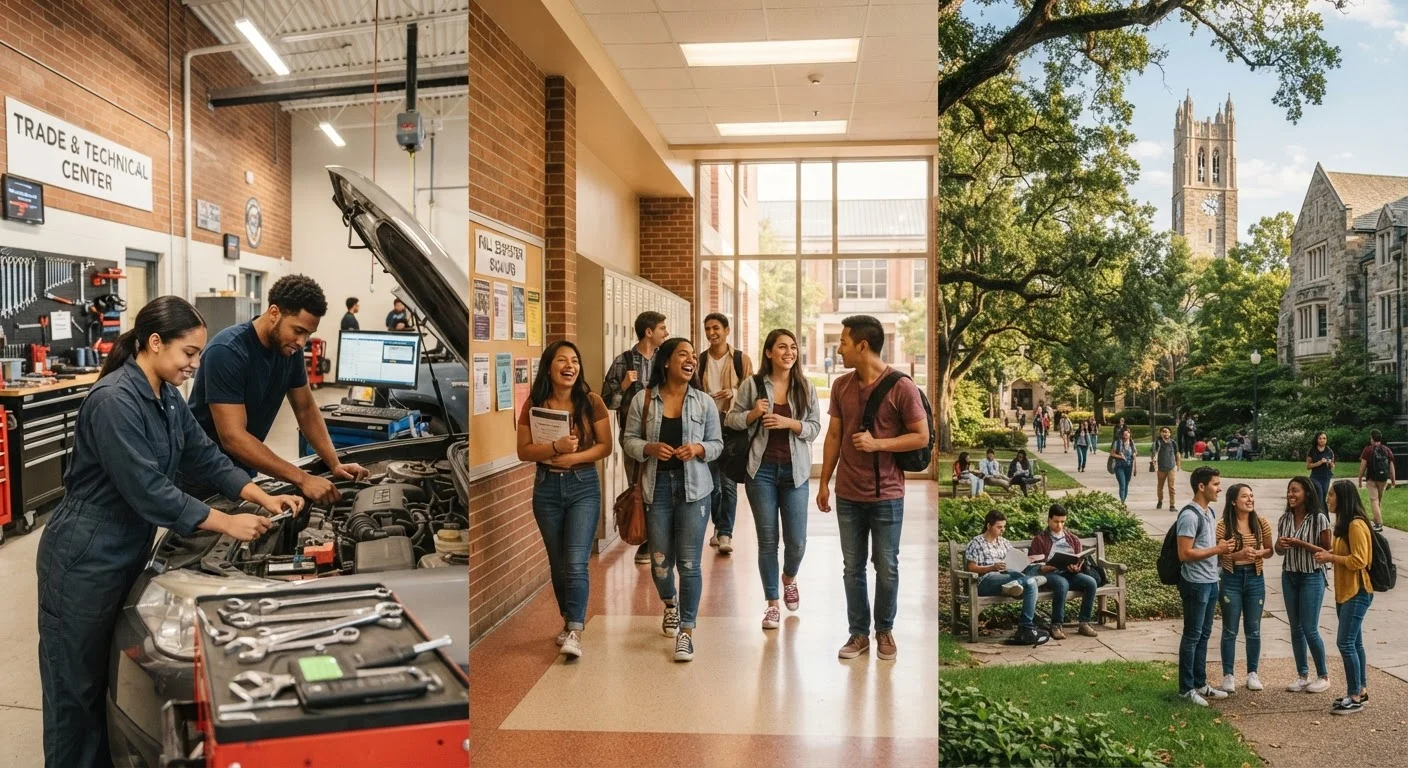
When it comes to formal education after high school, Americans have three primary institutional options: trade schools (also called vocational or technical schools), community colleges, and four-year universities. Each serves a distinct purpose, attracts different learners, and leads to different credentials. Understanding those differences at a structural level is the first step toward making a confident decision.
Trade schools are institutions focused exclusively on preparing students for specific skilled occupations - think electricians, medical assistants, HVAC technicians, welders, or dental hygienists. Programs typically run between six months and two years and award certificates or diplomas rather than academic degrees.
Community colleges are publicly funded institutions offering two-year associate degrees and shorter certificate programs. They serve a wide range of learners - recent high school graduates, working adults, and career changers - and many have formal transfer agreements with four-year universities.
Four-year universities (both public and private) award bachelor's degrees across a broad spectrum of academic and professional disciplines. Many also offer graduate and professional degree programs. Earning a bachelor's degree typically requires four years of full-time study, though timelines vary.
Key Differences: Cost, Time, and Credential
These three paths differ in ways that matter most to learners: what they cost, how long they take, and what credential you walk away with.
| Trade School | Community College | Four-Year University | |
|---|---|---|---|
| Typical Duration | 6 months - 2 years | 2 years | 4 years |
| Credential Awarded | Certificate or Diploma | Associate Degree or Certificate | Bachelor's Degree |
| Average Annual Tuition (general range) | $5,000 - $15,000 | $3,500 - $8,000 | $10,000 - $40,000+ |
| Curriculum Focus | Narrow, occupation-specific | Broad or career-focused | Broad academic and professional |
| Transfer Pathway Available | Generally no | Yes, to four-year schools | Graduate/professional programs |
| Federal Financial Aid Eligible | Often yes (if accredited) | Yes | Yes |
| Scheduling Flexibility | Moderate | High | Moderate |
Costs shown above are general ranges and vary significantly by institution, state, and program. For a detailed look at how funding options differ across each path, see our guide on financial aid across education types.
It's worth noting that a higher cost doesn't automatically mean a better return. The credential's value depends heavily on the field. A licensed electrician trained at a trade school may out-earn a bachelor's degree holder in an unrelated humanities field, at least early in a career.
Career Outcomes and Flexibility
Each path shapes your career options differently - and in ways that aren't always obvious upfront.
Trade school graduates enter highly specific career tracks. The training is hands-on and directly tied to employer needs, which often translates to faster hiring. However, if your career interests shift later, the credential may not transfer across fields.
Community college graduates have more flexibility. An associate degree in nursing or business provides direct employment pathways. Alternatively, transferring those credits to a four-year university - often through articulation agreements - allows learners to pursue a bachelor's degree without starting from scratch. This is a practical strategy for managing total education costs. Our article on associate vs. bachelor's degree tradeoffs explores this comparison in more depth.
University graduates tend to have the broadest career flexibility, particularly for fields that legally require a four-year degree - such as engineering, education, social work, or accounting. Graduate school and professional programs (law, medicine, business) also require an undergraduate degree as a prerequisite.
Check Accreditation Before You Enroll
Accreditation determines whether your credential is recognized by employers and whether you qualify for federal financial aid. For trade schools in particular, look for programmatic accreditation from bodies recognized by the U.S. Department of Education. Regional accreditation matters most for community college credits you plan to transfer to a university. Always verify a school's accreditation status directly through the Department of Education's database.
If you're navigating this decision after working in another field, choosing an education path as a career changer offers targeted guidance for your situation.
Who Thrives in Each Environment
Beyond credentials and costs, the learning environment itself matters. Consider how each institution is structured day-to-day.
Trade schools are typically intensive and applied. If you learn by doing - working with tools, equipment, or patients - rather than through lectures and essays, trade school may feel like a natural fit. Programs are usually smaller, with tight cohorts of students working toward the same credential.
Community colleges are designed for flexibility. Evening classes, online options, and part-time enrollment make them accessible for learners juggling work or family. They also tend to have strong advising services for adult students returning to education. See our guide on going to college as an adult learner for what to realistically expect.
Universities offer the richest academic environment - diverse course offerings, research opportunities, internships, and extensive alumni networks - but they also demand the most sustained time and financial commitment. Students who thrive tend to have a clear enough direction to commit to four or more years, or the flexibility to explore before declaring a major.
Before committing to any program, review key questions to ask before enrolling, including accreditation status and job placement rates.
This article provides general educational information and is not intended as personalized financial or career advice. Costs and program structures vary widely by institution and location. Readers should verify details directly with institutions and consult a qualified adviser for decisions specific to their circumstances.