

Key Takeaways
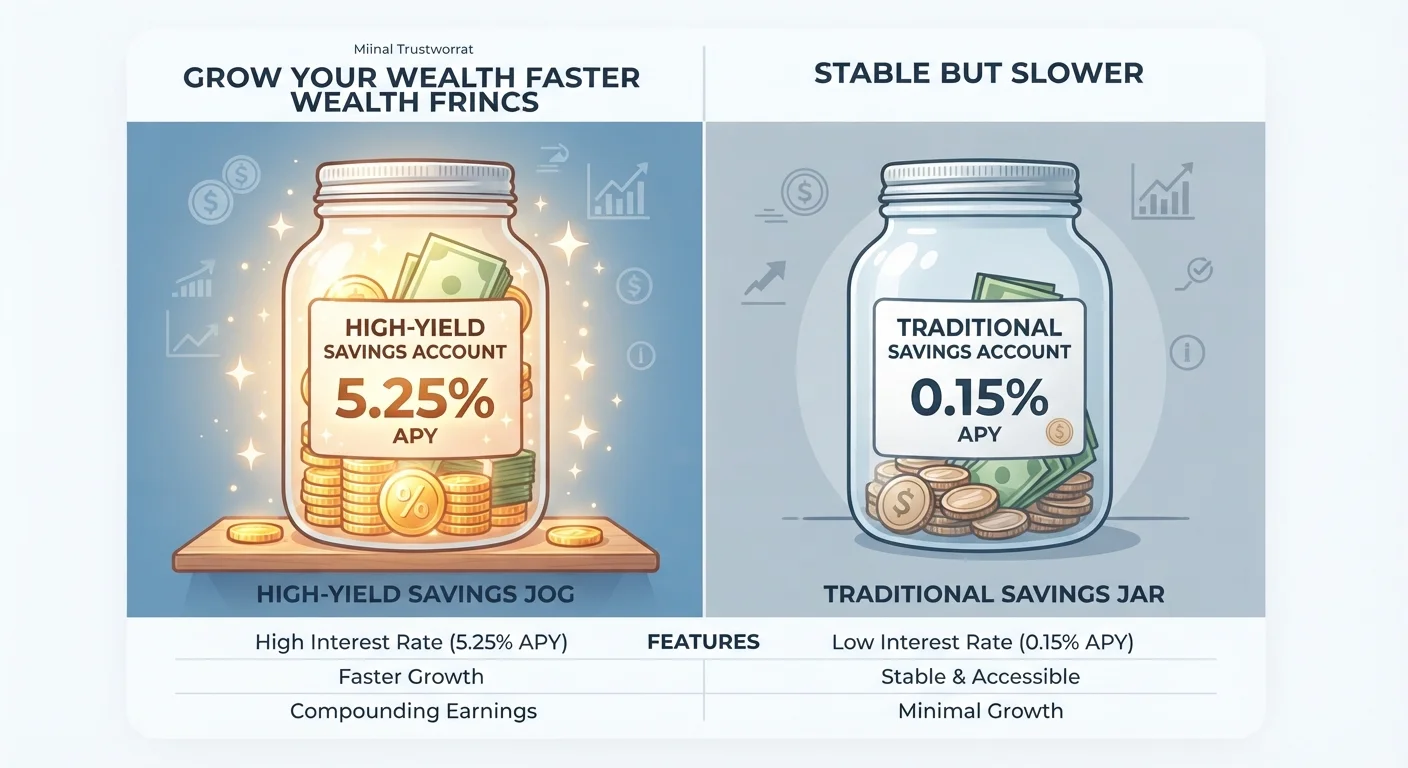
- High-yield savings accounts often pay significantly more interest than traditional savings accounts at the same FDIC insurance protection level.
- Traditional savings accounts offer convenience through branch access and seamless integration with everyday checking accounts.
- Both account types are federally insured up to $250,000 per depositor, per institution, making neither inherently riskier than the other.
- High-yield accounts are frequently offered by online banks, which may have fewer in-person service options.
- Your choice should align with your savings goal, how often you need access, and whether earning more interest meaningfully advances that goal.
Option A
High-Yield Savings Account (HYSA)
The higher-earning alternative for patient, goal-oriented savers.
Best for: Savers who want to maximize interest growth on an emergency fund or short-term financial goal without taking on investment risk.
Option B
Traditional Savings Account
The familiar, widely accessible foundation of everyday banking.
Best for: Consumers who value convenience, branch access, and keeping savings tightly linked to their existing checking account.
If you're building an emergency fund and won't need frequent access
High-Yield Savings Account (HYSA)
A higher APY means your idle cash earns more over time, which matters when you're holding three to six months of expenses in reserve.
If you prefer in-person banking or need seamless same-day transfers to your checking account
Traditional Savings Account
A savings account at your existing bank or credit union keeps things simple and may offer faster internal transfers with no friction.
If you carry high-interest debt and want to save simultaneously
High-Yield Savings Account (HYSA)
Every basis point of additional interest helps offset the cost of carrying debt. A HYSA at least ensures your safety net isn't losing ground to inflation.
If you're new to saving and want the lowest barrier to entry
Traditional Savings Account
Many traditional accounts have minimal opening requirements and are easy to open alongside an existing relationship with a bank or credit union.
What Sets These Two Account Types Apart
Both high-yield savings accounts (HYSAs) and traditional savings accounts serve the same core purpose: holding money safely while earning some interest. The critical difference lies in how much interest they pay and where they're offered.
Traditional savings accounts are what most Americans picture when they think of a savings account - offered by brick-and-mortar banks and credit unions, often with rates that have historically hovered near the federal minimum. High-yield savings accounts, by contrast, are most commonly offered by online banks or online divisions of larger institutions. Because these providers carry lower overhead costs, they routinely pass a larger share of interest income back to depositors.
It's worth understanding that interest rates on both account types are variable - they can and do change as the Federal Reserve adjusts the federal funds rate. Neither account locks in a rate the way a certificate of deposit (CD) would. For a broader look at how banks and credit unions differ in structure and priorities, see our article on credit unions and banks.
| Criterion | High-Yield Savings Account | Traditional Savings Account |
|---|---|---|
| Typical APY range | Often significantly above 1% | Often below 0.5%, sometimes near 0% |
| Where offered | Primarily online banks | Brick-and-mortar banks and credit unions |
| Branch access | Rarely available | Widely available |
| Transfer speed to checking | 1-3 business days (external transfers) | Same-day (internal transfers) |
| Federal deposit insurance | FDIC/NCUA up to $250,000 | FDIC/NCUA up to $250,000 |
| Minimum balance requirements | Varies; some have none | Varies; some have none |
| Best suited for | Emergency funds, goal-based saving | Everyday convenience, bundled banking |
Interest Rates: The Numbers That Matter Most
The interest rate differential between these account types is often the deciding factor for savers. Traditional savings accounts at large national banks have frequently paid annual percentage yields (APYs) well below 1% - sometimes as low as 0.01%. High-yield accounts, especially during periods of elevated federal interest rates, have offered APYs several times higher.
To put this in concrete terms: on a $10,000 balance, a 0.01% APY earns roughly $1 per year. At 4.50% APY, that same balance earns approximately $450 - a meaningful difference that compounds over time.
~0.01%
Typical APY at large traditional banks
The FDIC has historically reported national average savings rates well below 1% at many large brick-and-mortar institutions.
$449
Annual interest difference on $10,000
Illustrative comparison: 0.01% APY earns roughly $1/year vs. 4.50% APY earning roughly $450/year on a $10,000 balance.
$250,000
Federal deposit insurance limit per depositor
Both FDIC-insured banks and NCUA-insured credit unions protect deposits up to this amount per depositor, per institution.
That said, rate comparisons require context. Rates change frequently, and the highest advertised rate isn't always available without meeting specific conditions such as minimum balance thresholds or direct deposit requirements. Always read the fine print before opening any account.
Access, Convenience, and Practical Considerations
High earning potential comes with trade-offs. Most high-yield savings accounts are online-only, meaning there's no branch to walk into if you have a problem. Customer service is typically handled by phone, chat, or email. Transfers to an external checking account - even when fast - may take one to three business days depending on the institution.
Traditional savings accounts, particularly those bundled with your existing checking account, offer same-day internal transfers and in-person support. For savers who value that immediacy, or who are less comfortable with fully digital banking, this matters. If you're exploring everyday banking tools, weigh convenience alongside rate differences.
One practical overlap: both account types are insured by the FDIC (for banks) or the NCUA (for credit unions) up to $250,000 per depositor, per institution. Neither type is a riskier place to keep your money from a safety standpoint.
If you're also navigating debt while trying to save, this decision becomes part of a larger picture. Our article on saving while in debt addresses how to think through that balance honestly.
Choosing the Right Account for Your Goals
The right account isn't the one with the highest rate in isolation - it's the one that fits how you actually save. Ask yourself three questions:
- How often will I need to access this money? If it's a true emergency fund you hope to never touch, slower transfer speeds at an online bank are unlikely to matter.
- Will I be making regular deposits? Automating transfers into a high-yield account can accelerate growth significantly. Learn more in our piece on automating savings.
- Does the rate difference meaningfully change my outcome? On a small balance, the dollar difference may be modest. On a larger emergency fund or short-term savings goal, it adds up.
It's also worth noting that having both types isn't unusual. Some consumers keep a small buffer in a traditional savings account for fast access while parking the bulk of their reserves in a high-yield account.
This article is for general informational and educational purposes only and does not constitute personalized financial advice. Consult a licensed financial professional for guidance specific to your situation.