

| Regulatory body | FDA (federal) + AAFCO guidelines adopted by states |
| Ingredient list order | Descending by pre-cooking weight |
| AAFCO life stages recognized | Growth, reproduction, adult maintenance, all life stages (AAFCO Dog Food Nutrient Profiles) |
| "Supplemental feeding" label means | Not a complete diet - cannot be fed as sole food source |
| Guaranteed analysis shows | Min. crude protein & fat; max. crude fiber & moisture |
How Dog Food Labels Are Regulated
Dog food sold in the United States is regulated at two levels: federally by the Food and Drug Administration (FDA), and at the state level through guidelines set by the Association of American Feed Control Officials (AAFCO). AAFCO is not a government agency - it's a nonprofit that establishes model ingredient definitions and nutritional standards that most states adopt into law.
Every commercial dog food must display specific information on its packaging: the product name, net weight, manufacturer's name and address, a guaranteed analysis, an ingredient list, an AAFCO nutritional adequacy statement, and feeding directions. Understanding each element gives you a clearer picture of what you're actually buying.
| Regulatory body | FDA (federal) + AAFCO guidelines adopted by states |
| Ingredient list order | Descending by pre-cooking weight |
| AAFCO life stages recognized | Growth, reproduction, adult maintenance, all life stages (AAFCO Dog Food Nutrient Profiles) |
| "Supplemental feeding" label means | Not a complete diet - cannot be fed as sole food source |
| Guaranteed analysis shows | Min. crude protein & fat; max. crude fiber & moisture |
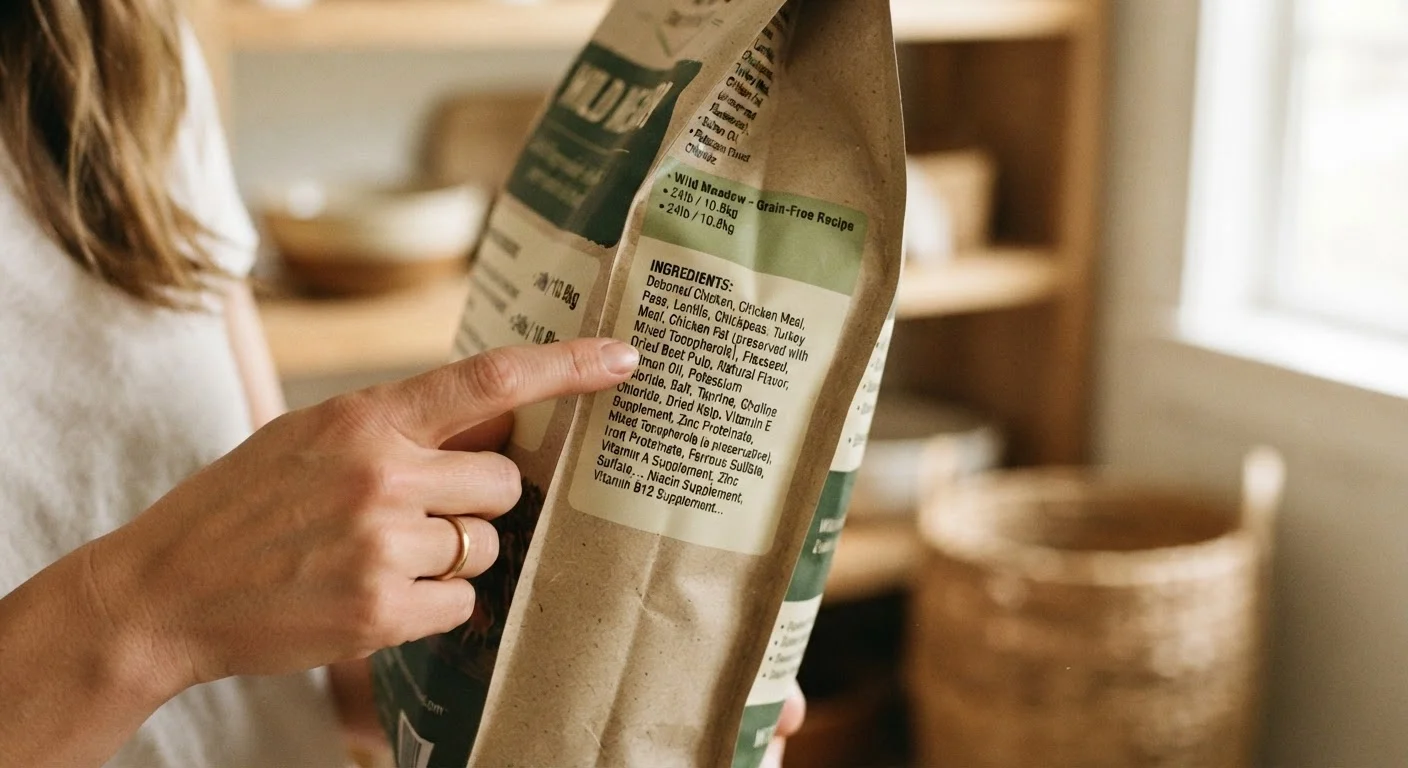
Reading the Ingredient List
Ingredients are listed in descending order by pre-cooking weight. That sounds straightforward, but moisture content complicates things. A whole meat like chicken contains roughly 70-75% water, so it may appear first on the list by raw weight - yet after cooking, its contribution to the finished product is significantly smaller than the weight-based ranking suggests.
Here's what some common ingredient terms actually mean:
- Chicken meal - Chicken with most moisture removed. Because it's already dry, a smaller volume delivers more concentrated protein than whole chicken. Its ranking in the list better reflects its actual contribution to the final product.
- By-products - Organ meats, lungs, and other non-muscle parts of an animal. These are not necessarily low quality; liver and kidney are nutrient-dense. The word "by-product" simply means it's not skeletal muscle meat.
- Meat and bone meal - A rendered mixture from various mammalian tissues. The species may not be specified, which is worth noting if your dog has protein sensitivities.
- Whole grains vs. fractions - "Brown rice" is a whole grain. "Rice bran" or "brewers rice" are fractions - less nutritious remnants of grain processing.
When evaluating an ingredient list, consider the first five to eight ingredients together rather than fixating on position one alone. Wet and dry foods differ significantly in how ingredients rank due to moisture differences - worth keeping in mind when comparing labels.
AAFCO
The Association of American Feed Control Officials. A nonprofit organization that establishes model definitions and nutritional standards for animal feed, including pet food, which most U.S. states adopt into regulation.
Crude Protein
A measure of total nitrogen-containing compounds in a food, used to estimate protein content. It does not distinguish between digestible and indigestible protein sources.
Meat Meal
A rendered, moisture-reduced protein ingredient made from animal tissues. Because water has been removed, it contains more concentrated protein per pound than whole meat.
By-Products
Non-muscle animal parts such as organs, glands, and other tissues. These are not inherently inferior - many are nutrient-dense - but the term signals they are not skeletal muscle meat.
Dry Matter Basis
A method of comparing nutrients in pet foods by removing the effect of moisture content. It allows accurate nutritional comparison between wet and dry formulas.
Nutritional Adequacy Statement
A required label statement indicating whether a pet food is complete and balanced for a specific life stage, and how that claim was validated - by nutrient profile formulation or actual feeding trials.
The Guaranteed Analysis and AAFCO Statement
The guaranteed analysis lists minimum percentages of crude protein and crude fat, and maximum percentages of crude fiber and moisture. These are not exact nutrient levels - they are guaranteed minimums or maximums the manufacturer must meet. To compare wet and dry foods accurately, you need to convert both to a dry matter basis by removing moisture from the equation (divide each nutrient percentage by the dry matter percentage).
The AAFCO nutritional adequacy statement is one of the most useful lines on the label. It tells you whether the food is complete and balanced, and for which life stage. Look for one of two phrases:
- "Formulated to meet the nutritional levels established by the AAFCO Dog Food Nutrient Profiles" - the recipe was designed to meet specific nutrient targets on paper.
- "Animal feeding tests using AAFCO procedures substantiate that provides complete and balanced nutrition" - the food was tested in actual feeding trials, a higher bar.
If the label says "for intermittent or supplemental feeding only," the food is not nutritionally complete and should not be a dog's sole diet. This phrasing often appears on treats or toppers.
For dogs with specific health conditions or unusual nutritional needs, a veterinarian or board-certified veterinary nutritionist can help interpret these labels in context. General label-reading skills are a good starting point, but they don't replace professional guidance for dogs with medical dietary requirements. A consistent feeding routine also plays a role in your dog's overall health alongside food quality.
This article provides general educational information about pet food labeling and is not a substitute for personalized veterinary advice. Consult your veterinarian before making significant changes to your dog's diet.