
Europe's Lesser-Known Capital Cities Worth Understanding Before You Dismiss Them

Key Takeaways
- Several European capitals receive far less visitor attention than their size, history, or culture warrants.
- Each overlooked capital has a distinct identity shaped by geography, history, and local life.
- Understanding a city's context before you visit leads to richer, more realistic expectations.
- Smaller capitals often offer walkable old towns, accessible museums, and fewer crowds than major hubs.
- Entry requirements, local conditions, and travel logistics vary - always verify with official sources before booking.
Why Some Capitals Get Skipped
When Americans plan a European trip, the same handful of cities dominate the itinerary: Paris, Rome, Amsterdam, Barcelona. That's understandable - those cities have earned their reputations. But Europe has dozens of national capitals, and many of them are genuinely distinct places with their own architecture, history, cuisine, and cultural rhythms that rarely make it into mainstream travel conversations.
Getting skipped doesn't mean getting outclassed. It often means a city lacks the marketing budget, the flight connections, or the Instagram presence of its larger neighbors. As the guide to reading destinations beyond their tourism branding explains, what a place promotes about itself and what it actually offers can differ considerably - and that gap is worth investigating.
The cities below aren't ranked or compared competitively. Instead, each profile offers a factual snapshot of what makes a lesser-known capital worth understanding on its own terms.
Ljubljana, Slovenia
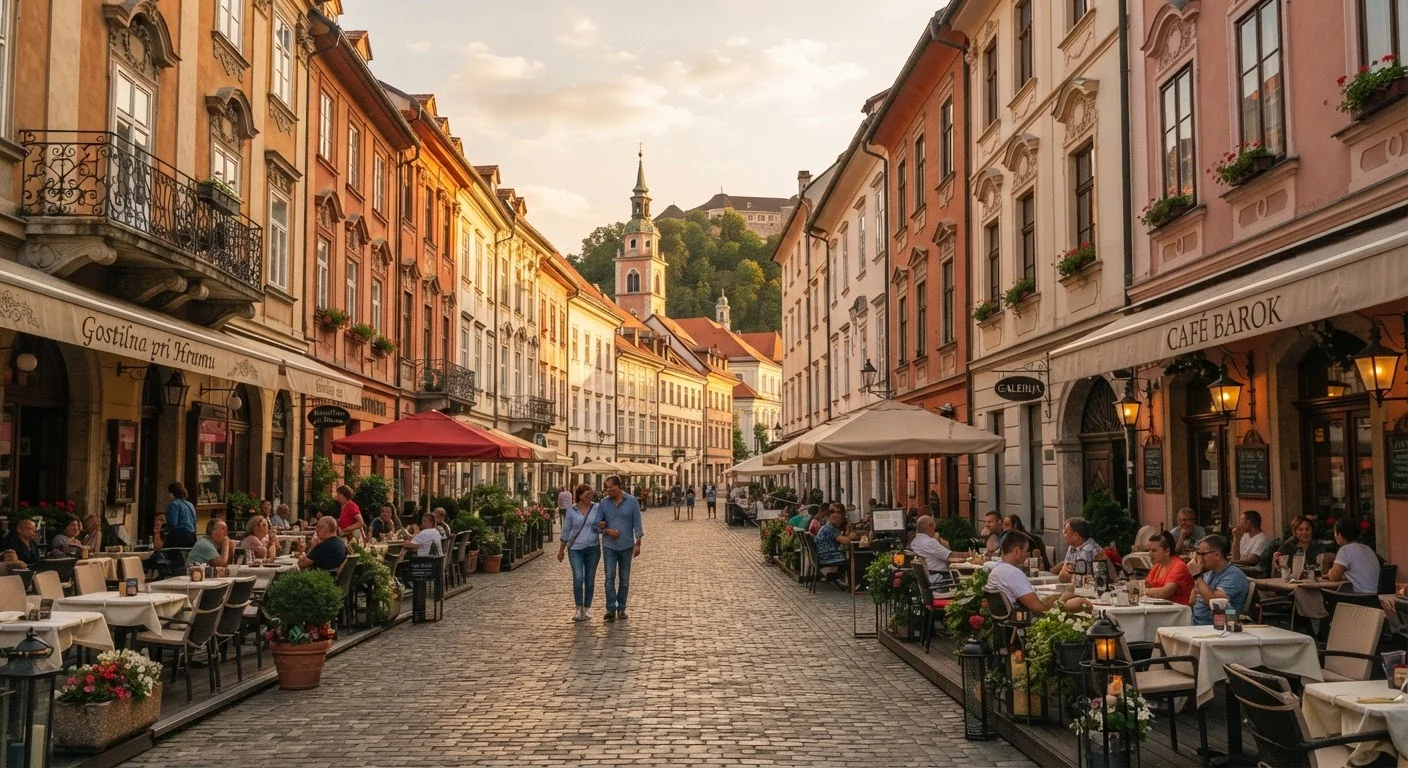
Ljubljana (pronounced lyoo-BLYAH-nah) is Slovenia's capital and home to roughly 300,000 people - making it one of the European Union's smallest capitals by population. The city is compact and highly walkable, centered on a medieval old town that climbs toward a hilltop castle overlooking the Ljubljanica River.
The city has a strong café culture, a well-preserved baroque and Art Nouveau streetscape, and a pedestrianized central district that keeps traffic largely out of the historic core. It's been recognized for sustainable urban planning initiatives. English is widely spoken, particularly among younger residents. Slovenia uses the euro, which simplifies budgeting for many American travelers already visiting Western Europe.
Ljubljana's pedestrianized core and castle-topped hill make it one of Europe's most walkable small capitals.
Valletta, Malta
Valletta holds the distinction of being the European Union's smallest capital city by area, covering roughly 0.8 square kilometers. What it lacks in size it compensates for in architectural density - the city is a UNESCO World Heritage Site, built largely in the 16th century by the Knights of St. John and defined by Baroque palaces, fortified walls, and panoramic harbor views.
Malta's official languages include English, making it unusually accessible for American travelers. The island has a complex layered history involving Phoenician, Roman, Arab, Norman, and British influence, all of which shaped its culture, architecture, and cuisine. Valletta is a starting point for understanding that broader Maltese identity rather than a single-day checkbox stop.
Valletta packs baroque architecture, harbor views, and centuries of layered history into under one square kilometer.
Nicosia, Cyprus
Nicosia is notable for being the world's last divided capital city. A UN-monitored buffer zone - commonly called the Green Line - has separated the southern, Republic of Cyprus-controlled part of the city from the northern, Turkish Cypriot-administered area since 1974. Crossing between the two sides is generally possible through designated checkpoints, though travelers should verify current crossing rules and any documentation requirements with official sources before visiting.
The city's old town, contained within Venetian-era walls, offers a concentrated look at its layered history. Each side of the divide has its own distinct character: different languages, currencies, and cultural references. Understanding Nicosia means grappling with its political complexity, which makes it one of the more intellectually substantive destinations on this list.
Nicosia is the world's last divided capital, where political history is literally written into the city's geography.
Podgorica, Montenegro
Podgorica doesn't attract the same attention as Montenegro's Adriatic coastline, and it's largely honest about that. The capital was heavily rebuilt after World War II and lacks a sweeping medieval center. What it does offer is a genuinely lived-in Balkan city with a young population, a growing café and arts scene, and proximity to dramatic natural landscapes including Skadar Lake and the Morača River canyon.
Travelers who approach Podgorica as a cultural base rather than a monument tour tend to leave with a more grounded sense of contemporary Montenegro. The city's relative obscurity means tourism infrastructure is still developing, so independent research into accommodation and transport options is advisable.
Podgorica works best as a cultural base for understanding modern Montenegro, not as a monument tour.
Skopje, North Macedonia
Skopje has an unusual visual identity that catches first-time visitors off guard. Following a major 2010 urban development project, the city center was populated with neoclassical statues, fountains, and ornamental facades - a deliberate effort to construct a monumental aesthetic in a relatively short time. Reactions to this project, known informally as Skopje 2014, vary widely among locals and visitors alike.
Beyond the central boulevard, Skopje has a well-preserved Ottoman old bazaar - the Čaršija - that predates the modern construction and represents a distinct layer of the city's history. The mix of architectural eras, the Ottoman, the socialist, and the recent neoclassical overlay, gives Skopje a character that rewards curious, contextual exploration over surface-level sightseeing.
Skopje's layered architectural eras - Ottoman bazaar, socialist blocks, and recent neoclassical overlay - make it genuinely unusual.
Vaduz, Liechtenstein
Vaduz is the capital of Liechtenstein, one of only two doubly landlocked countries in the world (meaning it's surrounded entirely by landlocked countries). The capital itself is a small town of around 5,000 residents, functioning more like a large village than a city in the conventional sense. It's notable for its perched castle - still the residence of the ruling princely family and not open to general visitors - and for being a functioning principality in the heart of modern Europe.
Liechtenstein uses the Swiss franc and has an open border with Switzerland. Many visitors pass through as a brief detour on a Swiss or Austrian itinerary. Understanding Vaduz means understanding Liechtenstein's unusual political and economic structure, which has made it a remarkably prosperous and stable microstate by most measures.
Vaduz is the capital of one of the world's only doubly landlocked countries - a genuine geopolitical curiosity in miniature.
Setting Realistic Expectations Before You Go
Smaller capitals come with real tradeoffs. Fewer direct flights, less English signage in some areas, and limited tourism infrastructure can make logistics more involved. On the other hand, many travelers find that reduced crowds and slower pace make the experience feel more authentic and less transactional.
Research logistics before assuming simplicity
Smaller capitals sometimes have limited direct flight options from the US, meaning connections through major hubs are often necessary. Budget extra time for research on local transport, currency, and any visa or entry requirements specific to each country. Official government travel advisory pages are the most reliable starting point.
If you've ever returned from a major city feeling underwhelmed, it's worth reading about why travelers return from cities disappointed - the culprits are often misaligned expectations and surface-level itineraries, not the destination itself. The same principle applies here: going in informed makes a measurable difference.
Travel conditions, entry requirements, local safety, and accessibility can change. Always verify current information through your government's official travel advisory site and the destination country's official tourism or consular resources before making any travel decisions.