

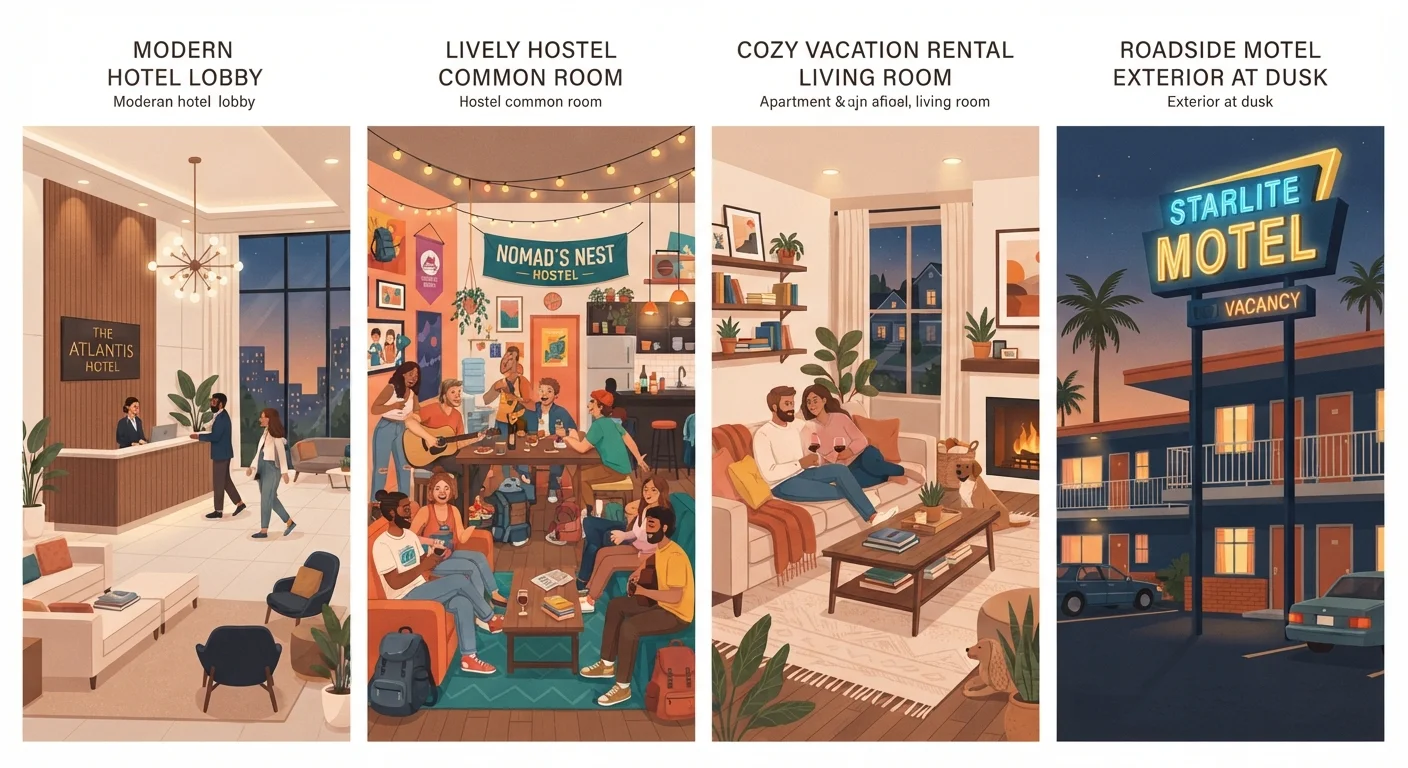
Key Takeaways
- Hotels offer consistency, amenities, and daily service but typically cost more per night.
- Hostels are the most budget-friendly option and best suited for solo travelers open to shared spaces.
- Vacation rentals work well for groups or extended stays where a kitchen and extra space matter.
- Motels provide no-frills, drive-up convenience for road trips with short, simple overnight stops.
Our Verdict
No single accommodation type wins across every trip. The right choice depends on how long you're staying, how many people are traveling, how much privacy you need, and what your budget can realistically support. Matching those factors honestly to each option saves money and prevents frustration on the road.
| Best for | Recommended |
|---|---|
| City travelers who value service, location, and consistency | Hotel |
| Solo travelers or backpackers prioritizing low cost and social interaction | Hostel |
| Families, groups, or anyone staying five or more nights | Vacation Rental |
| Road trippers needing a practical overnight stop | Motel |
Why Accommodation Type Matters More Than You Think
Where you sleep shapes far more than just your nightly bill. It affects how much cooking versus dining out you do, how much privacy you have, how easy it is to store luggage, and even how often you interact with other travelers. Before you search for the lowest price, it helps to understand what each category actually delivers - and what it doesn't.
For a deeper look at how your choice ripples through the entire trip experience, see how accommodation type shapes the whole trip experience. And if you're still building out your overall budget, building a realistic travel budget before you book anything covers how lodging fits into the full cost picture.
| Hotel | Hostel | Vacation Rental | Motel | |
|---|---|---|---|---|
| Typical cost structure | Per room/night | Per bed/night | Per unit/night + fees | Per room/night |
| Privacy level | High | Low (dorms) to medium | High | Medium |
| Best group size | 1-2 travelers | Solo or pairs | 3+ travelers | 1-2 travelers |
| Kitchen access | Rarely | Shared kitchen common | Full kitchen included | Rarely |
| Housekeeping | Daily | None or minimal | None (self-managed) | Often daily |
| Ideal stay length | 1-5 nights | 1-7 nights | 3+ nights | 1-2 nights |
| Location flexibility | Urban and resort areas | Mostly urban/tourist hubs | Broad - urban to rural | Highway corridors |
| Booking variability | Low - consistent quality | Low to medium | High - varies by listing | Medium |
Hotels: Reliable, Service-Oriented, and Broadly Available
Hotels offer a consistent experience: a private room, daily housekeeping, front-desk support, and on-site amenities that can include fitness centers, room service, and concierge help. That reliability has real value when you're traveling somewhere unfamiliar, arriving late, or simply don't want to manage logistics yourself.
The trade-off is cost. Hotels charge per room regardless of how many guests share it, which makes them less economical for larger groups. They also typically don't include kitchen access, so food expenses tend to be higher on hotel stays. That said, for one or two nights in a city - especially when location and walkability matter - a well-placed hotel often makes more practical sense than any alternative.
Ask What's Actually Included
Hotel rates can look similar on the surface but differ significantly once fees, parking, and resort charges are added. Always check the total price at checkout rather than the nightly base rate. A hotel in a walkable downtown can save on transportation costs even if the room rate is higher - factor in the full picture before deciding.
Hostels: Built for Budget Travelers and Social Connection
Hostels charge per bed rather than per room, usually in shared dormitory-style spaces with anywhere from four to twelve bunks. Common areas, shared bathrooms, and communal kitchens are standard. This setup keeps costs low and naturally creates opportunities to meet other travelers - which is part of the appeal for many.
Hostels work best for solo travelers or pairs who are flexible, comfortable with shared spaces, and prioritizing budget over privacy. They're less suitable for light sleepers, couples wanting quiet time together, or anyone traveling with children. Many hostels also offer private rooms at rates that still undercut comparable hotels, making them worth checking even if you prefer your own space.
Vacation Rentals: Space, Kitchen Access, and a Home Base Feel
Vacation rentals - entire apartments, houses, or cabins booked through various platforms - make the most economic sense when you have three or more people traveling together, or when you're staying long enough that cooking some meals yourself meaningfully reduces overall trip costs. You pay for the whole unit, so the per-person nightly rate drops quickly as group size increases.
The practical benefits go beyond price: a full kitchen, a living room to spread out in, laundry access, and the ability to stock groceries all add comfort on longer stays. The downsides include cleaning fees (often added at checkout), no daily housekeeping, and more variability in quality compared to hotel chains. Always read recent reviews carefully and verify the cancellation policy before booking - see key booking terms explained for what to look for.
Motels: Practical Stopovers for Drivers on the Move
Motels were designed around road travel: exterior-access rooms, parking right outside your door, and straightforward check-in with minimal formality. They tend to cluster along highways and at the edges of towns rather than in city centers. For a one-night stop during a multi-day road trip, that setup is genuinely convenient - you park once, sleep, and leave early without navigating a lobby or elevator.
Motel quality varies considerably, and amenities are generally minimal. Expect a bed, a bathroom, and perhaps a small TV - little more. They're rarely the right choice for a destination stay, but as a practical overnight tool on a driving route, they fill the role well and usually at a lower price point than hotels in the same area.
If you're thinking through a trip that mixes driving segments with city stops, your accommodation strategy may need to shift mid-trip. Understanding how each lodging type shapes the trip can help you plan those transitions intentionally.
Watch for Hidden Fees on Vacation Rentals
Cleaning fees, service charges, and security deposits can add a substantial amount to the advertised nightly rate - sometimes doubling the apparent cost for short stays. Always calculate the total cost for your full stay, including all fees, before comparing a vacation rental to a hotel. For short trips of one or two nights, a vacation rental is rarely the economical choice it first appears to be.