

Key Takeaways
- Accommodation type affects daily routine, budget, and overall trip atmosphere, not just sleep quality.
- Hotels offer consistency and services; vacation rentals provide space and a local-living feel.
- Hostels are built for social connection; campgrounds suit travelers prioritizing nature immersion.
- Group size, trip length, and destination all influence which accommodation type makes practical sense.
- Booking and cancellation policies vary widely - always read the fine print before committing.
Our Verdict
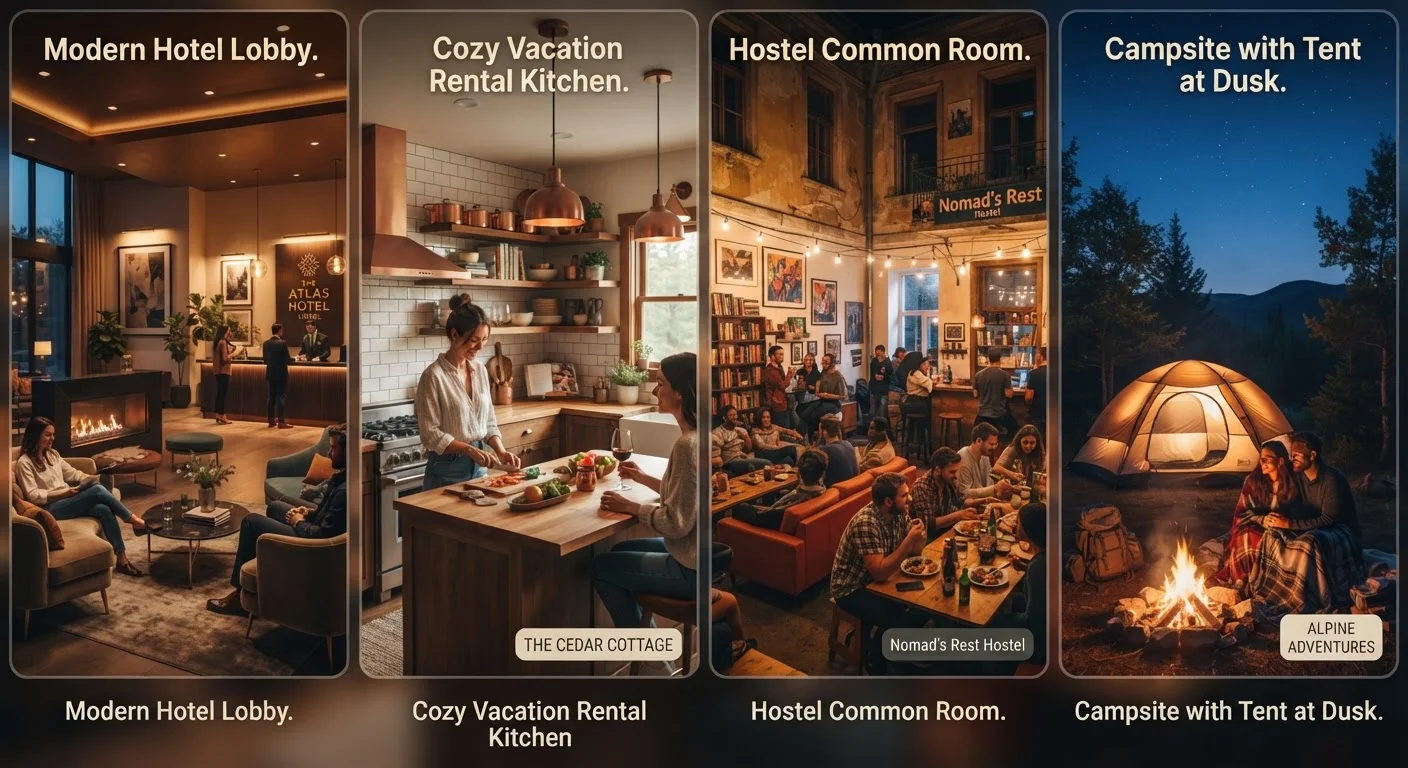
No single accommodation type is universally superior. Hotels reward travelers who value convenience and predictability. Vacation rentals suit groups or longer stays where cooking and space matter. Hostels work best for solo budget travelers eager to meet others. Campgrounds fit those whose trip is defined by outdoor experience. Matching the accommodation to the trip's purpose - rather than defaulting to habit - makes a measurable difference in how a journey feels from start to finish.
| Best for | Recommended |
|---|---|
| Travelers wanting convenience, services, and flexible scheduling | Hotels |
| Families or groups on multi-night stays who want to cook and spread out | Vacation Rentals |
| Solo or budget-conscious travelers seeking social experiences | Hostels |
| Outdoor enthusiasts for whom nature immersion is the point of the trip | Campgrounds |
Why Accommodation Is More Than a Place to Sleep
Most travelers think about accommodation last - after flights, destinations, and activities are decided. But where you stay shapes how a trip actually feels day to day. It affects how much you spend on meals, how easily you meet other travelers, how much prep work you do each morning, and whether the trip feels like an adventure or an errand.
Understanding what each accommodation type actually delivers - beyond square footage and price - helps you make a choice that fits your trip's purpose. A decision that looks smart on a spreadsheet can drain energy in practice if it's the wrong fit for how you travel. See how to build a realistic travel budget before you lock in any reservation.
Comparing the Four Main Accommodation Types
Each major accommodation category comes with a distinct set of trade-offs. The comparison below covers the criteria that matter most for everyday trip planning.
| Hotels | Vacation Rentals | Hostels | Campgrounds | |
|---|---|---|---|---|
| Typical nightly cost | Moderate to high | Varies; fees add up | Low to moderate | Low |
| Best trip length | 1-4 nights | 4+ nights | Any | 2+ nights |
| Privacy level | High | High | Low to moderate | Moderate |
| Social opportunity | Low | Low | High | Moderate |
| Kitchen access | Rarely | Yes | Shared kitchen | Outdoor cooking only |
| Self-sufficiency required | Low | Moderate | Low to moderate | High |
| Best suited for | Business, short stays | Families, groups | Solo, budget travelers | Outdoor enthusiasts |
| Cancellation flexibility | Often flexible | Often strict | Varies | Varies |
Keep in mind these are general patterns - a boutique hostel in a major city can rival a midrange hotel in comfort, and a well-equipped vacation rental may offer more amenities than a budget hotel. Context matters.
Hotels: Consistency, Services, and Flexibility
Hotels are the default for good reason. A standard hotel room delivers a predictable baseline: daily housekeeping, front-desk support, and usually a central location. For short trips - two or three nights - the simplicity is genuinely valuable. You arrive, drop your bag, and go.
The trade-off is cost and feel. Hotels rarely give a sense of living somewhere; they feel transactional by design. Meals add up quickly when there's no kitchen available. And in popular tourist areas, hotels cluster in places optimized for visitors, not necessarily for experiencing the local rhythm of a city.
Check Cancellation Terms Before You Book
Accommodation policies vary widely - some vacation rentals charge full price if you cancel within 30 days, while some hotels allow same-day cancellation. Always read the cancellation terms as part of your booking decision, not after. If your plans are likely to shift, prioritize flexibility even if it costs slightly more upfront.
For business travel, medical trips, or any journey where consistency matters more than immersion, hotels remain a practical anchor. They also tend to have the most flexible cancellation policies, which matters when plans are uncertain.
Vacation Rentals: Space, Autonomy, and a Local Feel
Vacation rentals - privately listed homes or apartments - shift the experience significantly. A kitchen means you control meal timing and cost. Multiple bedrooms mean a group of four doesn't need four separate hotel rooms. Living in a residential neighborhood, even briefly, changes how you interact with a place.
The catch: vacation rentals require more self-sufficiency. There's no front desk if something breaks, no daily towel swap, and check-in logistics can be complicated. Cleaning fees and minimum-stay requirements can also make short trips less economical than they appear at first glance. They tend to work best for stays of four nights or longer, for families, or for groups where shared space is genuinely useful. This detailed breakdown of accommodation types can help you weigh the specific trade-offs.
Hostels and Campgrounds: Social Connection and Nature Immersion
Hostels have evolved well beyond the barebones dorm experience. Many now offer private rooms alongside shared spaces, and the social infrastructure - common kitchens, organized activities, communal lounges - is the actual product. For solo travelers in particular, a hostel can provide a ready-made social context that a hotel room simply can't replicate. The difference between solo and group travel planning is relevant here: solo travelers often benefit most from the built-in community a hostel provides.
Campgrounds occupy a different category entirely. Choosing to camp isn't primarily a budget decision - it's a trip-philosophy decision. The accommodation is the experience. Early mornings, open skies, meals cooked over a camp stove - these define the trip rather than supporting it. That works beautifully when nature immersion is the goal; it's a poor fit when sightseeing or city exploration is the priority. Your packing strategy also shifts dramatically depending on whether you're camping or staying indoors.
Thinking through your broader itinerary structure before choosing accommodation helps ensure the two are working together rather than against each other.