

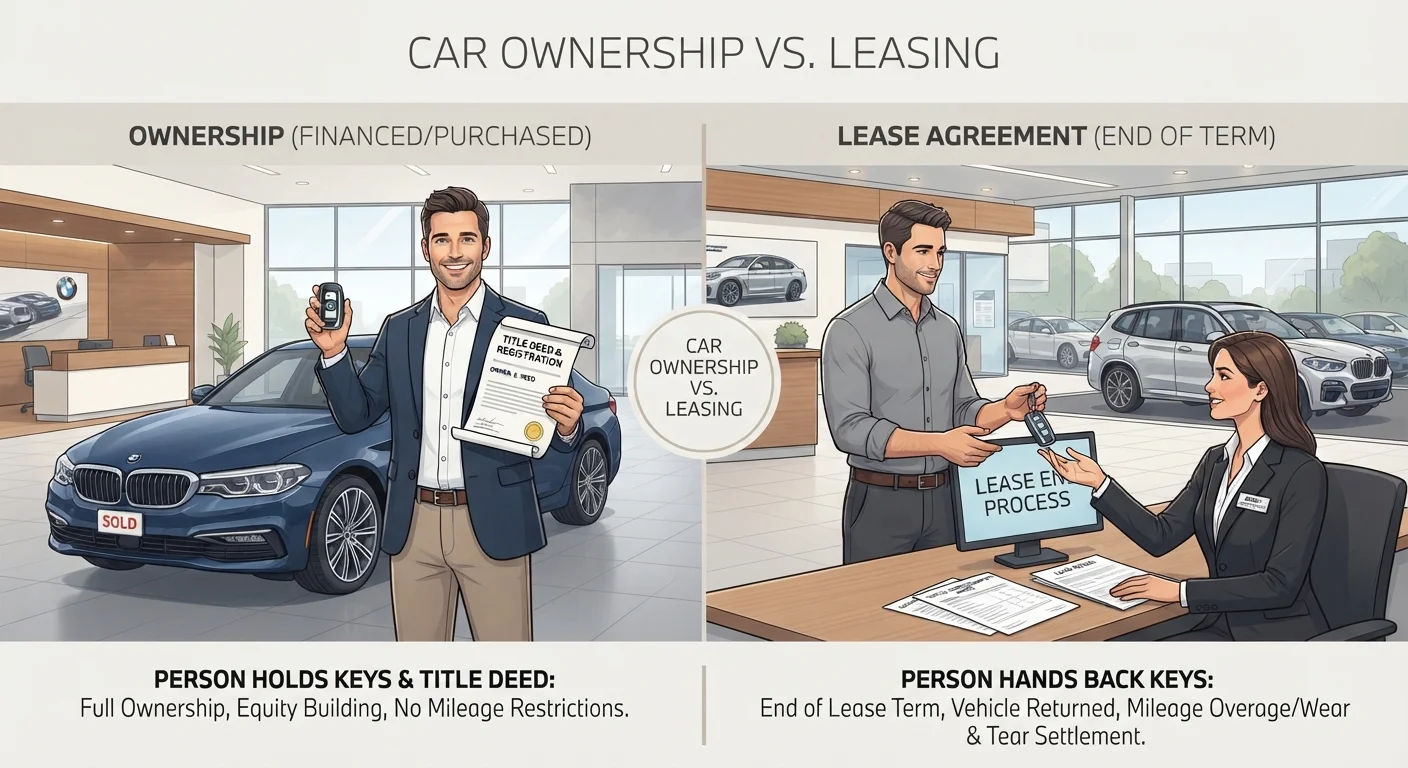
Key Takeaways
- Buying builds equity over time; leasing does not transfer ownership to the driver.
- Lease payments are typically lower month-to-month, but buying usually costs less over the long run.
- Leases carry mileage limits and condition fees that can add unexpected costs at return.
- Owners can modify, sell, or keep their vehicle indefinitely - lessees cannot.
- Insurance requirements and total cost of ownership differ meaningfully between both paths.
- Your driving habits, financial goals, and timeline are the key factors in deciding which fits you.
Option A
Buying (Owning)
The long-term, equity-building path.
Best for: Drivers who want to build ownership, drive without mileage restrictions, and eventually eliminate monthly payments.
Option B
Leasing
The lower-payment, shorter-commitment alternative.
Best for: Drivers who prefer lower monthly costs, like driving newer vehicles regularly, and keep annual mileage within typical limits.
If you drive more than 12,000-15,000 miles per year
Buying (Owning)
Most leases cap annual mileage at 10,000-15,000 miles, charging per-mile fees beyond that. High-mileage drivers typically fare better financially owning their vehicle outright.
If you want the lowest possible monthly payment right now
Leasing
Lease payments are generally lower than loan payments for the same vehicle because you're only financing the vehicle's depreciation during the lease term, not its full value.
If you plan to keep the vehicle for seven or more years
Buying (Owning)
Once a car loan is paid off, owners drive payment-free. Over a longer horizon, buying nearly always results in a lower total expenditure than cycling through successive leases.
If you prefer always driving a newer vehicle with the latest safety features
Leasing
A two- or three-year lease cycle lets you move into a new model regularly, often keeping you within the manufacturer warranty and benefiting from the newest driver-assistance technology.
If you want flexibility to modify or sell the vehicle on your schedule
Buying (Owning)
Owners have complete freedom to customize, sell, or trade in their vehicle at any time. Lessees are bound by contract terms, and modifications are generally prohibited or must be reversed.
The Core Structural Difference
When you buy a vehicle - whether with cash or an auto loan - you are purchasing an asset. If you finance, you make payments toward full ownership, and once the loan is repaid, you hold the title free and clear. The vehicle is yours to sell, trade, modify, or drive into the ground on your own terms.
When you lease, you are essentially renting the vehicle for a fixed term, typically 24 to 39 months. Your monthly payment covers the vehicle's projected depreciation during that period, plus interest (called the money factor in lease terminology) and fees. At lease end, you return the car - or in some cases exercise a purchase option at a predetermined price.
This structural distinction drives nearly every trade-off discussed below. For a deeper look at how the financial mechanics compare side by side, see our breakdown of the fundamental difference between leasing and buying.
| Criterion | Buying (Owning) | Leasing |
|---|---|---|
| Ownership | Full ownership after loan payoff | No ownership; return at term end |
| Monthly payment | Higher (full vehicle value financed) | Lower (depreciation only financed) |
| Long-term cost | Lower over many years | Higher with continuous lease cycles |
| Mileage limits | None | Typically 10,000-15,000 miles/year |
| Modifications allowed | Yes, at owner's discretion | Generally prohibited |
| Flexibility to exit | Sell or trade in at any time | Early termination fees apply |
| End-of-term options | Keep, sell, or trade in | Return, buy out, or re-lease |
| Maintenance responsibility | Owner's full responsibility | Owner's responsibility within lease terms |
Monthly Costs vs. Long-Term Costs
Lease payments are almost always lower than loan payments for an equivalent vehicle. That's because you're financing a portion of the car's value, not the whole thing. For drivers managing a tight monthly budget, this can be a genuine advantage.
Over time, however, the calculus often shifts. A buyer who pays off a five-year loan and drives the vehicle for another five years spreads the acquisition cost across a decade. A lessee who cycles through consecutive leases carries a perpetual monthly payment with no asset to show for it at the end.
~$1,500+
Typical average annual excess mileage cost for over-limit lessees
Industry estimates suggest drivers who exceed mileage caps by 5,000 miles at $0.25/mile face roughly $1,250 in fees at lease return, before any wear-and-tear charges.
6-8 years
Average length of time Americans keep a new vehicle
According to S&P Global Mobility data, the average age of vehicles on U.S. roads has risen steadily, suggesting many buyers hold their cars well beyond the typical loan term.
~20-30%
Typical new vehicle depreciation in first year
Automotive valuation sources consistently estimate new vehicles lose a significant portion of their value in year one, which is the core depreciation cost baked into lease payment calculations.
It's also worth accounting for the full picture of ownership costs - insurance, fuel, maintenance, and registration all apply whether you own or lease. Our article on the real costs of car ownership beyond the monthly payment walks through each of those categories in detail. If you're financing a purchase, the route you take for that loan also matters - see financing through a dealer vs. your own bank for a comparison of your options.
Restrictions, Flexibility, and Hidden Costs
Leases come with built-in constraints that buyers don't face. The most common are:
- Mileage caps: Contracts typically allow 10,000-15,000 miles per year. Excess mileage charges - often $0.15-$0.30 per mile - can add up to hundreds or thousands of dollars at lease end.
- Wear-and-tear standards: Lessees may be charged for damage deemed beyond normal use when the vehicle is returned. Minor dents, tire wear, and interior stains can trigger fees.
- Early termination penalties: Exiting a lease before the term ends is expensive and complicated. Buyers can sell or trade in their vehicle at any point, though negative equity (owing more than the car is worth) is its own risk to manage.
Owners also have full freedom to choose their insurance coverage structure, while lessees are typically required to carry higher liability and lower deductibles as specified in the lease agreement. Understanding the difference between coverage types is essential either way - our guide to comprehensive vs. collision coverage explains what each protects against.
For those considering a purchase, exploring new vs. used vehicle trade-offs is a useful next step, as the buying path includes its own set of variables around depreciation, warranty, and condition.
This article provides general educational information about vehicle financing structures and is not personalized financial or legal advice. Consult a qualified financial professional for guidance specific to your situation.