
A Driver's Complete Reference: Road Signs, Right-of-Way Rules, and Speed Limit Logic

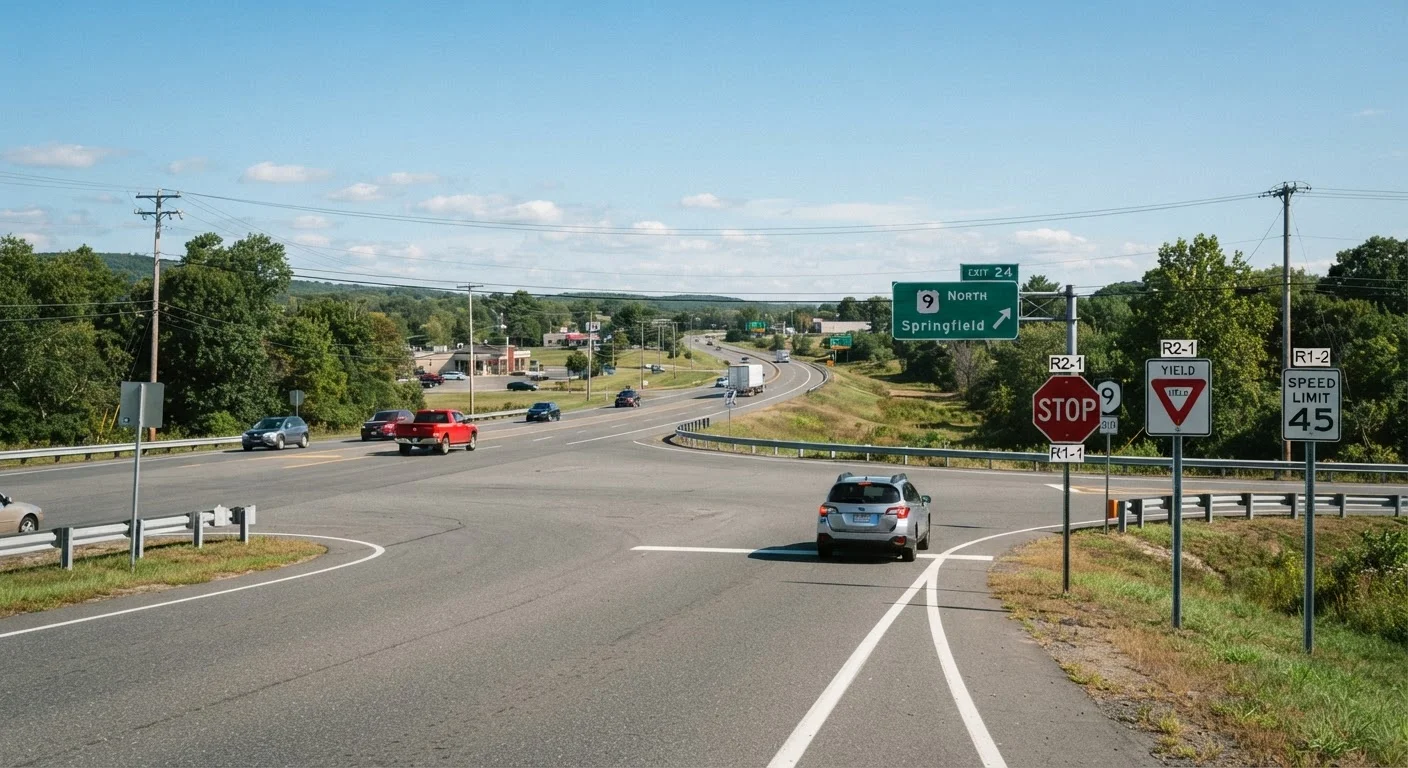
| Stop Sign Compliance | Complete stop required - rolling stops are illegal in all U.S. states |
| Residential Speed Limit (typical) | 25-30 mph (Varies by state and municipality) |
| Interstate Maximum (range) | 65-80 mph depending on state (State-set; Texas holds the highest posted limit at 85 mph on select roads) |
| School Zone Limit (typical) | 15-25 mph when children are present (Varies by state) |
| Move-Over Law Coverage | All 50 U.S. states have enacted some form of move-over law (National Conference of State Legislatures) |
| Right-of-Way at 4-Way Stop | First to stop proceeds first; ties go to the driver on the right |
U.S. Road Sign Categories at a Glance
Road signs in the United States follow a standardized system defined by the MUTCD, published by the Federal Highway Administration. Every sign's shape and color carries meaning before you even read the text.
MUTCD
The Manual on Uniform Traffic Control Devices, published by the Federal Highway Administration, sets the national standard for road signs, signals, and pavement markings across all U.S. public roads.
Right-of-Way
The legal right of a driver, pedestrian, or cyclist to proceed through a shared point before others. It is granted by law or traffic controls, never simply assumed.
85th Percentile Speed
A traffic engineering benchmark representing the speed at or below which 85% of vehicles travel under free-flow conditions. Often used as a reference point when establishing posted speed limits.
Move-Over Law
A law enacted in all 50 states requiring drivers to slow down and, where safe, shift lanes away from stationary emergency, law enforcement, or roadside service vehicles with lights activated.
Regulatory Sign
A road sign that legally requires a specific action or behavior from drivers, such as stopping, yielding, or observing a speed limit. Typically white with black or red markings.
Roundabout
A circular intersection where traffic flows counterclockwise around a central island. Entering drivers must yield to vehicles already circulating inside the roundabout.
Regulatory Signs
Regulatory signs - typically white with black or red text - carry the force of law. Stop signs, yield signs, speed limit markers, and no-turn signs all fall into this category. Ignoring them constitutes a traffic violation.
Warning Signs
Diamond-shaped yellow or orange signs alert drivers to upcoming hazards: sharp curves, pedestrian crossings, school zones, or merging traffic. They communicate conditions ahead, not commands.
Guide Signs
Green signs provide route and destination information on surface roads; blue signs indicate services such as fuel, food, and hospitals; brown signs mark recreational areas and cultural sites. These are informational rather than regulatory.
For new or returning drivers, our introduction to safe driving fundamentals covers how sign literacy fits into building core road habits.
Right-of-Way: Common Scenarios Explained
Right-of-way rules determine which driver proceeds first at a shared point. Misreading these situations is a leading contributor to intersection collisions. The rules below reflect general U.S. traffic law; always defer to your state's driver handbook for jurisdiction-specific nuances.
| Stop Sign Compliance | Complete stop required - rolling stops are illegal in all U.S. states |
| Residential Speed Limit (typical) | 25-30 mph (Varies by state and municipality) |
| Interstate Maximum (range) | 65-80 mph depending on state (State-set; Texas holds the highest posted limit at 85 mph on select roads) |
| School Zone Limit (typical) | 15-25 mph when children are present (Varies by state) |
| Move-Over Law Coverage | All 50 U.S. states have enacted some form of move-over law (National Conference of State Legislatures) |
| Right-of-Way at 4-Way Stop | First to stop proceeds first; ties go to the driver on the right |
Four-Way Stops
At an all-way stop, the first vehicle to come to a complete stop has the right of way. When two vehicles arrive simultaneously, the driver on the left yields to the driver on the right. When facing each other, vehicles turning left yield to oncoming traffic going straight.
Uncontrolled Intersections
Where no signs or signals govern an intersection, yield to any vehicle already in the intersection, then apply the right-side rule for simultaneous arrivals.
Roundabouts
Vehicles entering a roundabout always yield to traffic already circulating inside. Slow to a safe speed on approach, signal your exit, and do not stop inside the circle unless forced to by a collision risk.
Emergency Vehicles
Federal and state laws require drivers to pull to the right and stop when an emergency vehicle approaches with lights and sirens active. Most states also enforce a move-over law requiring drivers to slow and shift lanes when passing stationary emergency vehicles on the roadside.
Urban intersections add complexity - understanding how city driving differs from highway driving helps you adapt right-of-way instincts to denser traffic environments.
How Speed Limits Are Set - and Why They Matter
Speed limits are not arbitrary numbers. Transportation engineers and state authorities use several established methodologies to establish posted limits on any given road.
7-14%
Fuel economy lost per 5 mph above 50 mph
According to the U.S. Department of Energy, aggressive highway speeds meaningfully reduce fuel efficiency for most passenger vehicles.
~40%
Of fatal crashes occur at or near intersections
The Federal Highway Administration has identified intersections as one of the highest-risk environments in the U.S. road network.
The 85th Percentile Method
On many roads, traffic engineers conduct speed studies and set the limit near the speed at or below which 85% of drivers naturally travel under free-flow conditions. This approach is designed to reflect reasonable and safe behavior, though it is supplemented or overridden in school zones, residential areas, and construction zones where additional hazards exist.
Context-Based Limits
Residential streets typically carry limits of 25-30 mph; urban arterials range from 30-45 mph; rural highways commonly fall between 55-65 mph; and interstate freeways vary from 65-80 mph depending on the state. These ranges account for pedestrian density, intersection frequency, road geometry, and crash history.
Speed, Fuel, and Insurance
Driving at or near the posted limit has measurable practical benefits beyond safety. The U.S. Department of Energy notes that fuel economy drops significantly at speeds above 50 mph, with each 5 mph over that threshold reducing efficiency roughly 7-14%. Consistent speeding convictions also raise auto insurance premiums - sometimes substantially - making speed-limit compliance a financial consideration, not just a legal one.
Pairing speed discipline with defensive driving techniques creates a compounding safety benefit, giving you more time to react and more margin for error. Road surface conditions also affect how posted limits apply in practice - adjusting your speed for wet roads, black ice, and gravel explains when driving below the posted limit is the right call.
This article provides general traffic information for educational purposes. Traffic laws vary by state and locality - always consult your state's official driver handbook and applicable statutes for rules that govern your jurisdiction.