

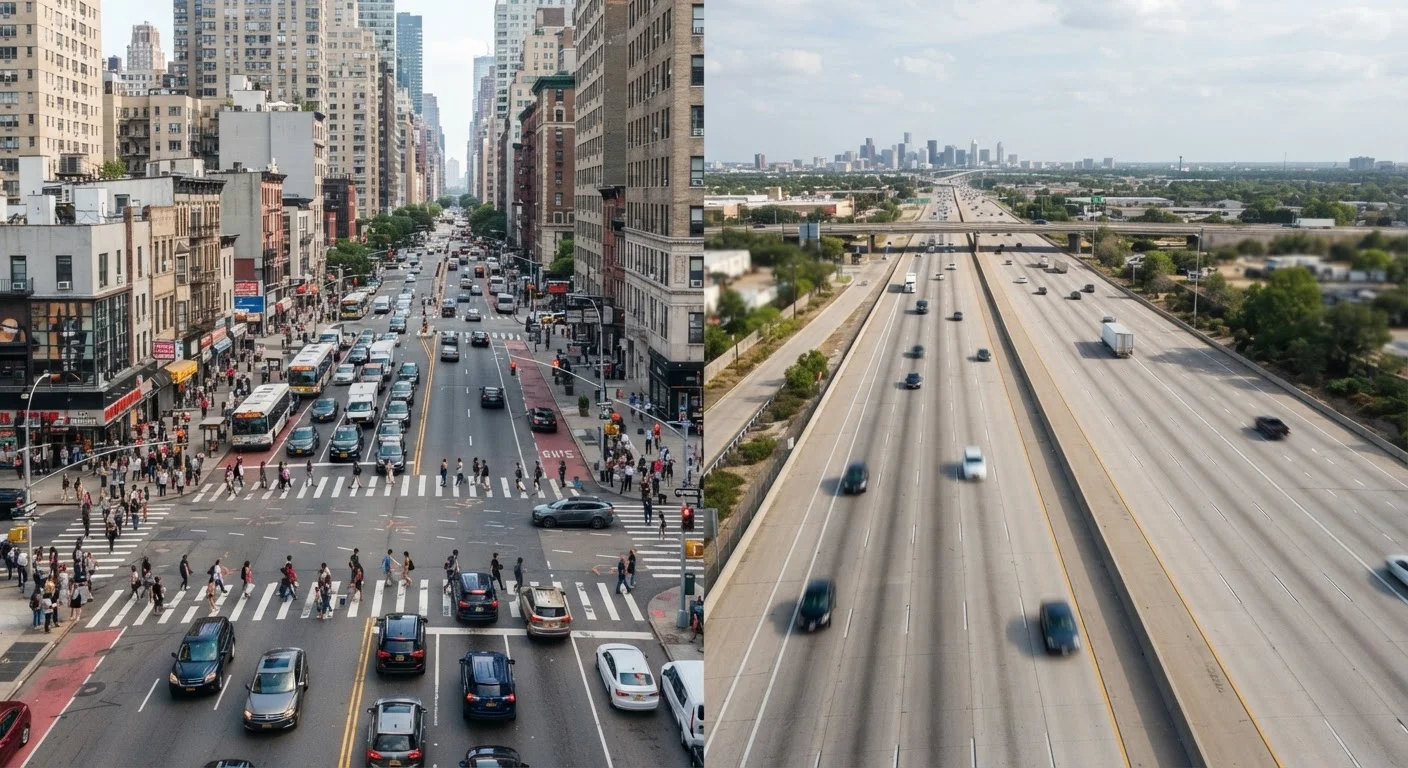
Key Takeaways
- City driving demands constant short-range attention, while highway driving requires broad, long-range scanning.
- Stop-and-go traffic is harder on fuel efficiency than steady highway cruising, but high-speed highway driving carries its own fuel penalty.
- Tailgating is dangerous in both environments but for different reasons - closing distance at highway speeds dramatically reduces reaction time.
- Smooth acceleration and gradual braking improve safety and fuel economy in both settings.
- Distraction risk differs by environment: city driving demands constant re-engagement, highway driving can cause complacency and fatigue.
- Your following distance, mirror-check frequency, and lane discipline strategies should adjust between urban and highway contexts.
Option A
City Driving
The high-attention, low-speed environment.
Best for: Drivers navigating dense traffic, pedestrians, cyclists, frequent signals, and unpredictable short-range hazards.
Option B
Highway Driving
The sustained-speed, long-range awareness environment.
Best for: Drivers covering longer distances at consistent speeds, managing merge zones, and maintaining alertness over extended periods.
If you primarily drive in dense urban areas
City Driving techniques
Prioritizing short-range hazard scanning, frequent mirror checks, and anticipatory braking will have the greatest impact on your daily safety and fuel costs.
If you regularly make long-distance or commuter highway trips
Highway Driving techniques
Maintaining proper following distance, using cruise control judiciously, and managing fatigue are the habits that matter most at sustained speeds.
If you drive both urban and highway routes regularly
Both - with deliberate transitions
Consciously shifting your mindset at on-ramps and off-ramps, not just your speed, is the key to staying safe across both environments.
Why the Two Environments Demand Different Skills
Most drivers treat every road the same way - they get in, buckle up, and go. But city streets and highways place fundamentally different cognitive and physical demands on a driver. Treating them identically is one of the quieter causes of both accidents and unnecessary fuel waste.
City driving is defined by density and unpredictability. Pedestrians step off curbs, cyclists lane-split, delivery vehicles double-park, and traffic signals compress decision-making into seconds. Your eyes need to work in a tight radius - scanning intersections, crosswalks, and the vehicle immediately ahead simultaneously.
Highway driving, by contrast, is defined by speed and sustained attention. The hazards are fewer but the consequences of missing them are more severe. At 65 mph, a car travels roughly 95 feet per second. A two-second lapse in attention covers nearly two hundred feet of road - enough to miss a rapidly slowing vehicle ahead. See our defensive driving fundamentals for a broader look at the principles that underpin both environments.
Head-to-Head: Key Differences at a Glance
The table below captures the core practical differences between the two driving environments across criteria that directly affect safety and efficiency.
| Criterion | City Driving | Highway Driving |
|---|---|---|
| Typical speed range | 15-45 mph | 55-75 mph |
| Primary hazard type | Pedestrians, cyclists, signals | High-speed merges, fatigue, tailgating |
| Recommended following distance | 2+ seconds | 3-4+ seconds |
| Fuel efficiency impact | Lower - stop-and-go cycles waste fuel | Higher at moderate speeds; drops at high speed |
| Mirror check frequency | Every 5-8 seconds, tight radius | Every 5-8 seconds, extended scan range |
| Main attention risk | Sensory overload, missed cues | Monotony, complacency, fatigue |
| Lane-change frequency | Higher - navigating intersections | Lower - minimize unnecessary changes |
| Cruise control use | Not appropriate | Useful on clear, flat stretches |
One difference worth elaborating: following distance. In city traffic, a one-to-two-second gap is often compressed by the nature of congestion - but drivers should aim for at least two seconds whenever possible. On the highway, the standard guidance from safety organizations is a minimum three-to-four-second gap, increasing in poor weather or low visibility. For more on adapting to difficult conditions, see adjusting for changing road surfaces.
Fuel Efficiency: How Each Environment Affects Your Tank
The mechanics of fuel consumption differ significantly between urban and highway driving. In city traffic, frequent acceleration from a stop, idling at red lights, and constant speed changes force the engine to work inefficiently. This is why most vehicles carry a separate city fuel economy rating - it's consistently lower than the highway figure.
~20-30%
Typical city vs. highway fuel economy gap
The U.S. EPA uses separate city and highway test cycles because stop-and-go driving consistently returns lower mpg than steady highway cruising for most vehicle types.
95 ft/sec
Distance traveled per second at 65 mph
At highway speed, even a two-second distraction means a vehicle travels nearly 200 feet without active driver input - a significant safety margin erased.
40%
Of fatal crashes occur on urban roads
According to NHTSA data, urban roads account for a substantial share of traffic fatalities, driven largely by pedestrian exposure and intersection conflicts.
On the highway, efficiency improves because the engine operates at a steady load. However, this advantage erodes at higher speeds. Aerodynamic drag increases with the square of speed, meaning driving at 75 mph rather than 65 mph can reduce fuel efficiency noticeably - the exact amount varies by vehicle. The practical takeaway: smooth, moderate-speed highway driving often returns the best real-world economy. Smooth acceleration and coasting are the single most transferable habits across both environments. Using cruise control on flat, clear highway stretches can help maintain that consistency - though it has limitations worth understanding. See our breakdown of when cruise control helps and when it hurts for more.
Safety Habits That Need to Shift Between Environments
Certain habits are universally good, but their application shifts depending on where you are driving.
Mirror Checks
In the city, checking mirrors every five to eight seconds helps track cyclists and vehicles changing lanes in tight spaces. On the highway, that same frequency remains important but your scan should extend further - looking well ahead and monitoring vehicles two or three car lengths back that may be approaching quickly.
Speed Management
Urban speed limits exist because the margin for error is razor-thin. A pedestrian stepping into a crosswalk at 30 mph gives a driver far more stopping distance than the same scenario at 40 mph. On highways, maintaining a consistent posted speed - not simply matching surrounding traffic flow - helps reduce the risk of rear-end collisions and keeps you within the limits your vehicle's braking system is designed to handle.
Distraction
Distraction affects drivers differently in each environment. City driving requires constant re-engagement - a glance at a phone may occur between lights, but conditions change instantly. Highway driving creates a false sense of security through monotony, which can invite phone use, mental drift, or drowsiness. Both are dangerous; the mechanisms differ.
Highway Fatigue Is a Real Safety Issue
Long, monotonous highway stretches can trigger drowsiness more quickly than drivers expect, particularly on routes with little visual variation. Safety organizations recommend taking a break every two hours or 100 miles on extended trips. If you feel drowsy, pulling off safely is always the correct response - no destination is worth the risk of microsleep at speed.
Lane Discipline
In city driving, frequent lane changes are sometimes necessary but should be deliberate and well-signaled. On the highway, unnecessary lane changes - especially in dense traffic - are a leading contributor to collisions. Choose your lane based on exit needs and traffic flow, and avoid lingering in blind spots of large vehicles.
For those new to either environment or returning after a break, a foundational review of core driving habits is a worthwhile starting point.