

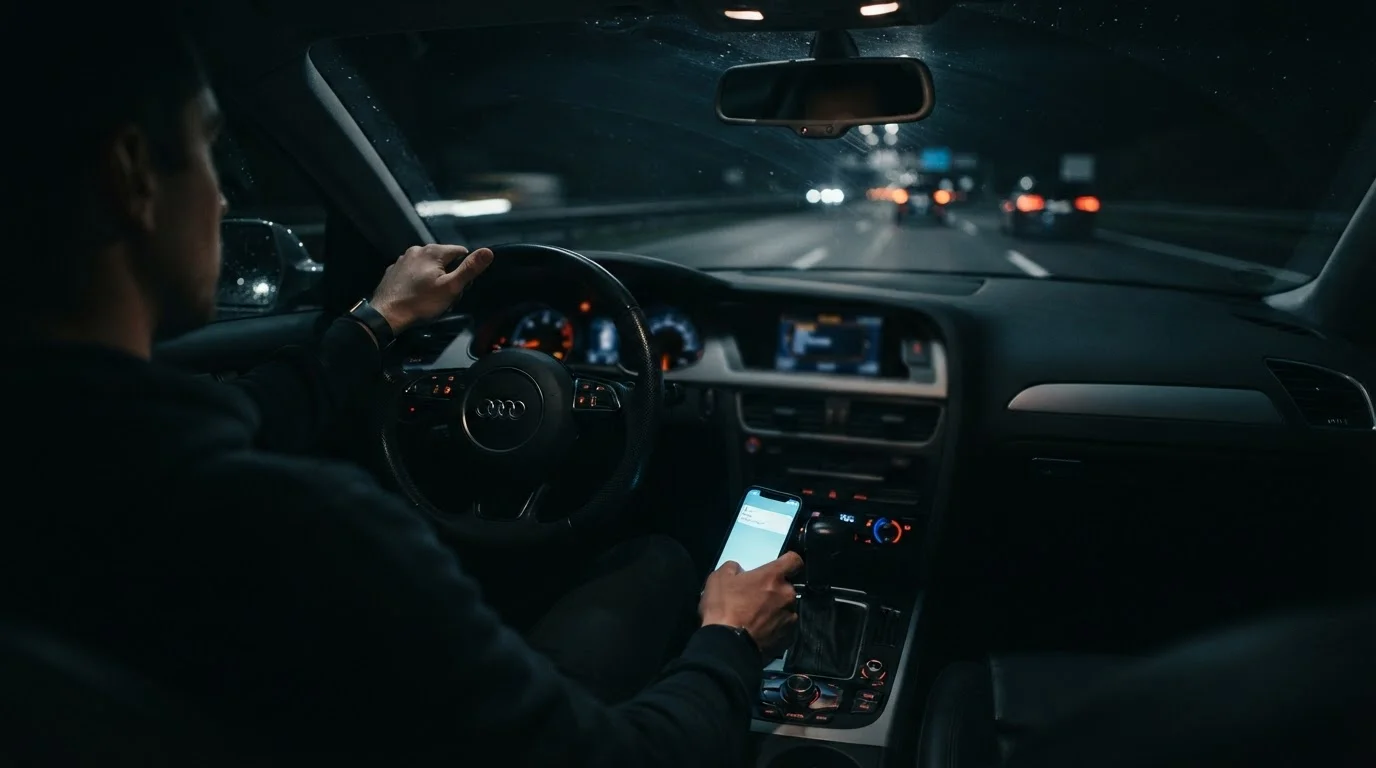
Key Takeaways
- Distracted driving includes three distinct types: visual, manual, and cognitive - phone use often combines all three.
- Research shows that even hands-free calls significantly impair reaction time compared to undistracted driving.
- Talking to a passenger is generally less dangerous than a phone call due to real-time situational awareness shared between both people.
- Distraction affects insurance risk profiles - habitual unsafe behaviors can influence premiums over time.
- Most drivers overestimate their ability to multitask behind the wheel, a well-documented phenomenon called 'inattention blindness.'
The Three Types of Distraction - and Why All Three Matter
Most drivers think of distracted driving as synonymous with texting. The reality is broader and more nuanced. Researchers and safety agencies categorize distraction into three distinct types:
- Visual distraction - taking your eyes off the road (glancing at a GPS screen, reading a text).
- Manual distraction - removing your hands from the wheel (eating, adjusting the radio, picking up a dropped item).
- Cognitive distraction - redirecting your mental attention away from driving (daydreaming, processing an emotional phone conversation).
The reason texting while driving is considered so dangerous is that it combines all three simultaneously. But activities that seem minor - tuning a radio station or replaying a frustrating conversation in your head - still qualify as distraction in at least one category. Understanding this framework is the first step toward building safer habits. For a broader look at safe driving foundations, see our practical introduction to safe driving.
Myth
Hands-free phone calls are safe because your eyes stay on the road.
Fact
Hands-free calls still cause significant cognitive distraction, impairing reaction time and situational awareness even when both hands are on the wheel.
This is one of the most persistent myths in driving safety. Legislation in many states permits hands-free device use while driving, which many drivers interpret as a safety endorsement. Research from the AAA Foundation for Traffic Safety found that hands-free calls produce a measurably elevated cognitive load compared to undistracted driving. Because the person on the other end of a call cannot see road conditions, they don't pause conversation when hazards arise - unlike an in-car passenger, who naturally adjusts. The result is sustained cognitive distraction even without a phone in hand.
Myth
Talking to a passenger is just as distracting as talking on a phone.
Fact
Passenger conversations are generally less cognitively demanding because passengers naturally respond to road conditions and pause when hazards arise.
This myth is understandable - both involve talking while driving. However, research distinguishes them in an important way. A passenger shares the driver's visual environment, which means they instinctively stop mid-sentence when they see heavy traffic, a pedestrian, or an emergency vehicle. Remote callers have no such context and maintain conversational demands regardless of road conditions. That said, highly emotional or distracting passenger conversations can still impair driving, and the risk increases significantly with teen drivers whose passengers may encourage risk-taking behavior.
Myth
You only need a split second to check a text - it's not a big deal at speed.
Fact
At 55 mph, a five-second glance at a phone covers the length of a football field traveled without your eyes on the road.
This statistic, frequently cited by NHTSA, translates abstract time into concrete distance in a way that illustrates the real stakes. A five-second phone glance may feel trivial, but at highway speed it means traveling approximately 100 yards without any processing of road conditions. During that interval, a vehicle ahead can brake suddenly, a child can enter the roadway, or a lane marker can be missed. Even a two-second glance produces a statistically significant increase in crash risk. The perception that brief glances are safe is a function of survivorship bias - most brief glances end without incident, reinforcing the mistaken belief that they are low risk.
Myth
Experienced drivers can handle more distraction because they're better at multitasking.
Fact
Driving experience does not eliminate the cognitive limits that cause distraction-related impairment - all drivers are subject to inattention blindness.
Experienced drivers do develop faster hazard recognition and more efficient vehicle control, but they are not immune to cognitive overload. Research consistently shows that inattention blindness - the failure to consciously perceive road events despite eyes being open and directed forward - affects drivers regardless of experience level. In some cases, experienced drivers may be more vulnerable to overconfidence bias, underestimating their distraction risk. No amount of driving history makes true multitasking neurologically possible; the human brain switches rapidly between tasks rather than processing them simultaneously, and switching has a cognitive cost.
Myth
Voice-to-text technology is distraction-free because you don't look at your phone.
Fact
Voice-to-text systems produce a moderate to high cognitive distraction load, with some systems scoring worse than hand-held texting in controlled research.
AAA Foundation research rated various voice-to-text systems on a cognitive distraction scale and found that many popular systems produced higher mental workload than expected - with some scoring in a high-distraction range. Errors in voice recognition require mental correction. Composing a coherent message verbally requires more sustained concentration than many drivers anticipate. While voice-to-text eliminates visual and manual distraction, the cognitive component remains significant and can be comparable to or worse than a phone conversation depending on the system and the complexity of the message.
What the Research Actually Shows
The data on distracted driving is both consistent and striking. Studies from the National Highway Traffic Safety Administration (NHTSA) and the AAA Foundation for Traffic Safety have documented measurable degradation in driver performance across all three distraction types - even when a driver feels fully in control.
~9 sec
Average distraction duration per phone interaction while driving
NHTSA research indicates that a typical phone-related task takes approximately nine seconds - nearly double the five-second figure used in football-field illustrations.
2-3×
Increased crash risk from hand-held phone use while driving
Multiple observational studies, including those cited by NHTSA, associate hand-held phone use while driving with a crash risk two to three times higher than undistracted driving.
~25%
Reduction in brain activity devoted to driving during phone calls
Carnegie Mellon University researchers found that listening to someone speak on the phone reduced the parietal lobe activity associated with driving by approximately 37% in brain imaging studies.
One of the most counterintuitive findings involves inattention blindness - a documented cognitive phenomenon in which a driver's eyes remain on the road, but their brain fails to process what it sees. Drivers engaged in cognitive tasks such as hands-free phone calls have been shown to miss traffic signals, pedestrians, and sudden stops that undistracted drivers catch reliably. This is why legislation permitting hands-free calls does not eliminate distraction risk entirely.
In city environments, where hazards appear and change rapidly, the consequences of even brief cognitive distraction are amplified. Our article on city driving vs. highway driving explores how situational demands vary and why attention management must shift accordingly.
Distraction also has a financial dimension. Insurers are increasingly using telematics and driving behavior data to assess risk. Erratic braking, sudden lane changes, and high-speed phone use patterns can affect your risk profile. For more on how driving habits translate to real insurance outcomes, see our overview of habits insurance companies pay attention to.
Building Habits That Reduce Distraction Risk
Awareness alone does not change behavior - structured habits do. Safety researchers and driving educators generally recommend a set of pre-drive and in-drive practices that reduce exposure to all three distraction types:
- Set navigation before you move. Entering a destination while stationary eliminates an ongoing source of visual and manual distraction during the trip.
- Use Do Not Disturb modes. Most smartphones have driving-specific modes that silence notifications automatically. Enabling them by default removes the temptation to glance at alerts.
- Pull over for complex conversations. If a call requires real decision-making or emotional engagement, finding a safe place to stop is a practical solution that addresses cognitive distraction directly.
- Eat before or after - not during. Eating while driving is one of the most underappreciated forms of manual distraction and is linked to slower reaction times in observational research.
- Prepare your environment. Adjusting mirrors, seat position, climate, and music before departure means fewer in-trip adjustments.
These habits integrate naturally with defensive driving principles - a discipline focused on anticipating hazards rather than simply reacting to them. Our guide to defensive driving techniques covers how situational awareness and proactive habits work together to reduce collision risk. The same principles apply equally on nighttime roads, where distraction compounds reduced visibility - see our piece on night driving demands and adaptations.
Distraction Risk Is Cumulative, Not Binary
Many drivers evaluate distraction on a pass-fail basis - either they're distracted or they're not. In practice, distraction compounds. A mildly fatigued driver listening to a podcast while navigating unfamiliar roads is stacking multiple cognitive loads. No single habit change eliminates all risk, but each reduction in distraction load meaningfully improves your ability to respond to unexpected hazards.