
Nutrient Density vs. Calorie Density: The Distinction That Changes How You See Food

Key Takeaways
- Nutrient density measures how many beneficial nutrients a food provides per calorie.
- Calorie density measures how much energy is packed into a given weight or volume of food.
- Two foods can share the same calorie count while delivering very different levels of nutrition.
- Neither concept alone tells the full story - both perspectives help you see food more clearly.
- Understanding these ideas supports more informed food choices without requiring calorie counting.
- Always consult a qualified healthcare professional for personalized nutrition guidance.
Option A
Nutrient Density
The measure of nutritional value relative to calories.
Best for: Evaluating how much vitamins, minerals, fiber, and protein a food delivers per calorie consumed.
Option B
Calorie Density
The measure of energy packed into a given amount of food.
Best for: Understanding how much energy - and how quickly - a food contributes to your daily intake by volume or weight.
If you want to feel fuller while eating a variety of foods
Nutrient Density
Foods high in nutrients and fiber tend to promote satiety without excess calories, making nutrient density a useful lens for day-to-day choices.
If you're trying to understand why some foods lead to overeating
Calorie Density
High calorie-dense foods pack a lot of energy into a small volume, making it easier to consume more than intended before feeling full.
If you're building a long-term, balanced eating pattern
Nutrient Density
Prioritizing nutrient-dense foods aligns with most evidence-based dietary approaches and supports overall health goals over time.
If you're evaluating portion sizes and energy balance
Calorie Density
Calorie density helps you understand how much food volume you're getting for the energy you're consuming, which can clarify portion decisions.
What Do These Terms Actually Mean?
You've probably heard that not all calories are created equal - but what does that actually mean in practice? The answer comes down to two distinct concepts: nutrient density and calorie density.
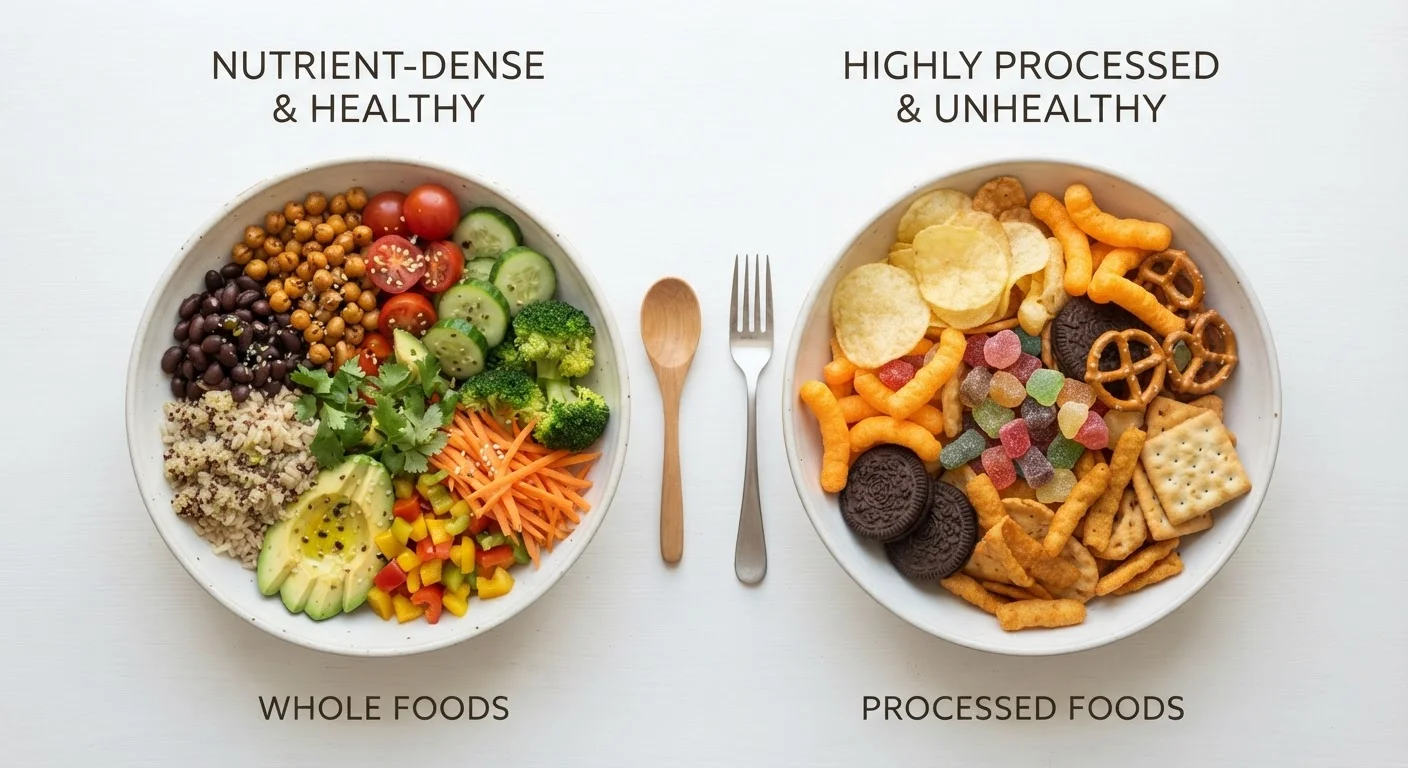
Nutrient density refers to how much nutritional value - vitamins, minerals, fiber, protein, and beneficial compounds - a food delivers relative to its calorie count. A food is considered nutrient-dense when it provides substantial nutrition without a disproportionately high calorie load. Think leafy greens, legumes, eggs, or whole grains.
Calorie density, on the other hand, describes how much energy is packed into a given weight or volume of food. A small handful of nuts, for example, is calorie-dense because it contains a large number of calories in a small physical amount. A large bowl of broth-based soup may contain far fewer calories for a much greater volume.
These two concepts are related but not the same. A food can be both nutrient-dense and calorie-dense (like avocados or salmon), or it can be calorie-dense but low in nutrients (like many ultra-processed snack foods). Understanding the difference gives you a richer picture of what food is actually doing for your body. For a deeper look at how to find this information on packaging, see how to read a Nutrition Facts label.
Comparing the Two: A Side-by-Side Look
To make these concepts concrete, it helps to place them side by side across several key dimensions.
| Criterion | Nutrient Density | Calorie Density |
|---|---|---|
| Core question answered | How much nutrition per calorie? | How much energy per gram or cup? |
| Primary focus | Vitamins, minerals, fiber, protein | Total caloric energy by volume |
| High example | Spinach, lentils, eggs | Oils, nuts, cheese, pastries |
| Low example | Soda, white rice crackers | Cucumbers, broth, leafy greens |
| Useful for | Evaluating overall dietary quality | Understanding portion size and satiety |
| Can a food score well on both? | Yes (e.g., salmon, avocado) | Yes (e.g., salmon, avocado) |
| Commonly used by | Nutrition researchers, dietary guidelines | Weight management and satiety research |
As the table illustrates, the two lenses answer different questions. Calorie density answers: How much energy am I getting per bite? Nutrient density answers: What else am I getting along with that energy? Both are useful - and neither alone tells the complete story.
For context, nutrition researchers and public health bodies often use nutrient density as a framework for evaluating dietary quality. Calorie density, meanwhile, is more commonly applied when thinking about portion size and overall energy intake. Learning to hold both ideas at once can meaningfully shift how you evaluate everyday food choices.
~87%
Americans not meeting vegetable intake recommendations
According to the CDC's Behavioral Risk Factor Surveillance System, the vast majority of U.S. adults fall short of recommended vegetable consumption - a key marker of nutrient density in the diet.
57%
Share of U.S. calories from ultra-processed foods
Research published in BMJ Open estimated that ultra-processed foods - which tend to be high in calorie density and low in nutrient density - account for more than half of daily caloric intake for many Americans.
3x
Volume difference: broccoli vs. potato chips (same calories)
A roughly 100-calorie serving of raw broccoli is approximately three times larger by volume than a 100-calorie serving of potato chips, illustrating calorie density in practical terms.
Why This Distinction Matters in Real Life
Consider two common breakfasts: a plain white bagel with cream cheese versus a bowl of oatmeal topped with fruit and a hard-boiled egg. Both might land in a similar calorie range, but their nutritional profiles are strikingly different. The oatmeal combination delivers fiber, protein, complex carbohydrates, and micronutrients. The bagel and cream cheese provides mostly refined starch and saturated fat, with comparatively little else.
This kind of comparison isn't meant to shame any food choice - it's meant to illustrate that calorie equivalence doesn't mean nutritional equivalence. When you start seeing food through both lenses, patterns emerge: foods that give you more for each calorie, and foods that deliver energy without much else.
These insights connect naturally to understanding macronutrients - because the type of calorie (carbohydrate, fat, or protein) also shapes how your body responds to food, not just the total count.
It's also worth noting that calorie density isn't inherently bad. Healthy fats from olive oil, nuts, and fatty fish are calorie-dense foods that contribute meaningfully to nutrition. Context matters more than any single metric.
Not All Calorie-Dense Foods Are Equal
It's easy to conflate 'calorie-dense' with 'unhealthy,' but that's an oversimplification. Nuts, seeds, olive oil, and fatty fish are all calorie-dense foods with well-documented nutritional benefits. The concern arises when calorie-dense foods are also nutrient-poor - a combination common in ultra-processed products. Judging food quality requires looking at the full picture, not just energy content.
Putting It Together: A More Helpful Way to Think About Food
Once you understand both concepts, you can use them together as a practical framework - without obsessing over numbers. Foods that are high in nutrient density and moderate in calorie density tend to be the backbone of most well-researched eating patterns. This is reflected in approaches like the Mediterranean diet and DASH, which you can explore in our comparison of popular eating patterns.
A few grounding principles worth keeping in mind:
- Vegetables, fruits, legumes, and whole grains are generally high in nutrient density.
- Heavily processed foods tend to be calorie-dense and nutrient-light.
- Some calorie-dense foods - nuts, seeds, avocado, oily fish - are also genuinely nutrient-rich.
- Volume matters: lower calorie-density foods can help you feel satisfied on fewer calories.
If you'd like to see how these principles translate to an actual meal, our guide on building a balanced plate walks through practical applications that work across most dietary styles.
This article is for general informational and educational purposes only and is not a substitute for personalized medical or nutritional advice. Please consult a qualified healthcare professional before making significant changes to your diet.