

Key Takeaways
- Drip irrigation delivers water directly to plant roots, cutting evaporation compared to overhead sprinklers.
- Setup requires planning your layout, selecting appropriate emitters, and connecting to a water source.
- The system works especially well for vegetable gardens, raised beds, and shrub borders.
- Clogged emitters and upfront costs are the most common practical drawbacks homeowners encounter.
- Pairing drip irrigation with a timer and pressure regulator maximizes efficiency and reduces maintenance.
Significantly reduces water waste versus overhead sprinklers
Water is delivered slowly at low volume directly to the root zone, greatly reducing evaporation and surface runoff. Studies from university extension programs suggest drip irrigation can use 30-50% less water than traditional sprinkler systems in comparable applications.
Keeps foliage dry, reducing fungal disease risk
Because water never contacts leaves or stems, conditions that promote common fungal diseases - such as powdery mildew - are less likely to develop. This is especially valuable for vegetable crops like tomatoes and squash.
Delivers consistent moisture to the root zone
Slow, steady water application encourages deeper root growth and reduces the stress cycle of dry-then-wet soil, which can crack clay soils or cause blossom-end rot in vegetables.
Works well with automated timers for low-maintenance watering
A simple battery-operated timer turns a drip system into a nearly hands-off operation, ensuring plants are watered even when you travel or skip a day.
Flexible and scalable for most garden layouts
Drip tubing is easy to cut, expand, or reconfigure as your garden evolves. Systems can be scaled from a single raised bed to multiple garden zones using a multi-outlet timer.
Higher upfront cost than hand watering or soaker hoses
A complete drip kit - tubing, emitters, pressure regulator, filter, and timer - can cost anywhere from $30 for a basic setup to several hundred dollars for a larger, multi-zone system.
Emitters clog and require regular inspection
Mineral deposits, algae, and debris can block emitters, leaving plants underwatered without obvious visual signs. Monthly checks during the growing season are recommended.
Not well suited to lawns or densely planted ground covers
Drip systems are designed for defined plant locations; they are impractical for large turfgrass areas or tightly spaced plantings where uniform coverage across the soil surface is needed.
Tubing can be damaged by digging, pests, or UV exposure
Surface-laid tubing is vulnerable to damage from garden tools, burrowing rodents, and ultraviolet degradation over time. Burying or covering tubing with mulch extends its lifespan considerably.
Requires initial planning effort to size and route correctly
An improperly designed system - wrong emitter flow rates, unequal pressure across zones, or poor layout - can result in uneven watering that harms plants rather than helping them.
Our Verdict
Drip irrigation is one of the most water-efficient methods available to home gardeners, and it delivers real benefits in vegetable beds, shrub borders, and raised gardens. That said, it requires a modest upfront investment, thoughtful planning, and routine maintenance to perform well. Going in with realistic expectations makes the difference between a system that works reliably for years and one that gets abandoned after one season.
Drip irrigation is best suited for homeowners with defined planting beds, vegetable gardens, or water restrictions who are comfortable with a one-time setup process.
What Drip Irrigation Actually Is
Drip irrigation is a low-pressure watering method that delivers water slowly and directly to the root zone of individual plants through a network of tubing and small emitters. Unlike overhead sprinklers - which spray water across a broad area and lose a significant portion to evaporation and wind drift - drip systems put moisture exactly where plants need it: at the soil surface or just below, near the roots.
A basic residential system consists of a main supply line connected to your outdoor faucet, a pressure regulator to protect the tubing from high household water pressure, a filter to prevent debris from clogging emitters, and distribution tubing that branches out to individual drip emitters or soaker lines. A simple timer can automate the entire process.
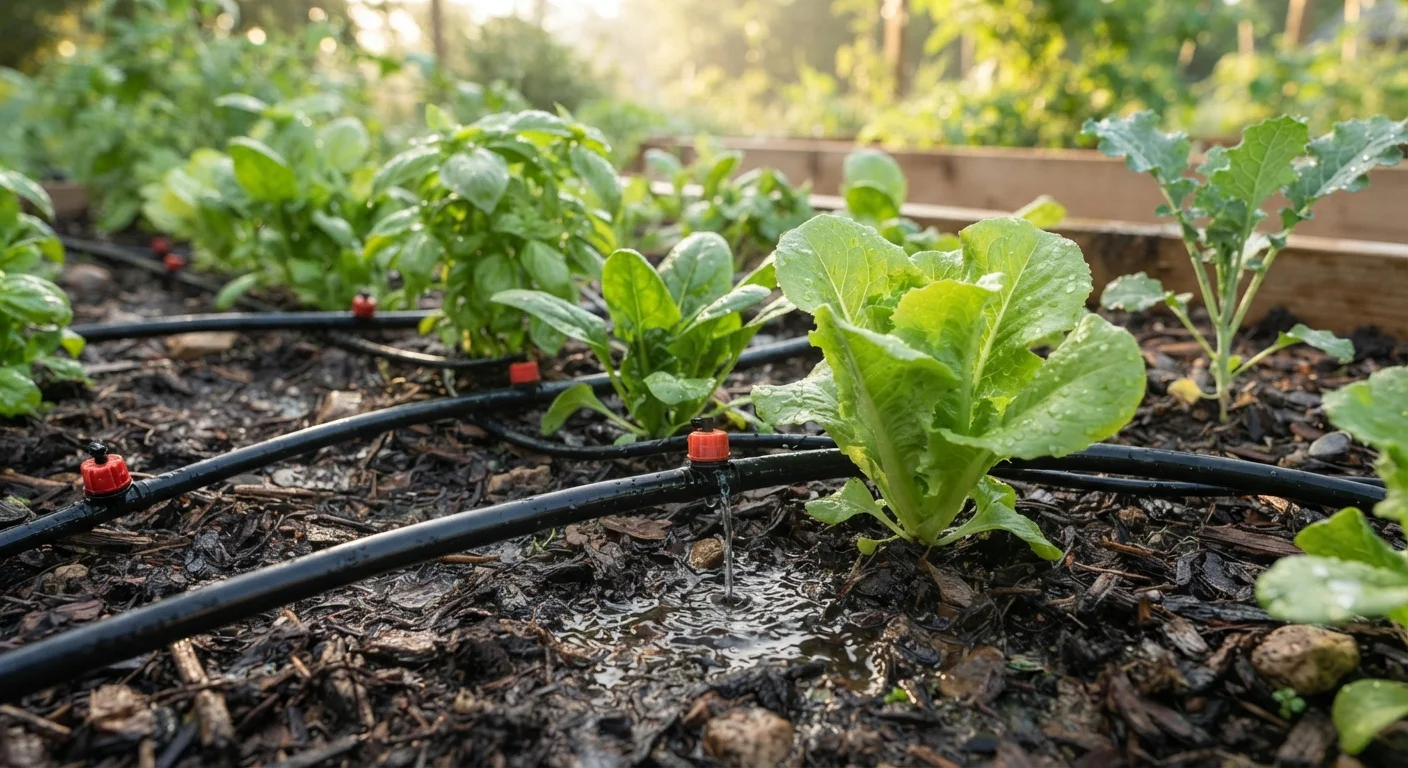
Drip systems pair particularly well with raised bed gardens, where the contained layout makes routing tubing straightforward and efficient.
The Real Advantages of Going Drip
Significantly reduces water waste versus overhead sprinklers
Water is delivered slowly at low volume directly to the root zone, greatly reducing evaporation and surface runoff. Studies from university extension programs suggest drip irrigation can use 30-50% less water than traditional sprinkler systems in comparable applications.
Keeps foliage dry, reducing fungal disease risk
Because water never contacts leaves or stems, conditions that promote common fungal diseases - such as powdery mildew - are less likely to develop. This is especially valuable for vegetable crops like tomatoes and squash.
Delivers consistent moisture to the root zone
Slow, steady water application encourages deeper root growth and reduces the stress cycle of dry-then-wet soil, which can crack clay soils or cause blossom-end rot in vegetables.
Works well with automated timers for low-maintenance watering
A simple battery-operated timer turns a drip system into a nearly hands-off operation, ensuring plants are watered even when you travel or skip a day.
Flexible and scalable for most garden layouts
Drip tubing is easy to cut, expand, or reconfigure as your garden evolves. Systems can be scaled from a single raised bed to multiple garden zones using a multi-outlet timer.
Water savings are the most cited reason homeowners switch to drip, and the efficiency gains are genuine. Because water is applied slowly and at the root zone, far less is lost to surface runoff or evaporation. Keeping foliage dry also matters: overhead watering that leaves leaves wet - especially in the evening - can promote fungal diseases. Drip sidesteps this entirely. See our article on why watering timing matters for more context on how moisture on leaves can cause problems.
The Limitations You Should Know About
Higher upfront cost than hand watering or soaker hoses
A complete drip kit - tubing, emitters, pressure regulator, filter, and timer - can cost anywhere from $30 for a basic setup to several hundred dollars for a larger, multi-zone system.
Emitters clog and require regular inspection
Mineral deposits, algae, and debris can block emitters, leaving plants underwatered without obvious visual signs. Monthly checks during the growing season are recommended.
Not well suited to lawns or densely planted ground covers
Drip systems are designed for defined plant locations; they are impractical for large turfgrass areas or tightly spaced plantings where uniform coverage across the soil surface is needed.
Tubing can be damaged by digging, pests, or UV exposure
Surface-laid tubing is vulnerable to damage from garden tools, burrowing rodents, and ultraviolet degradation over time. Burying or covering tubing with mulch extends its lifespan considerably.
Requires initial planning effort to size and route correctly
An improperly designed system - wrong emitter flow rates, unequal pressure across zones, or poor layout - can result in uneven watering that harms plants rather than helping them.
Understanding the drawbacks before you invest helps you set realistic expectations and plan around common pitfalls. The upfront cost of tubing, emitters, a pressure regulator, and a timer adds up - though the system typically pays back over time in lower water bills where metered. Clogged emitters are the most frequent maintenance issue; a good inline filter reduces but doesn't eliminate this problem, so periodic inspection matters.
Pressure Regulation Is Non-Negotiable
Standard household water pressure (typically 40-80 psi) is too high for most drip systems, which are designed to operate at 15-25 psi. Without a pressure regulator, emitters can pop off tubing and lines can split. Always include a pressure regulator between your faucet connection and the main supply line - it's an inexpensive part that protects the entire system.
How to Set Up a Basic Home Drip System
Planning comes first. Sketch your planting area and note the location of each plant - emitter placement depends on mature plant size and root spread. Vegetables and annuals typically need one emitter per plant; larger shrubs may need two or three positioned around the drip line.
- Connect to the water source: Attach a backflow preventer to your outdoor faucet first, then add the pressure regulator and filter.
- Run the main supply line: Lay half-inch polyethylene tubing from the faucet to the planting area, securing it with garden staples.
- Add distribution tubing: Use quarter-inch micro-tubing to branch off the main line and route to each plant.
- Install emitters: Punch emitters into the tubing end at each plant location. Flow rate (measured in gallons per hour) should match your soil type - slower for clay, faster for sandy soil.
- Add a timer: Even a basic mechanical timer allows you to automate watering cycles and ensure consistency without daily attention.
- Test and adjust: Run the system and check every emitter for even flow. Cap unused ends and flush the lines before sealing.
Most residential drip systems do not require a permit, but always verify local plumbing and irrigation codes before connecting to any potable water supply.
30-50%
Potential water savings vs. sprinklers
University cooperative extension research consistently estimates drip irrigation reduces water use by 30-50% compared to overhead sprinkler systems in garden bed applications.
1-2 GPH
Typical emitter flow rate per plant
Most residential drip emitters are rated at 0.5 to 2 gallons per hour, allowing slow soil absorption that reduces runoff regardless of soil type.