

Key Takeaways
- Watering at night leaves foliage wet for hours, creating ideal conditions for fungal disease.
- Early morning is generally the best time to water - soil absorbs moisture before heat peaks.
- Drip irrigation at roots can reduce timing sensitivity significantly.
- Plant type, climate, and soil drainage all influence how much watering timing matters.
- Wilting during midday heat doesn't always mean your plants need immediate water.
A Common Habit Worth Reconsidering
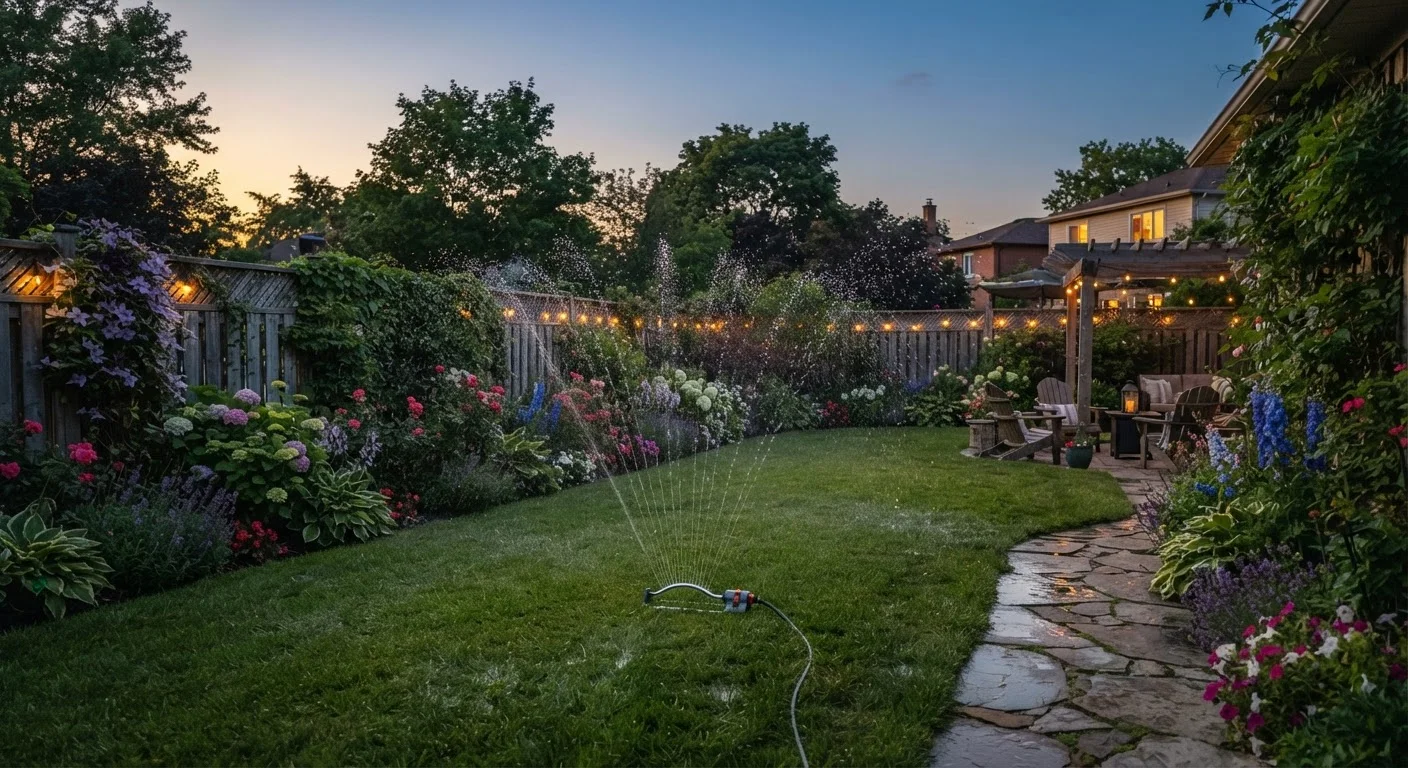
Plenty of homeowners water their gardens after dinner - it feels convenient, the sun is down, and there's a sense that cooler temperatures mean less evaporation. That logic isn't entirely wrong, but it glosses over a significant downside: moisture sitting on leaves, stems, and soil surfaces through the night creates a prime environment for fungal pathogens to take hold.
This article separates gardening fact from fiction when it comes to irrigation timing, so you can make smarter choices for your specific yard. For a broader look at planning mistakes that quietly undermine a season's work, see our guide to common garden planning mistakes.
Myth
Watering at night is better because cooler temperatures mean less water evaporates.
Fact
While evaporation is lower at night, wet foliage sitting for hours promotes fungal disease - a risk that typically outweighs the efficiency gain.
Evaporation rates are genuinely lower at night, but this benefit mainly applies to water in the soil, not water sitting on leaves and stems. When foliage stays wet for six to eight hours in the dark - typical of an evening watering - fungi like powdery mildew, gray mold (Botrytis), and leaf spot pathogens can germinate and spread. Early morning watering captures much of the same evaporation advantage while giving foliage hours of sunlight and airflow to dry out before night returns.
Myth
Plants don't absorb water as well during the heat of the day, so morning watering is wasteful.
Fact
Root absorption happens underground, largely unaffected by surface temperatures. Morning watering is absorbed just as effectively as nighttime watering.
Plant roots draw in water based on osmotic pressure and the moisture gradient in the soil - not the air temperature above ground. What does increase with heat is evaporation from the soil surface, which means some morning water does evaporate before reaching deep roots if your soil is very sandy or the sun is intense. Watering longer and deeper rather than shifting to night is a more targeted fix than changing your time slot.
Myth
If a plant is wilting, you should water it immediately regardless of the time of day.
Fact
Midday wilting is often a temporary heat-stress response, not a sign of drought. Watering prematurely can contribute to overwatering problems.
Many plants - tomatoes, squash, and large-leafed ornamentals especially - close their stomata and droop in peak afternoon heat to reduce moisture loss. This is a built-in survival mechanism, not a distress signal. Before watering, check soil moisture two to three inches below the surface. If it still feels damp, wait until the plant revives in the evening (which it typically will) and reassess in the morning. Overwatering is among the most common causes of plant death in home gardens.
Myth
The time of day you water doesn't matter much - what really counts is how much you use.
Fact
Both volume and timing matter. Watering at the wrong time can undermine even the right amount of water by promoting disease or surface evaporation.
Volume is critically important, but timing shapes how effectively that volume reaches roots and whether it creates harmful conditions. Overhead watering at night with a perfectly calibrated amount can still trigger fungal outbreaks. Conversely, the ideal time slot with the wrong volume - too little or too much - produces its own problems: drought stress or root rot. Timing and quantity work together; adjusting one without considering the other gives only partial results.
When Timing Actually Matters - and When It Doesn't
The importance of watering time varies considerably depending on your irrigation method, plant types, and local climate. Overhead sprinklers spraying foliage are the most timing-sensitive setup because they wet leaves directly. Drip systems that deliver water to the root zone largely sidestep the nighttime-disease problem - the foliage stays dry regardless of when you run the system. Our explainer on drip irrigation covers how those systems work and what to realistically expect from them.
Climate adds another layer. In hot, arid regions, evening overhead watering may dry relatively quickly even at night, lowering fungal risk. In humid climates - the Southeast, Pacific Northwest, or any area with warm, muggy nights - wet foliage overnight is genuinely problematic. Know your local conditions before following blanket advice.
Humid Climates Amplify Nighttime Watering Risks
If you live in a region with warm, humid summers - such as the Southeast or Mid-Atlantic - wet foliage overnight poses a significantly higher fungal disease risk than in drier climates. In these areas, shifting to morning watering with an overhead system is especially worthwhile. If changing your schedule isn't practical, consider switching to drip irrigation to keep foliage dry entirely.
Finally, consider your soil. Sandy, fast-draining soil loses moisture quickly regardless of timing. Heavy clay retains water longer, meaning nighttime watering can leave roots waterlogged into the next afternoon - a stress all its own. If you're weighing different growing setups for drainage control, our overview of raised beds vs. in-ground planting may be useful.
~30%
Outdoor water wasted through inefficient irrigation
The U.S. Environmental Protection Agency estimates that as much as 30% of residential outdoor water use is lost to inefficiency, including evaporation and runoff.
6-8 hrs
Hours foliage stays wet after evening overhead watering
Plant pathology research consistently identifies extended leaf wetness periods - often six to eight hours overnight - as a primary driver of fungal disease development.
Building a Smarter Watering Routine
The goal isn't to add stress to your gardening routine - it's to help water work more efficiently for your plants. A few practical adjustments can make a meaningful difference:
- Shift to early morning when possible. Water pressure is typically higher, temperatures are cooler without being nighttime-low, and foliage has the whole day to dry before evening.
- Water deeply, less often. Frequent shallow watering encourages shallow root systems. Deep, infrequent watering pushes roots downward where soil stays moist longer.
- Observe before you irrigate. Soil probing with a finger or a moisture meter two to three inches deep tells you more than a schedule does. Dry at that depth means it's time to water; moist means hold off.
- Don't panic at midday wilt. Many plants temporarily droop in afternoon heat as a self-protection response, then recover by evening. Water at that moment is often wasted rather than absorbed.
Getting irrigation right is one piece of overall lawn health. If your grass seems slow to respond no matter how well you water, compacted soil could be limiting root absorption - something our article on lawn aeration addresses in detail.