

Key Takeaways
- Ground covers can reduce mowing demands, control erosion, and add visual texture to your yard.
- Many options thrive in conditions where grass struggles, such as deep shade or steep slopes.
- Some ground covers, like clover, actively improve soil by fixing nitrogen naturally.
- Choosing the right plant for your specific climate, soil, and sun exposure is key to success.
Why Ground Covers Deserve a Spot in Your Yard
Traditional grass lawns have their place, but they're not always the most practical or sustainable choice for every corner of your property. Slopes prone to erosion, heavily shaded areas under trees, or dry patches that resist irrigation can all become problem zones when planted with turf. Ground covers - low-growing plants that spread horizontally to blanket the soil - offer a way to turn those challenges into design opportunities.
Beyond aesthetics, the right ground cover can reduce your weekly mowing routine, lower water usage, and even support pollinators. If you've ever wrestled with growing grass in shaded areas, a shade-tolerant ground cover may be the more realistic long-term solution.
The options below cover a range of climates, soil types, and use cases - from foot-traffic-tolerant plants to fragrant flowering spreaders.
Creeping Thyme
Creeping thyme (Thymus serpyllum) is one of the most versatile ground covers available to American homeowners. It forms a dense, low mat - typically just two to four inches tall - covered in tiny pink or purple flowers during late spring and early summer. It tolerates moderate foot traffic, making it a popular choice for planting between stepping stones or along garden paths.
This plant thrives in full sun and well-drained soil, making it well-suited to hot, dry spots where turf grass struggles. It's notably drought-tolerant once established and attracts bees and other pollinators. It does not perform well in consistently wet or clay-heavy soils.
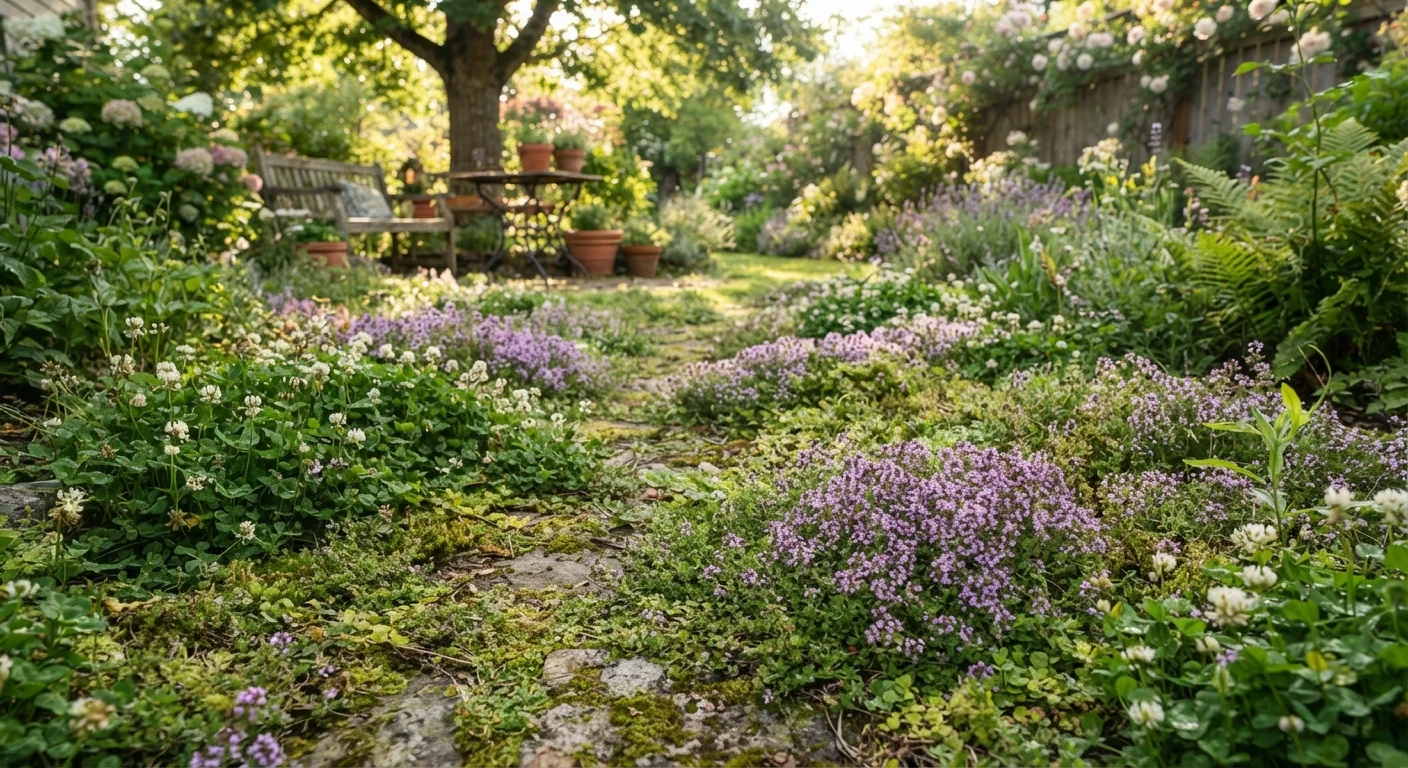
Creeping thyme tolerates moderate foot traffic and thrives in dry, sunny spots where grass often fails.
White Clover
White clover (Trifolium repens) has made a comeback in recent years as homeowners recognize its practical benefits. It's a nitrogen-fixing plant, meaning its roots host bacteria that convert atmospheric nitrogen into a form usable by surrounding plants - effectively fertilizing the soil naturally over time.
Clover stays low, tolerates mowing, and remains green through summer heat when many grasses turn brown. It's also attractive to pollinators. One trade-off: it can feel slippery when wet, and some people prefer not to walk barefoot through it due to bee activity during bloom. It grows in a wide range of soil conditions and is relatively inexpensive to establish from seed.
White clover fixes nitrogen naturally, reducing the need for supplemental fertilizer in the surrounding area.
Pachysandra
Pachysandra (Pachysandra terminalis) is a go-to ground cover for deeply shaded areas, particularly under large trees where grass refuses to establish. It's an evergreen perennial that produces glossy, dark green foliage year-round, giving your yard structure and color even in winter.
It spreads gradually via underground runners and forms a weed-suppressing mat once fully established. Pachysandra prefers well-drained, slightly acidic soil and does not do well in full sun or waterlogged conditions. It's low-maintenance once in place, rarely requiring anything beyond occasional edging to keep it within its intended boundaries.
Pachysandra is one of the most reliable evergreen options for dense shade where grass simply won't grow.
Creeping Jenny
Creeping Jenny (Lysimachia nummularia) is a fast-spreading, low-growing plant with round, coin-shaped leaves and bright yellow flowers. Its golden or chartreuse foliage adds striking color to garden beds and slopes, and it works well cascading over walls or along the edges of water features.
It tolerates both sun and partial shade and can handle moderately moist soils - even brief periods of standing water - making it useful in areas that tend to stay damp. Because it spreads quickly, it's worth monitoring to prevent it from encroaching on neighboring plants. In some regions it can behave aggressively; check with your local cooperative extension service before planting near natural water bodies.
Creeping Jenny's bright foliage and tolerance for moist soil make it a strong candidate for low-lying areas.
Sedum (Stonecrop)
Low-growing sedum varieties - sometimes called stonecrop - are excellent ground covers for sunny, rocky, or gravelly sites with poor soil. These succulents store water in their thick, fleshy leaves, giving them exceptional drought tolerance. Varieties like Sedum acre or Sedum spurium spread into dense mats and produce cheerful star-shaped flowers in summer.
Sedums ask very little: good drainage, adequate sun, and minimal watering once established. They're a smart choice for sloped areas prone to erosion where irrigation is impractical. They generally don't tolerate heavy foot traffic or consistently wet conditions, so they're best used in ornamental rather than high-use areas.
Sedum's drought tolerance and erosion-controlling spread make it ideal for sunny slopes with poor or rocky soil.
Ajuga (Bugleweed)
Ajuga (Ajuga reptans) is a fast-spreading ground cover that works in both sun and shade, giving it flexibility that many alternatives lack. It produces attractive rosettes of foliage - available in purple, bronze, and variegated forms - and sends up spikes of blue-violet flowers in spring that are highly attractive to pollinators.
It handles a range of soil conditions and spreads via surface runners (stolons), filling in gaps relatively quickly. Ajuga can become invasive in some climates, particularly in moist regions of the Pacific Northwest and parts of the Southeast, so check whether it's considered invasive in your state before planting. Where it's well-behaved, it's one of the most adaptable and visually interesting ground covers available.
Ajuga adapts to sun and shade alike, making it one of the more flexible ground covers for mixed-condition yards.
Choosing and Establishing Your Ground Cover
Success with ground covers starts before you plant. Assess your site honestly: How much sun does the area receive? Is the soil sandy and dry, or clay-heavy and wet? Will people or pets walk through it? Matching the plant to the conditions - rather than forcing a plant into the wrong environment - is what separates thriving plantings from perpetual disappointments.
Control Weeds During Establishment
The first growing season is when ground covers are most vulnerable to weed competition. Hand-pull weeds promptly and consider a thin layer of mulch between young plants to suppress germination. Avoid heavy herbicide use, as many ground covers are sensitive during establishment. Once plants fill in, they'll do much of the weed-suppression work themselves.
Establishment typically takes one to two full growing seasons. During that window, weed competition is the biggest threat. Consider pairing new plantings with a layer of mulch between plants; our guide to mulch types and trade-offs can help you pick an appropriate option. Once established, most ground covers become largely self-sustaining and crowd out weeds on their own.
If you're transitioning from turf, late summer or early fall is generally a good planting window in most US regions - soil is still warm enough to encourage root development before winter. For a broader seasonal framework, the spring lawn readiness walkthrough offers useful context for timing yard work across the growing calendar.