

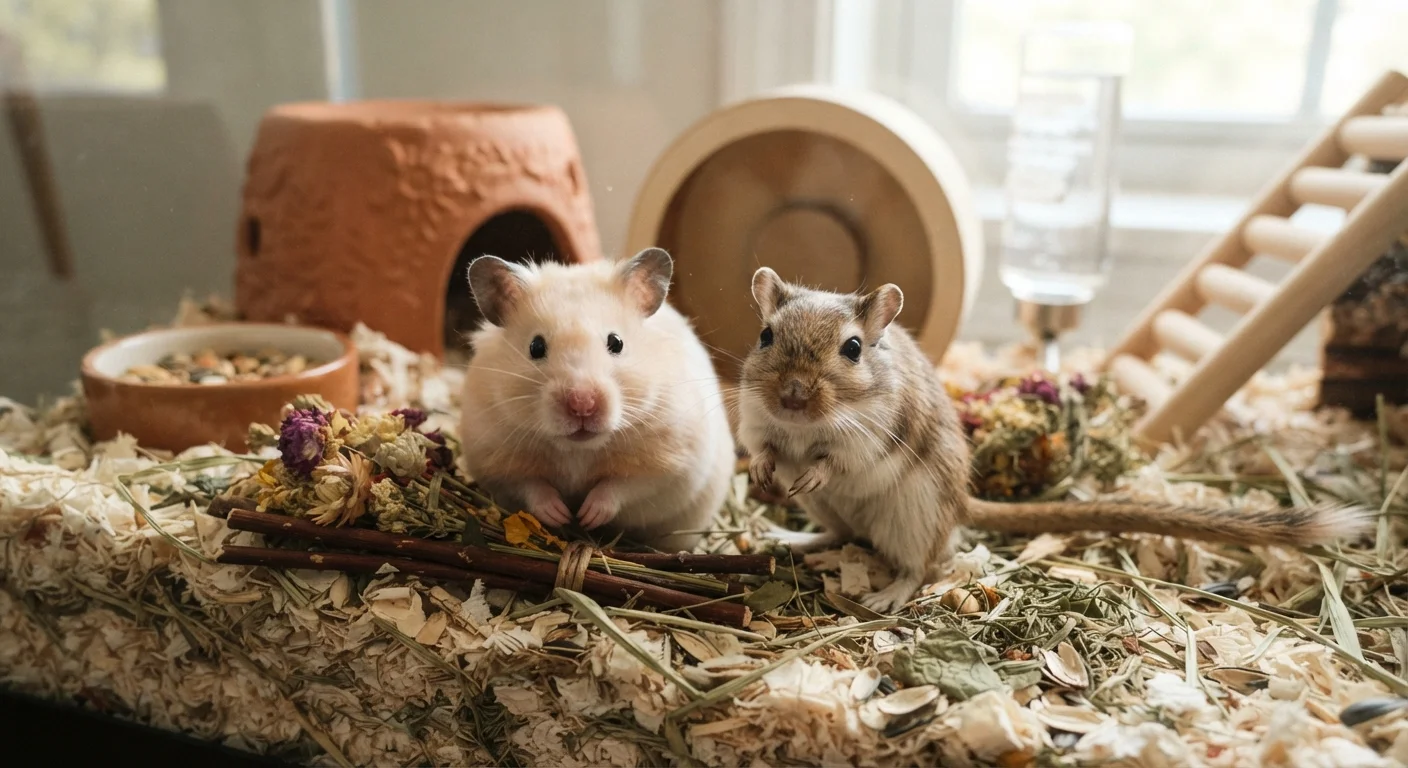
Key Takeaways
- Hamsters are solitary and typically most active at dusk and night, while gerbils are social and active in shorter bursts throughout the day.
- Gerbils generally require a companion of the same species, whereas hamsters do better - and safer - living alone.
- Both animals need spacious, enriched enclosures, but gerbils tend to dig more and benefit from deeper substrate.
- Hamsters can be more prone to stress-related behaviors if handled incorrectly; gerbils are often easier to socialize.
- Lifespan and veterinary needs differ: hamsters typically live 2-3 years, gerbils 3-5 years on average.
Option A
Hamster
The independent, low-maintenance solo dweller.
Best for: Best for owners who want a hands-off pet that is active in the evenings and comfortable living alone.
Option B
Gerbil
The social, curious daytime explorer.
Best for: Best for owners who enjoy watching active, social animals and can commit to keeping them in pairs or small groups.
If you work during the day and are home in the evenings
Hamster
Hamsters are naturally most active at dusk and overnight, so your evening schedule aligns well with their active period.
If you enjoy watching pets interact with each other
Gerbil
Gerbils are social animals that thrive in pairs and display engaging behaviors like grooming, burrowing, and playing together.
If you live in a small apartment and want minimal noise
Hamster
A single hamster in a well-sized enclosure is quiet and self-contained, making them well-suited to compact living spaces.
If you want a pet with a longer potential lifespan
Gerbil
Gerbils generally live 3-5 years compared to the hamster's typical 2-3 years, giving owners a longer bonding window.
If you are choosing a first pet for an older child
Gerbil
Gerbils tend to be more tolerant of handling and less prone to biting when properly socialized, though adult supervision is always recommended.
Activity Patterns: When Will Your Pet Actually Be Awake?
One of the most practical differences between hamsters and gerbils is when they are active. Hamsters are primarily crepuscular and nocturnal - meaning they are most lively at dusk, through the night, and into early morning. During the day, they sleep deeply and should not be disturbed, as waking them abruptly can cause stress and increase the chance of a defensive bite.
Gerbils, by contrast, follow a more polyphasic (many short cycles) activity pattern, alternating between periods of activity and rest throughout the day and night. This means you are more likely to catch a gerbil digging, running, or exploring at almost any hour, which many owners find more engaging.
If you are home primarily in the evenings, a hamster's schedule may suit you well. If you want to interact with your pet during daytime hours - particularly relevant for families with children - gerbils may be the more practical match. For a broader look at how small animals fit different home environments, see our guide on small pets that tend to suit apartment living.
| Criterion | Hamster | Gerbil |
|---|---|---|
| Activity pattern | Nocturnal / crepuscular | Active in short bursts all day |
| Social needs | Solitary (must live alone) | Social (needs a companion) |
| Typical lifespan | 2-3 years | 3-5 years |
| Ease of handling | Moderate - requires patience | Generally easier to socialize |
| Burrowing needs | Moderate - 4-6 inches substrate | High - 6-8+ inches substrate |
| Minimum enclosure size | 600+ sq in floor space | 600+ sq in floor space |
| Cost of ownership | Lower (one animal) | Higher (pair recommended) |
| Noise level at night | Wheel noise possible | Generally quiet |
Social Needs: Solo Living vs. Companionship
Hamsters are solitary by nature. In the wild, adult Syrian hamsters - the most common pet variety - actively defend territories and will fight other hamsters on sight. Housing two Syrian hamsters together is generally considered harmful and can result in serious injury or death. Even dwarf hamster species, which are sometimes described as more social, can be unpredictable in pairs and require careful monitoring.
Gerbils sit at the opposite end of the social spectrum. In the wild, they live in family groups and engage in constant social behavior: grooming, sleeping in piles, and exploring together. Keeping a gerbil alone is widely considered detrimental to its wellbeing; most animal welfare organizations and exotic animal veterinarians recommend housing gerbils in same-sex pairs or small groups. This means the cost and commitment of gerbil ownership effectively doubles from the start.
This distinction matters enormously when planning your setup. A solo hamster in a large, enriched enclosure is content. A lone gerbil, regardless of enclosure size, is likely to show signs of stress over time. Be sure to review small pet myths that can actually harm your animal before making assumptions about either species' needs.
3-5 yrs
Average gerbil lifespan in captivity
Gerbils generally outlive hamsters by one to two years, a meaningful consideration for long-term commitment.
600 sq in
Minimum recommended hamster floor space
Animal welfare organizations such as the RSPCA cite this as a baseline, noting that more is always better for hamster wellbeing.
2
Minimum number of gerbils recommended
Most exotic animal veterinarians and welfare groups advise keeping gerbils in same-sex pairs to meet their social needs.
Enclosure, Handling, and Day-to-Day Care
Both hamsters and gerbils need more space than many standard pet-store cages provide. Animal welfare guidelines in various countries recommend a minimum of 600-800 square inches of unbroken floor space for hamsters, with deep substrate for burrowing. Gerbils similarly need substantial depth - at least 6-8 inches of substrate - because burrowing is a core behavioral need, not an optional enrichment.
When it comes to handling, gerbils tend to acclimate to human contact more readily and are less prone to biting once socialized. Hamsters can absolutely become comfortable with gentle, consistent handling, but the process requires patience, especially during the first few weeks. Waking a hamster to handle it during its sleep phase is a common beginner mistake that undermines trust. Our guide on handling and socializing small rodents without stressing them out covers this process in detail for both species.
Diet for both species is broadly similar - a quality rodent mix supplemented with fresh vegetables and occasional protein - though gerbils tend to favor seeds and are prone to obesity if given too many high-fat options. Fresh water should always be available for both. Before bringing either animal home, use a first-week readiness checklist to make sure your setup is truly prepared.
This article is for general informational purposes only and does not constitute veterinary advice. Always consult a qualified exotic animal veterinarian for guidance specific to your pet's health and care needs.