

Key Takeaways
- Carry-on travel avoids checked baggage fees and eliminates wait time at baggage claim.
- Checked bags offer significantly more space and freedom from liquid and sharp-item restrictions.
- Airlines set their own size and weight limits - always verify before you fly.
- Overhead bin space is not guaranteed on full flights, even with a qualifying carry-on.
- Trip length, destination climate, and planned activities should drive your luggage decision.
- Baggage fees can add meaningful cost to a trip; factor them into your overall travel budget.
Option A
Carry-On Baggage
The fast, fee-free option for light packers.
Best for: Short trips, frequent flyers, and travelers who want to skip baggage claim entirely.
Option B
Checked Baggage
The spacious, flexible choice for longer journeys.
Best for: Extended trips, family travel, and anyone who needs to pack gear, gifts, or more than one pair of shoes.
If you're taking a weekend or short business trip
Carry-On Baggage
A few days of clothing fits comfortably in a carry-on, and you'll save on fees while moving through the airport faster.
If you're traveling for a week or more
Checked Baggage
Longer trips require more clothing and supplies than most carry-ons can hold; a checked bag removes the stress of fitting everything in.
If you're traveling with children or as a family
Checked Baggage
Families typically need bulkier gear, extra clothing, and supplies that exceed carry-on limits; checked bags handle that volume comfortably.
If you're a frequent flyer trying to minimize costs
Carry-On Baggage
Regular travelers who master packing light avoid recurring checked bag fees that can add up significantly across multiple trips per year.
If your destination requires special gear or equipment
Checked Baggage
Sports equipment, hiking gear, formal attire, or fragile items that can't be compressed typically require a checked bag for safe transport.
What Each Option Actually Involves
A carry-on bag is any luggage small enough to fit in an aircraft's overhead bin or under the seat in front of you. Most U.S. carriers allow one carry-on plus one personal item (such as a backpack or tote), though size and weight limits vary by airline. Because it stays with you, a carry-on never gets lost in the baggage system, and you walk straight off the plane when you land.
A checked bag is luggage handed over to the airline at check-in, tagged, and loaded into the cargo hold. It's retrieved from baggage claim after landing. Checked bags accommodate far more volume - typically 50 lbs and 62 linear inches under standard U.S. airline rules - making them the default for longer trips or anyone who needs to pack bulky items.
Before committing to either approach, it helps to understand the full cost picture. Building a realistic travel budget should include potential baggage fees, which can range from $30 to $60 or more per checked bag each way on many domestic carriers.
| Criterion | Carry-On | Checked Bag |
|---|---|---|
| Typical fee (domestic U.S.) | Usually free | $30-$60+ each way |
| Space / capacity | Limited (approx. 40-45L) | Large (50 lbs, 62 linear in.) |
| Liquids restriction (TSA) | Yes - 3-1-1 rule applies | No restriction on liquids |
| Risk of loss or delay | Very low - stays with you | Small but real risk |
| Airport time required | Faster - no bag drop or claim | Extra time at both ends |
| Sharp or oversized items | Not permitted in cabin | Generally permitted |
| Overhead bin availability | Not guaranteed on full flights | N/A - stored in hold |
The Real Trade-Offs: Speed, Cost, and Flexibility
Speed and convenience strongly favor carry-on travel. You skip the check-in bag drop line, clear security more quickly when you know the rules (see our guide to navigating airport security without the stress), and walk directly to ground transportation after landing. On a short trip, that time savings is real.
Cost is another carry-on advantage - most airlines include at least one carry-on at no extra charge, though a handful of budget carriers do charge for overhead bin bags. Checked bag fees, by contrast, are nearly universal on domestic U.S. flights unless you hold elite frequent-flyer status or a co-branded airline credit card that waives them.
Packing flexibility swings firmly toward checked bags. Carry-on travelers must comply with TSA's 3-1-1 liquids rule (containers of 3.4 oz or less, in a single quart-sized bag) and cannot pack sharp tools, full-size toiletries, or certain sporting goods. Checked bags carry all of those without restriction, which matters enormously for adventure travel, extended international trips, or anyone who relies on specific personal care products.
3-1-1
TSA liquids rule for carry-on bags
The TSA requires all carry-on liquids to be in containers of 3.4 oz (100ml) or less, placed in a single quart-sized clear bag - one bag per passenger.
~$30-$60+
Typical checked bag fee per direction
Most major U.S. carriers charge a fee for the first checked bag on domestic routes; costs vary by airline and can compound quickly on round trips.
50 lbs
Standard checked bag weight limit (U.S.)
Most U.S. airlines set a 50-pound weight limit for standard checked bags; overweight bags typically incur an additional fee on top of the base baggage charge.
Packing Strategies That Work for Either Approach
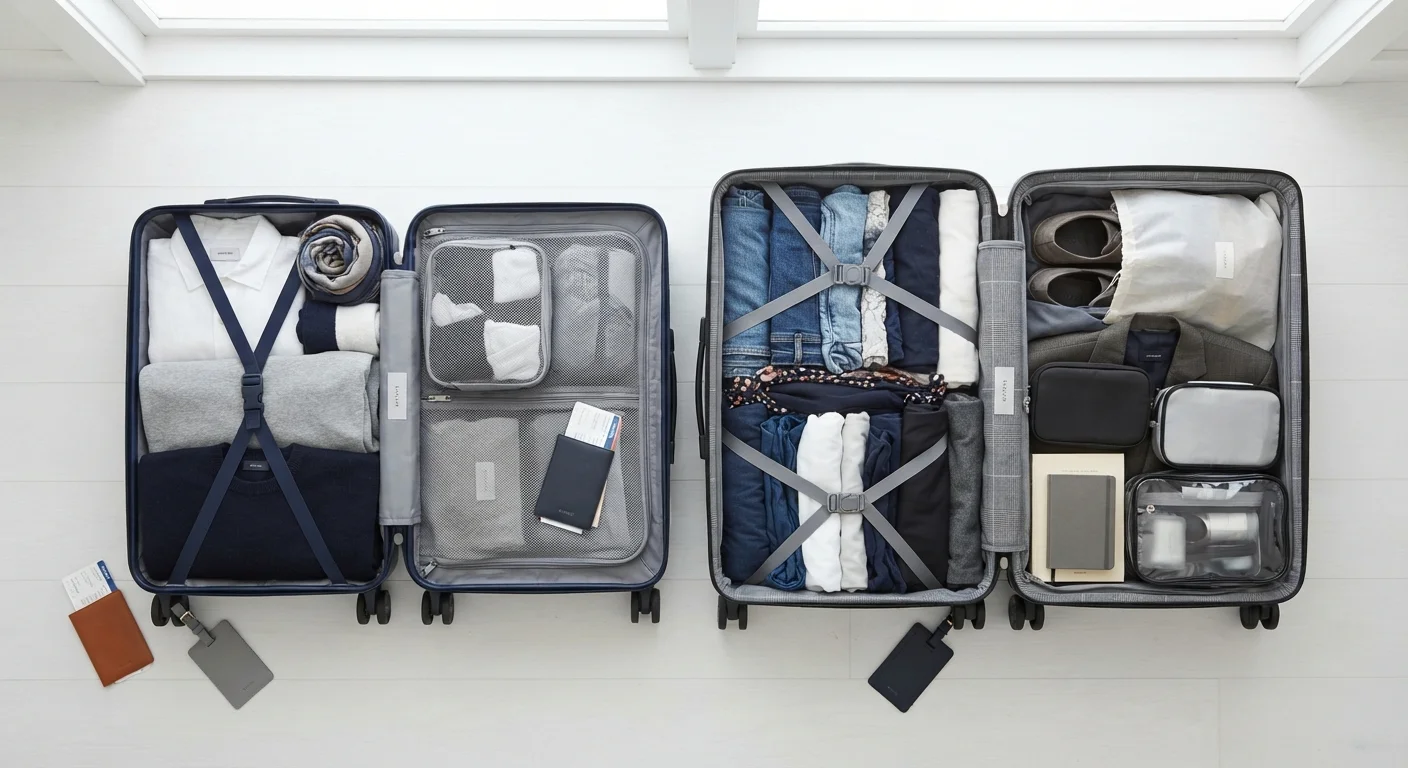
Regardless of which you choose, a few habits make packing more effective. Rolling clothes instead of folding them reduces wrinkles and compresses volume. Packing cubes keep categories of clothing separated and make retrieval easy without upending your bag. Wearing your bulkiest items - heavier shoes, a jacket - on the plane frees up space in either bag type.
Carry-on travelers benefit from planning outfits around a single color palette so pieces mix and match, reducing the total number of items needed. Checking a bag? Still pack a change of clothes and any irreplaceable valuables in your personal item in case your checked bag is delayed - it happens even on direct flights.
For trip-length packing principles that adapt across different scenarios, see our guide to packing approaches that hold up across different trip lengths. And before you head to the airport, run through a full pre-departure logistics checklist to make sure nothing critical gets left behind.
Always Verify Limits Before You Fly
Baggage policies - including size limits, weight allowances, and fees - vary by airline, fare class, and even specific route. Budget carriers in particular may have stricter or more expensive rules than legacy airlines. Always check your airline's current baggage policy directly on their official website after booking, and again before you pack. Rules can and do change.