

Key Takeaways
- Under-inflated tires increase stopping distance, raising crash risk in emergency situations.
- The U.S. Department of Energy estimates properly inflated tires can improve fuel economy by up to 3%.
- Tire pressure drops roughly 1 PSI for every 10°F decrease in ambient temperature.
- The correct PSI for your vehicle is on the driver's door jamb sticker - not the tire sidewall.
- Monthly pressure checks are a simple habit that extends tire life and protects handling.
- A tire can be dangerously under-inflated without looking visibly flat to the naked eye.
Tire Pressure (PSI)
Tire pressure refers to the amount of air inside a tire, measured in pounds per square inch (PSI). Every vehicle has a manufacturer-recommended PSI range that balances safety, handling, ride comfort, and fuel efficiency. Running tires outside that range - too low or too high - creates real, measurable consequences for how your car drives and how much you spend.
PSI recommendations are based on the vehicle's weight distribution and suspension tuning, not the tire's maximum rated pressure stamped on the sidewall - those are two different numbers.
Why Tire Pressure Is a Safety Issue, Not Just a Maintenance Detail
Most drivers think of tire pressure as a minor upkeep task - something to address only when a warning light appears. In reality, it's one of the most direct links between a routine habit and your ability to control your vehicle in an emergency.
Under-inflated tires flex more than they should with each rotation. That excess flex generates heat, degrades the tire structure over time, and - most critically - reduces the tire's ability to grip the road. The result is longer stopping distances. If you're traveling at highway speed and need to brake suddenly, a few extra feet of stopping distance can be the difference between a near-miss and a collision. Our explainer on why following distance matters covers how stopping physics work in more detail.
Handling is affected too. Low pressure causes the tire's sidewalls to bow outward, reducing steering responsiveness and increasing the risk of sudden blowouts - particularly at high speeds or in hot weather. A tire that looks acceptably inflated to the eye can still be 10-15 PSI below the recommended level.
TPMS Is a Warning System, Not a Substitute for Checking
Most vehicles sold in the U.S. after 2008 include a Tire Pressure Monitoring System (TPMS) that triggers a dashboard light when pressure drops significantly - typically 25% below the recommended level. However, a tire can still affect handling and fuel economy while remaining below that alert threshold. Monthly manual checks catch problems before they reach the warning stage.
The Fuel Economy Connection Most Drivers Overlook
Tires that are underinflated create more rolling resistance - the force your engine must overcome to keep the car moving forward. The harder the engine works, the more fuel it burns. This isn't a dramatic effect you'd notice on a single trip, but it adds up significantly over thousands of miles.
The U.S. Department of Energy has noted that keeping tires properly inflated can improve fuel economy by up to 3%. For a driver covering 15,000 miles annually, that's a real and recurring saving at the pump - achieved with no new equipment or behavioral change beyond a monthly pressure check.
Up to 3%
Fuel economy improvement from proper inflation
According to the U.S. Department of Energy, keeping tires at the correct PSI can improve gas mileage by up to 3% compared to under-inflated tires.
~1 PSI
Pressure lost per 10°F temperature drop
A widely cited rule of thumb from tire and automotive engineering sources holds that tire pressure falls by approximately 1 PSI for every 10-degree Fahrenheit decrease in ambient temperature.
28%
U.S. vehicles with at least one significantly under-inflated tire
NHTSA data has indicated that a substantial share of passenger vehicles on American roads operate with at least one tire significantly below the recommended pressure at any given time.
It's worth comparing this against other fuel-economy habits. Some commonly believed strategies - like coasting in neutral or using premium fuel in a standard engine - don't deliver measurable savings. Proper tire inflation actually does. For more on separating fact from fiction, see our guide on fuel economy myths.
How to Check Pressure the Right Way
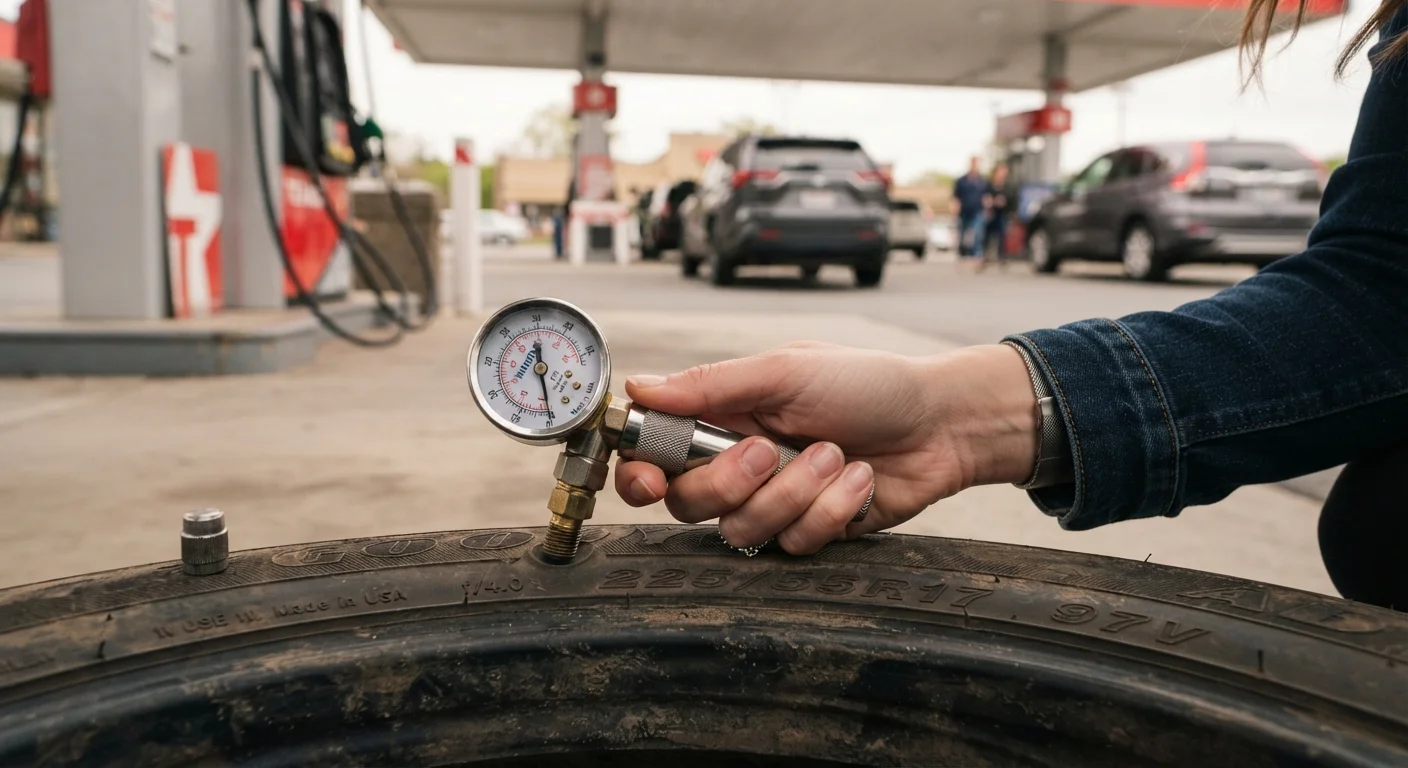
The correct target pressure for your vehicle is printed on a sticker inside the driver's door jamb. It may also appear in the owner's manual. This number - not the figure molded into the tire sidewall - is what you should aim for. The sidewall number indicates the tire's maximum safe pressure, not your vehicle's recommendation. For a deeper look at what the other numbers on your tire mean, see what tire sidewall markings actually tell you.
Check pressure when tires are cold - meaning the car has been parked for at least three hours or driven fewer than a mile at low speed. Driving heats air inside the tire and raises pressure artificially, which can cause a warm reading to appear normal when the cold pressure is actually low.
A basic digital or dial tire pressure gauge costs only a few dollars and gives reliable readings. Many service stations have air compressors available, and some modern vehicles include a tire pressure monitoring system (TPMS) that alerts you when pressure drops significantly - though TPMS is designed as a warning system, not a replacement for proactive monthly checks.
Check Pressure Before the Car Warms Up
Always measure tire pressure when tires are cold - before driving or after the car has sat for at least three hours. Even a short drive heats the air inside tires and temporarily raises pressure, which can make an underinflated tire appear normal on a gauge. Morning checks before your first drive of the day give the most accurate reading.
Check all four tires plus the spare if your vehicle carries one. Spare tires are frequently neglected and may be flat when you actually need them.
Seasonal Changes and Long-Term Tire Health
Temperature swings are the most common reason properly inflated tires go low without a slow leak. Cold air is denser, so as temperatures drop in fall and winter, tire pressure drops with it - roughly 1 PSI per 10°F. A tire set to the correct pressure on a 70°F day may be 4-5 PSI low by the time temperatures regularly dip below 30°F.
Consistently low pressure also accelerates uneven tire wear, particularly on the outer edges of the tread. This shortens tire life and can eventually compromise structural integrity. Tires are a significant purchase, and maintaining correct pressure is one of the simplest ways to protect that investment.
Drivers who want to build better habits beyond tire pressure will find it helpful to distinguish real maintenance requirements from popular myths - our article on car maintenance myths addresses several common misconceptions that waste money without improving vehicle health.
For complete guidance on pressure checks, including what to do when your TPMS light illuminates, see what every driver should know about tire pressure.