

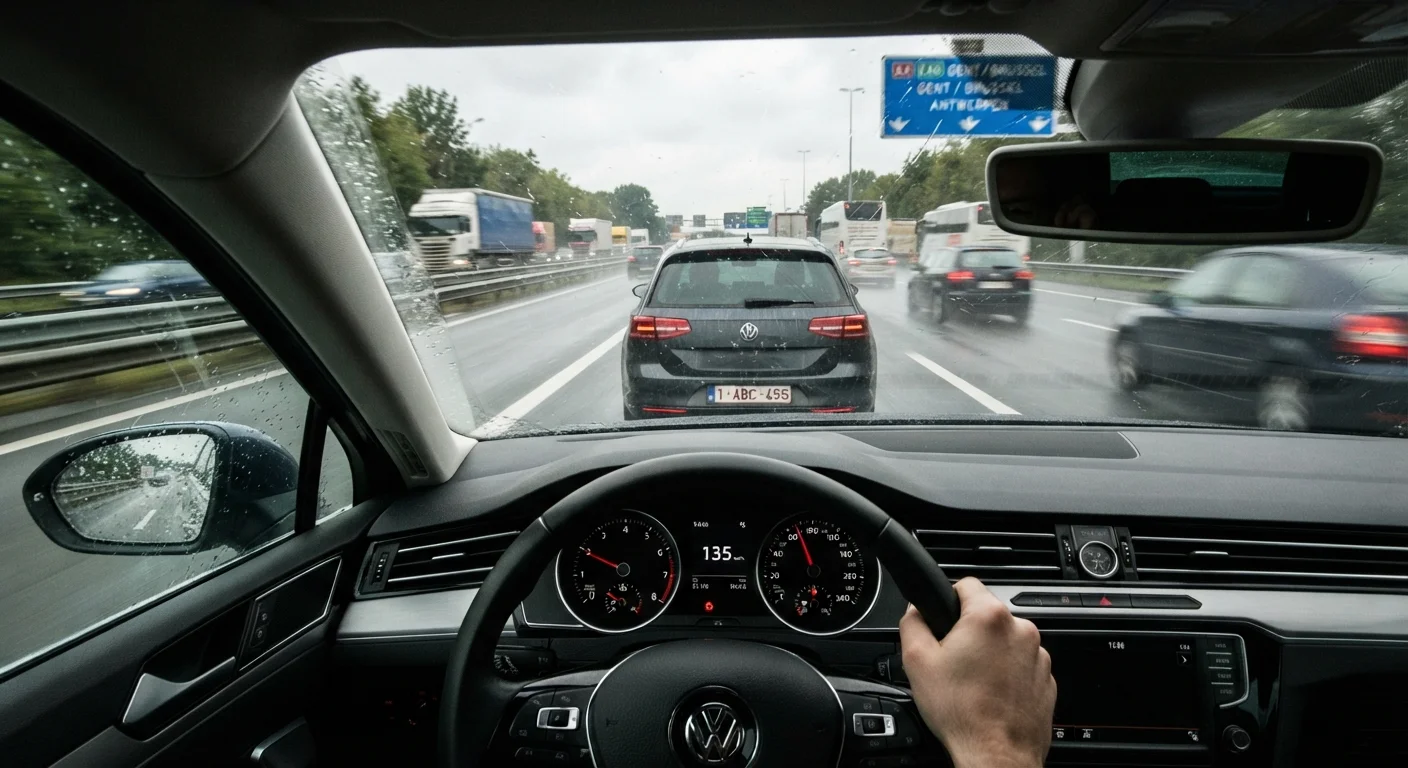
Key Takeaways
- Most drivers follow at 1-2 seconds of gap, well below the 3-second minimum recommended for dry conditions.
- Reaction time alone - before brakes engage - consumes roughly 1.5 seconds of travel distance at highway speeds.
- Tailgating increases rear-end collision risk and is a leading cause of crash-related injuries on U.S. roads.
- Maintaining proper following distance also reduces hard braking, improving fuel economy and reducing brake wear.
- In rain, ice, or low-visibility conditions, following distance should be doubled or tripled from the baseline.
- The 3-second rule is easy to apply using any fixed roadside object as a reference point.
Following Distance
Following distance is the space between the front of your vehicle and the rear of the vehicle ahead of you. It is most usefully measured in time - how many seconds would pass before you reach the spot where the car in front of you currently is. Maintaining adequate following distance gives you the reaction time and braking room needed to avoid a collision if traffic stops suddenly.
The commonly recommended minimum is the 3-second rule under normal conditions, but stopping distance is affected by speed, vehicle weight, tire condition, road surface, and driver reaction time - all of which can extend the gap you actually need.
Why the Gap That Feels Fine Is Often Dangerous
Ask most drivers how much space they leave behind the car ahead and the answer is roughly: enough. That instinct is consistently wrong. Research from the National Transportation Safety Board and highway safety agencies identifies rear-end collisions as one of the most common crash types on U.S. roads, with following too closely as a primary contributing factor.
The reason the gap that feels adequate rarely is comes down to physics. At 60 mph, your vehicle travels 88 feet every second. If you are following at a one-second gap - common in real-world traffic - you have less than 90 feet to perceive a hazard, move your foot, engage the brakes, and come to a stop. That distance is simply insufficient for most vehicles under most conditions.
Human reaction time alone averages around 1.5 seconds for an alert, unimpaired driver. That means before your brakes even begin to slow the car, you have already consumed more space than a one- or two-second gap provides. The vehicle does the rest of the math, and it is rarely in your favor.
~1.5 sec
Average driver reaction time before braking begins
This estimate is widely cited in traffic safety literature and represents an alert, unimpaired driver under expected conditions - not distracted or fatigued driving.
300+ ft
Estimated stopping distance at 65 mph on dry pavement
This figure combines perception, reaction, and braking distance and is consistent with data published by the Federal Highway Administration and traffic safety educators.
~29%
Share of all U.S. crashes that are rear-end collisions
According to the National Highway Traffic Safety Administration, rear-end crashes are consistently among the most common crash types on American roads.
The Physics of Stopping: Perception, Reaction, and Braking
Total stopping distance has three components that drivers often collapse into one. Perception distance is the space your vehicle covers while your brain registers a hazard. Reaction distance is the additional space consumed as your foot moves from accelerator to brake pedal. Braking distance is the space the vehicle needs to physically decelerate to a full stop once the brakes are applied.
Each component is longer than most people expect, and they compound. At 65 mph on dry pavement with alert, unimpaired reflexes, total stopping distance is typically estimated at 300 feet or more - well over the length of a football field. Add any degrading factor - fatigue, wet pavement, worn tires, a moment of distraction - and that number grows quickly.
This is also why road surface conditions have such a dramatic impact on safety. Ice does not change your reaction time; it changes how long your brakes need to work. The vehicle's kinetic energy must go somewhere, and on a slick surface there is far less friction available to convert it into a stop.
“Drivers tend to underestimate stopping distances because they have rarely experienced a true emergency stop. The gap that feels safe at 60 mph is often the gap that makes a crash unavoidable.”
— Cars & Driving Editorial Team, Automotive safety editors drawing on NHTSA and FHWA stopping-distance data
How to Apply the 3-Second Rule - and When to Extend It
The 3-second rule is the most practical tool available for managing following distance. As the vehicle ahead passes a fixed roadside marker - a sign, a shadow, a crack in the pavement - begin counting: one-one-thousand, two-one-thousand, three-one-thousand. If your front bumper reaches that marker before you finish counting, close the gap by easing off the accelerator.
Three seconds is a minimum, not a target. Under conditions that demand more safety margin, extend the gap accordingly:
- Rain or wet pavement: Allow at least 4-5 seconds.
- Ice, snow, or freezing conditions: 8-10 seconds or more is not excessive.
- Night driving: Increase to at least 4 seconds - your headlights may not illuminate a hazard in time at standard following distances. See our article on driving safely after dark for additional guidance.
- Towing or carrying heavy loads: Add extra time - heavier vehicles require significantly more braking distance.
- Following large trucks: Increase distance because sightlines are reduced and debris can fall from cargo.
The 3-second rule also adjusts automatically for speed, which is one of its advantages. At 30 mph, three seconds of distance is shorter in feet than at 70 mph - which is exactly right, because stopping distances scale with speed.
The Hidden Costs of Tailgating
The consequences of inadequate following distance extend beyond crash risk. Driving aggressively close to the vehicle ahead forces constant reactive braking and re-acceleration - a pattern that measurably increases fuel consumption and accelerates brake wear. This connection between driving habits and running costs is explored in detail in our piece on how aggressive driving costs more than drivers realize.
There is also an insurance dimension. Being found at fault in a rear-end collision - the most common outcome when following distance is insufficient - typically results in a claim that can raise premiums for multiple policy periods. In most U.S. states, following too closely is also a ticketable moving violation that adds points to a license.
Maintaining a proper gap, by contrast, creates a smoother driving experience with less braking, lower stress, and fewer abrupt speed changes. This approach is a core element of defensive driving - a set of habits that reduce both collision risk and the day-to-day mental load of navigating traffic.
Following distance habits also shift depending on the driving environment. The stop-and-go rhythms of city traffic and the sustained higher speeds of highway travel each create different demands, a distinction covered in our guide to adjusting your technique between city and highway driving.