

Key Takeaways
- The letters and numbers on your tire sidewall describe size, load capacity, speed rating, and construction type.
- Replacing tires with the wrong size or rating can affect handling, safety, and your vehicle's load limits.
- The correct tire size for your vehicle is listed in your owner's manual and on the driver's door jamb sticker.
- The DOT code on the sidewall includes the tire's manufacture date, which helps you track age-related wear.
- Tires older than six years should be inspected regularly; many manufacturers recommend replacement by ten years regardless of tread depth.
Tire Sidewall Code
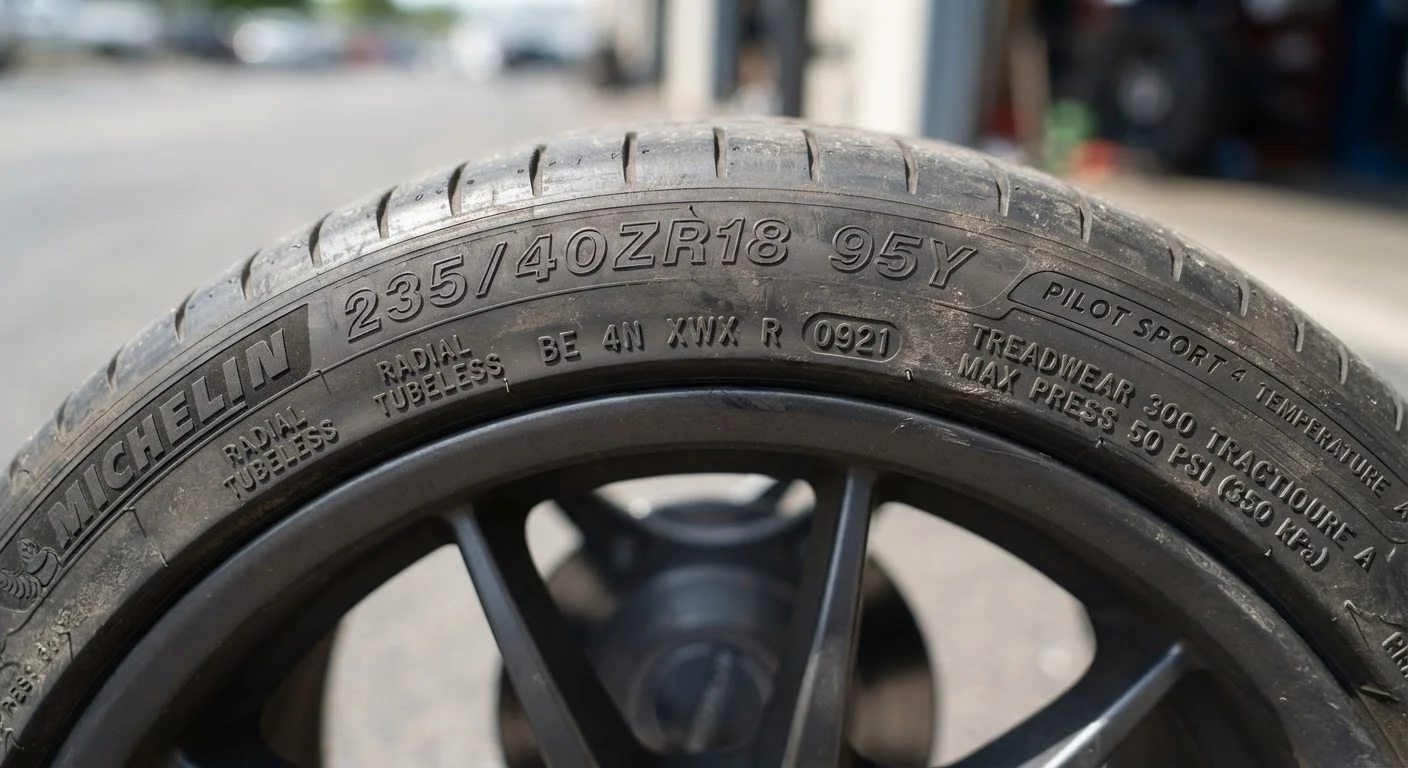
The string of letters and numbers molded into the side of every tire - such as P215/65R16 98H - is a standardized code that describes the tire's size, construction, load capacity, and speed rating. Each segment of the code tells you something specific about how the tire is built and what conditions it's designed to handle. Understanding this code helps you confirm you have the right tire for your vehicle and driving conditions.
The code follows standards set by the Tire and Rim Association (TRA) in the U.S. and the European Tyre and Rim Technical Organisation (ETRTO) internationally; some differences exist between the two systems, particularly for metric versus flotation sizing.
Breaking Down the Main Code: P215/65R16
Take a typical tire marking: P215/65R16. Each segment carries distinct information.
- P - The service type. "P" stands for passenger vehicle. "LT" indicates a light truck tire, which carries a higher load rating. If there is no letter prefix, the tire follows a metric standard common in European-market vehicles.
- 215 - The section width in millimeters, measured from sidewall to sidewall at the tire's widest point when properly mounted and inflated.
- 65 - The aspect ratio. This is the sidewall height expressed as a percentage of the section width. Here, the sidewall height equals 65% of 215 mm, or about 140 mm.
- R - The construction type. "R" means radial, the standard construction for virtually all modern passenger tires. Radial tires have internal ply cords running perpendicular to the direction of travel, giving them flexibility and durability.
- 16 - The wheel diameter in inches. This must match your rim size exactly - a 16-inch tire only fits a 16-inch wheel.
Getting any one of these dimensions wrong when replacing tires can affect ride quality, speedometer accuracy, and in some cases, clearance within the wheel well.
Load Index and Speed Rating: The Safety Numbers
After the size code, you'll typically see two more pieces of information - a load index number and a speed rating letter, such as 98H.
The load index is a numeric code that corresponds to the maximum weight a single tire can support when properly inflated. An index of 98, for example, corresponds to 1,653 pounds per tire. Multiply by four to get the total load capacity for the vehicle. Your vehicle's minimum required load index is specified on the door jamb sticker - never install tires with a lower load index than specified.
The speed rating is the letter that follows. Common ratings include:
- S - Up to 112 mph (common on family sedans and minivans)
- H - Up to 130 mph (common on sport sedans)
- V - Up to 149 mph
- W / Y - Up to 168 mph and 186 mph respectively (performance vehicles)
Speed ratings don't encourage driving at those speeds - they indicate the tire's ability to safely manage heat at sustained velocity. Always replace with a speed rating equal to or higher than your vehicle's requirement.
Always Verify Size Before You Buy
The tire size currently on your vehicle may not match the manufacturer's original specification - previous owners sometimes install non-standard sizes. Before purchasing replacements, confirm the correct size using the sticker on the driver's door jamb or your owner's manual, not just the existing tires.
For a broader picture of how tire condition connects to everyday driving safety, see our guide on how tire pressure affects safety and gas mileage.
The DOT Code: Finding Your Tire's Birthday
On one sidewall - not always both - you'll find a DOT code beginning with the letters "DOT." This code confirms the tire complies with U.S. Department of Transportation safety standards. The most practically useful part for owners is the final four digits, which encode the manufacture date.
For example, DOT ...2319 means the tire was manufactured in the 23rd week of 2019. Tires degrade from the inside out due to oxidation, even if tread depth looks adequate. Most major manufacturers and safety organizations recommend having tires older than six years inspected annually, and many suggest replacement by ten years regardless of visible condition.
If you're buying a used vehicle or replacing tires at a shop, checking the DOT date ensures you're not receiving old stock that has been sitting in a warehouse.
TPMS Light and Tire Size Changes
If you change to a tire size that differs from the factory specification, your Tire Pressure Monitoring System (TPMS) may give inaccurate readings or trigger false alerts. A qualified technician may need to reprogram the system to match the new tire size and pressure requirements.
If a dashboard warning light related to your tires illuminates - such as the TPMS (Tire Pressure Monitoring System) light - consult our dashboard warning lights guide to understand what action is needed.
Using This Knowledge as an Everyday Owner
You don't need to memorize every detail of the sidewall code to benefit from understanding it. A few practical habits make a real difference:
- Before any tire purchase or replacement, check the door jamb sticker and confirm the new tires match the specified size, load index, and speed rating - or exceed them.
- When rotating or replacing tires, verify the DOT date on any new tires to avoid old inventory.
- If your vehicle has all-wheel drive, pay close attention to matching sizes across all four positions, as drivetrain components can be stressed by size discrepancies.
Once you can read the sidewall, the next step is understanding how inflation levels affect everything from tread wear to braking distance. Our guide on what every driver should know about tire pressure covers how to find and maintain the right pressure for your specific vehicle.
Tire knowledge sits alongside other car ownership basics - like reading your vehicle's maintenance schedule - that help you stay ahead of problems rather than react to them.