

Key Takeaways
- Zero-based budgeting assigns every dollar of income a specific job, leaving a zero balance at month's end.
- The 50/30/20 rule divides take-home pay into three broad buckets: needs, wants, and savings or debt repayment.
- Zero-based budgeting offers more control but requires more time; the 50/30/20 rule is faster to maintain but less precise.
- Your income stability, financial goals, and tolerance for detail should guide which method you choose.
- Both methods work best when paired with consistent tracking of actual spending against your plan.
Option A
Zero-Based Budgeting
The meticulous, every-dollar-counts approach.
Best for: People who want granular control over spending and are willing to invest time planning each month.
Option B
The 50/30/20 Rule
The streamlined, percentage-driven framework.
Best for: People who want a simple, flexible structure without tracking every individual expense.
If you have variable income or irregular expenses
Zero-Based Budgeting
Rebuilding your budget from scratch each month lets you adapt to income fluctuations and unexpected costs without being locked into fixed percentages.
If you're new to budgeting and want a low-friction start
The 50/30/20 Rule
Three broad categories are much easier to set up and sustain, making it less likely you'll abandon the habit in the first few months.
If you're aggressively paying down debt or building an emergency fund
Zero-Based Budgeting
Assigning every dollar intentionally makes it harder for money to quietly disappear into discretionary spending, accelerating progress toward financial goals.
If your income is stable and your lifestyle costs are predictable
The 50/30/20 Rule
Steady earners can apply fixed percentages confidently month to month, with minimal recalculation required.
If you want to identify and eliminate specific spending leaks
Zero-Based Budgeting
Line-by-line allocation forces you to justify each expense category, making it far easier to spot where money is slipping away unnoticed.
How Each Method Works
Understanding the mechanics of each approach is the first step to picking the right one. Before diving in, it helps to know a few foundational terms - our plain-language glossary covers concepts like net income and discretionary spending if anything below is unfamiliar.
Zero-Based Budgeting
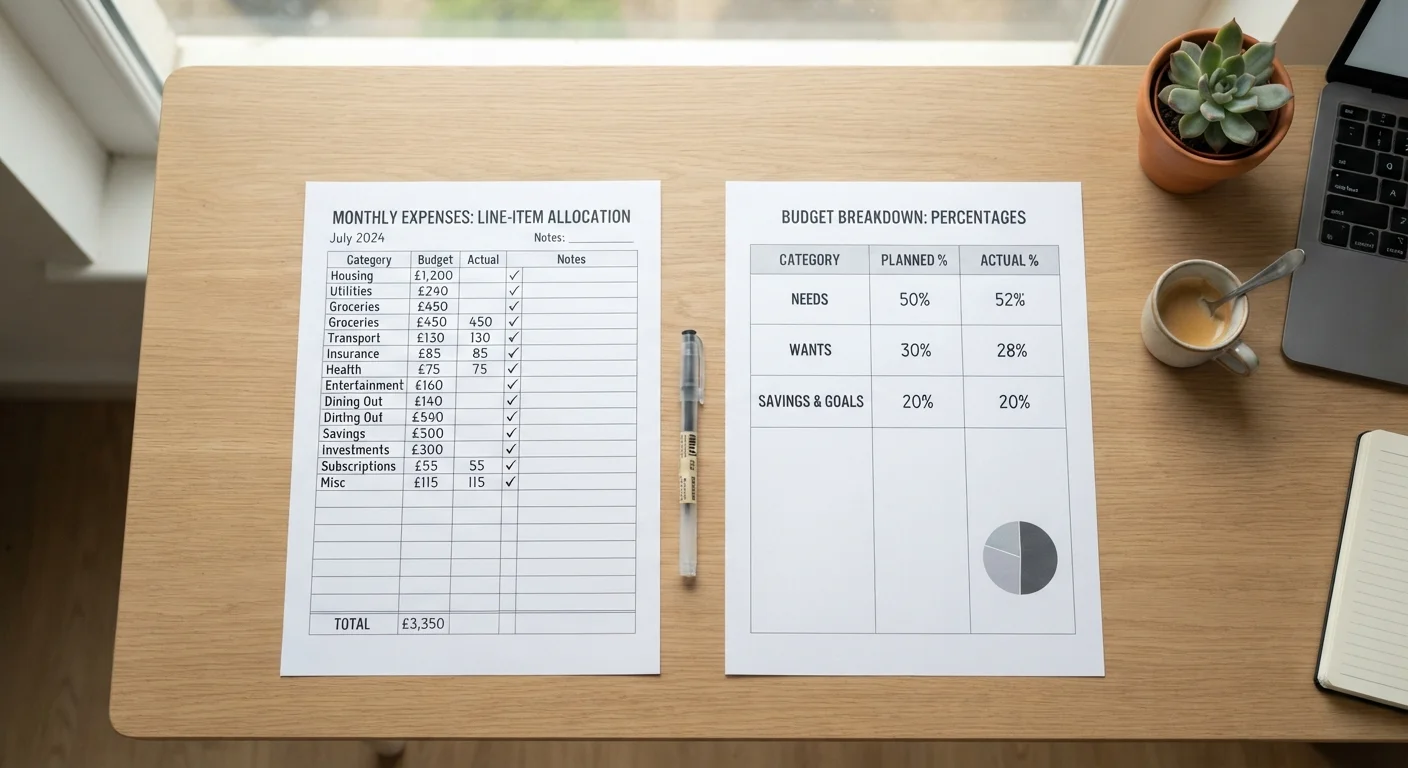
With zero-based budgeting (ZBB), you begin each month by writing down your total expected take-home (net) income. You then assign every single dollar to a specific category - rent, groceries, utilities, savings, debt payments, entertainment, and so on - until the math reads: Income minus all allocations = $0. The zero doesn't mean you spend everything; it means every dollar has a declared purpose, including dollars set aside for saving or investing.
The 50/30/20 Rule
The 50/30/20 rule takes a broader approach. You divide your after-tax income into three percentage-based buckets: 50% toward needs (housing, utilities, groceries, minimum debt payments), 30% toward wants (dining out, subscriptions, hobbies), and 20% toward savings and debt repayment beyond minimums. The framework was popularized in personal finance literature as a guideline for people who want structure without spreadsheet-level detail. For a deeper look at how the rule holds up in real life, see our article The 50/30/20 Rule Explained.
| Criterion | Zero-Based Budgeting | The 50/30/20 Rule |
|---|---|---|
| Setup time | High - detailed line items monthly | Low - three percentages applied once |
| Level of detail | Every dollar allocated by category | Broad buckets: needs, wants, savings |
| Monthly maintenance | Ongoing - requires active tracking | Minimal - check percentages periodically |
| Best income type | Variable or irregular income | Stable, predictable salary |
| Flexibility mid-month | Requires reallocating specific lines | Adjust freely within each bucket |
| Ideal for aggressive goals | Yes - granular control aids speed | Limited - fixed 20% may not be enough |
| Beginner-friendliness | Moderate - learning curve upfront | High - simple to understand quickly |
Strengths and Limitations of Each Approach
No budgeting method is universally superior - each has trade-offs worth understanding before you commit.
Zero-Based Budgeting: Strengths
- Maximum intentionality: Every expense is deliberate, reducing mindless spending.
- Adaptable month to month: You rebuild from scratch, so irregular expenses (car registration, annual subscriptions) get their own line rather than blowing up a percentage bucket.
- Reveals spending patterns: Itemizing categories often surfaces expenses people didn't realize they were making consistently.
Zero-Based Budgeting: Limitations
- Time-intensive: Building a detailed line-item plan monthly takes meaningful effort, especially early on.
- Can feel rigid: An unexpected expense mid-month requires actively reshuffling allocations.
The 50/30/20 Rule: Strengths
- Easy to start: Three categories lower the barrier to entry significantly for budgeting beginners.
- Flexible within buckets: You decide how to allocate within each broad category without micro-managing every dollar.
- Sustainable long-term: Lower maintenance makes it easier to stick with month after month.
The 50/30/20 Rule: Limitations
- Less precise: Money can still drift within large categories without accountability.
- Percentage fit varies: In high-cost-of-living cities, needs alone can exceed 50% of take-home pay, making the formula difficult to apply as written.
- May under-serve aggressive goals: A fixed 20% savings allocation may not be enough for those trying to accelerate debt payoff or retirement contributions.
High-Cost-of-Living Adjustment
In cities where housing alone can consume 40-45% of take-home pay, the 50/30/20 rule's thresholds may not be realistic as written. If needs consistently exceed 50%, consider adjusting the percentages - for example, 60/20/20 - rather than abandoning the framework entirely. Zero-based budgeting can also help here by letting you see exactly where the pressure is coming from and make deliberate trade-offs.
Choosing the Right Method - and What Comes Next
The best budgeting system is the one you'll actually use consistently. A few questions can help narrow the choice:
~74%
Americans living paycheck to paycheck
A 2023 survey by LendingClub found that approximately 74% of U.S. consumers reported living paycheck to paycheck, underscoring the value of having any structured budget in place.
$0
Remaining after zero-based allocation
The defining rule of zero-based budgeting: income minus all assigned spending, saving, and debt categories must equal zero at the start of each month.
50 / 30 / 20
Income split for needs, wants, savings
The 50/30/20 framework offers a percentage-based starting point; actual proportions may need adjustment based on cost of living, income level, and personal goals.
- How much time can you commit? If a monthly planning session sounds manageable, ZBB's detail pays off. If it sounds overwhelming, 50/30/20 gives you structure without the burden.
- Is your income predictable? Steady salaries suit both methods, but variable income - freelance work, tips, commission - tends to benefit from ZBB's month-by-month flexibility.
- What are your immediate financial priorities? Paying off high-interest debt quickly or saving for a specific goal in a defined timeframe generally calls for tighter control over every dollar.
Whichever framework you choose, the next practical step is putting it into action. Our first-month budgeting walkthrough takes you through tracking income, categorizing spending, and setting realistic limits from day one. And because the tool you use to track matters too, comparing paper, spreadsheet, and app-based tracking can help you find the right fit. You'll also want a solid list of categories to populate whichever method you choose - see our reference on spending categories every budget should include.
This article is for general informational and educational purposes only and does not constitute personalized financial advice. Consider consulting a qualified financial professional for guidance tailored to your specific situation.