

Key Takeaways
- Solo cats are at higher risk for boredom and stress without deliberate enrichment strategies.
- Interactive play sessions that mimic hunting are among the most effective mental stimulators.
- Environmental design - vertical space, hiding spots, and window access - reduces restlessness significantly.
- Food puzzles and foraging activities tap into a cat's natural problem-solving instincts.
- Rotating toys and introducing novelty prevents habituation and keeps engagement levels high.
- Regular human interaction, including training, can meaningfully improve a solo cat's quality of life.
Why Mental Stimulation Matters for the Only Cat
Cats are often described as independent, but that reputation can be misleading - particularly for cats living alone. Without a feline companion to chase, groom, or spar with, a solo cat relies almost entirely on its environment and its human family to meet its cognitive and social needs. When those needs go unmet, the result can include destructive behavior, excessive vocalization, over-grooming, or withdrawal - signs that are easy to misread as quirks rather than stress responses.
The good news is that solo cats don't need another cat to thrive. They need an owner who understands enrichment. Whether your cat is a kitten brimming with energy or a quieter adult, the strategies below can help keep them mentally engaged, behaviorally balanced, and genuinely content. If you're weighing whether to add a second cat to address boredom, our guide on introducing a new cat to a household that already has one can help you make that decision thoughtfully.
Schedule daily interactive play sessions
Interactive play - where you control a wand toy, laser pointer, or crinkle ball - is not optional enrichment. For a solo cat, it's a cornerstone of mental and physical health. These sessions mimic the predatory sequence cats are hardwired to follow: stalk, chase, pounce, catch. Aim for two sessions of 10 to 15 minutes each day, ideally once in the morning and once in the evening when cats are naturally more active.
The key is variety in movement. Drag the toy under a blanket, flutter it across a shelf, or let it "hide" behind a chair. Unpredictable motion holds attention far longer than repetitive back-and-forth. End each session with a small treat or a bit of wet food to complete the predatory cycle and reduce post-play frustration.
Mimic the predatory sequence - stalk, chase, pounce, catch - to satisfy your cat's deepest instincts.
Rotate and introduce novel toys regularly
Cats habituate quickly to familiar objects. A toy that thrilled your cat last week may be completely ignored by Monday. The simple fix is rotation: store most toys out of sight and swap them in and out every few days. When a toy reappears after a week's absence, it registers as new and interesting again.
True novelty also matters. Introduce a new texture, sound, or shape occasionally - a crinkle tunnel, a catnip-filled plush, or a simple paper bag with the handles removed can provide genuine novelty. You don't need to spend much; some of the most effective cat toys cost nothing at all.
Rotating toys in and out of rotation costs nothing but keeps your cat's interest reliably refreshed.
Use food puzzles and foraging opportunities
Feeding a cat from a standard bowl delivers calories efficiently but offers zero cognitive engagement. Food puzzles - containers that require batting, spinning, or manipulating to release kibble - turn mealtime into a problem-solving exercise. Research in animal behavior consistently shows that animals, including domestic cats, often prefer earning food through effort over receiving it freely, a concept sometimes called contrafreeloading.
Start with simple puzzles if your cat is new to the concept, and gradually increase difficulty. Alternatively, scatter a small portion of dry food across a textured mat or hide it in paper cups to encourage sniffing and searching. These low-tech approaches tap directly into foraging instincts that a bowl-fed indoor cat never gets to use.
Cats often prefer earning food through effort - puzzles engage their mind at every single meal.
Design a stimulating vertical environment
Cats instinctively seek elevation. Height offers safety, a vantage point for observing activity, and in multi-cat households, a way to manage social distance. For a solo cat, vertical space serves a different but equally important purpose: it expands the usable territory of your home and provides physical exercise with a cognitive reward at the top.
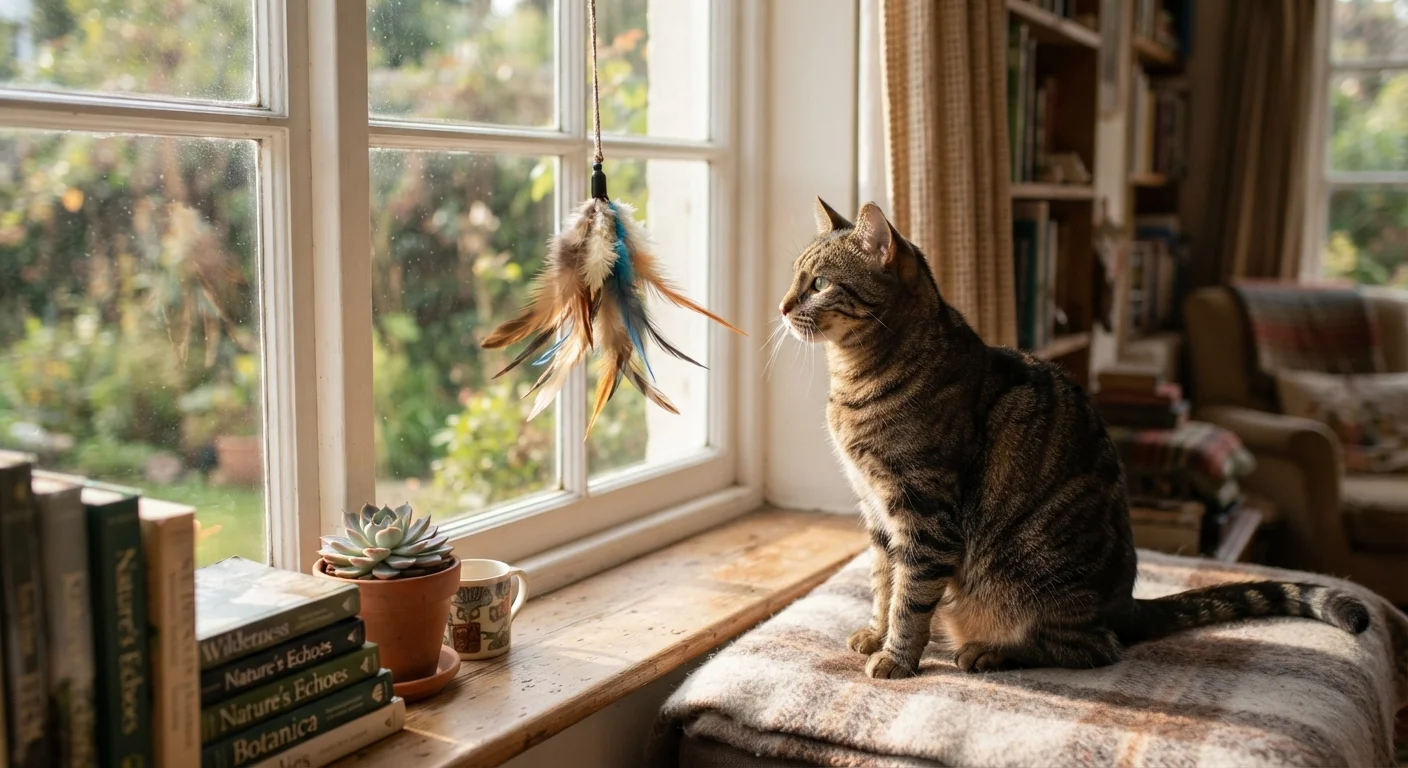
Cat trees, wall-mounted shelves, and window perches all contribute to a richer environment. Position a perch near a window where bird feeders, squirrels, or street activity are visible - even passive observation of outdoor movement is a form of mental engagement sometimes called "cat TV." Add a bird feeder outside the window and you've created an enrichment station that functions on its own for hours.
A well-placed window perch near a bird feeder gives your cat hours of passive mental engagement daily.
Teach simple training exercises
Most cat owners don't think of training as enrichment, but it's one of the most powerful cognitive tools available. Cats are fully capable of learning to sit, high-five, spin, or come when called - not through force, but through positive reinforcement with small, desirable treats. Short training sessions of three to five minutes engage concentration, reinforce the human-cat bond, and give your cat a sense of agency and accomplishment.
Start with one behavior at a time, always ending on a success. The goal isn't performance - it's the mental engagement the process creates. A cat that has to think and problem-solve during an interaction with its owner is a cat that's getting meaningful cognitive stimulation, not just passive petting.
Training a cat isn't about tricks - it's about providing purposeful cognitive engagement through positive reinforcement.
Offer safe sensory variety indoors
Cats experience the world primarily through smell, texture, and sound. Enriching these senses - beyond the visual - gives a solo cat additional layers of stimulation throughout the day. Safe herbs like catnip and silver vine produce well-documented behavioral responses in many cats. Dried valerian root or honeysuckle wood can have similar effects for cats who don't respond to catnip.
Auditory enrichment matters too. Nature sound recordings, birdsong audio, or even ambient "cat TV" videos on a tablet can hold attention for stretches of time. Vary the sensory inputs available so that your cat's environment doesn't feel static, even when you're not home to interact with them directly.
Engaging smell, texture, and sound - not just sight - gives solo cats a far richer daily experience.
Building a Routine That Supports Long-Term Wellbeing
Mental stimulation works best when it's woven into a consistent daily routine rather than delivered in sporadic bursts. Cats are creatures of habit, and predictable schedules for play, feeding, and interaction help regulate their stress levels. Consider pairing enrichment activities with mealtimes - for example, using a food puzzle at dinner engages your cat's brain precisely when they're naturally motivated to hunt and forage. Our article on building healthy eating habits for your cat covers how meal timing fits into an overall care routine.
Track what your cat responds to
Every cat has a different enrichment profile - some are toy-driven, others are food-motivated, and some respond best to human interaction. Spend two weeks experimenting with different approaches and note which ones produce the most active engagement. Doubling down on what genuinely works for your individual cat is always more effective than applying a one-size-fits-all routine.
For cats entering their senior years, enrichment remains important but should be adapted to their changing energy levels and physical capabilities. The needs of a senior cat after age 10 differ in meaningful ways, and gentle cognitive games can support mental acuity as they age. The goal, at any life stage, is a cat that feels safe, engaged, and connected to its home and the people in it.